
Clinical picture. A, a man in his early thirties, presents with marked social anxiety centred on professional settings: he avoids speaking in team meetings, declines lunch invitations, and has recently turned down a promotion to limit interpersonal exposure. The clinician introduces the exposure list exercise, asking him to write down feared social situations and arrange them from least to most distressing. A identifies eleven items, placing "saying good morning to a colleague" at the bottom and "presenting results to the whole department" at the top. Having a ranked, self-generated list shifts his account from a diffuse sense of dread to a concrete, workable sequence, and he agrees to attempt the first two items before the next session.
Building a Personal Exposure List for Anxiety Disorders
A structured homework exercise helping patients rank feared situations from easiest to hardest, making graded exposure concrete and personally owned.
Clinical vignettes
Ranking Fears in Social Anxiety
Structuring Agoraphobia Hierarchy
Clinical picture. M, a woman in her mid-forties, has progressively restricted her radius of movement following two panic attacks on public transport; she now leaves home only when accompanied and avoids shops, buses, and any crowded space. During the session, the clinician guides her through the exercise questions, inviting her to list and rank situations she has been avoiding. M produces a hierarchy of nine items, beginning with "standing at the building entrance alone for two minutes" and ending with "taking the metro at rush hour." The act of writing the list herself makes the gradient visible and reduces the sense that all avoided situations are equally impossible; she selects the first step as a between-session task with a clear behavioural criterion for success.
The Clinical Problem: Getting Patients to Generate Their Own Hierarchy
Graded exposure is one of the most robust tools in anxiety treatment, yet the step that consistently slows things down is not the exposure itself. It is the moment you ask a patient to name, on their own, which situations they actually avoid and in what order they might approach them. That inventory rarely emerges fully formed from a conversation. Patients either produce a vague list, anchor on the most frightening items, or flatten the gradient entirely by listing only situations they are already comfortable with.
For the disorders where exposure is most indicated, agoraphobia, social anxiety, and specific phobias, the personal relevance of the hierarchy matters as much as its clinical accuracy. A list the patient has not constructed themselves rarely feels like a map they want to follow. Words alone, in session, often do not give patients enough space or time to translate the concept of a fear ladder into their own life. They need a quiet moment, away from the consultation, to think it through honestly.
Use this resource with your patients
Handout, exercises and materials ready to use, right inside SessionFuel.
What the Exercise Contains
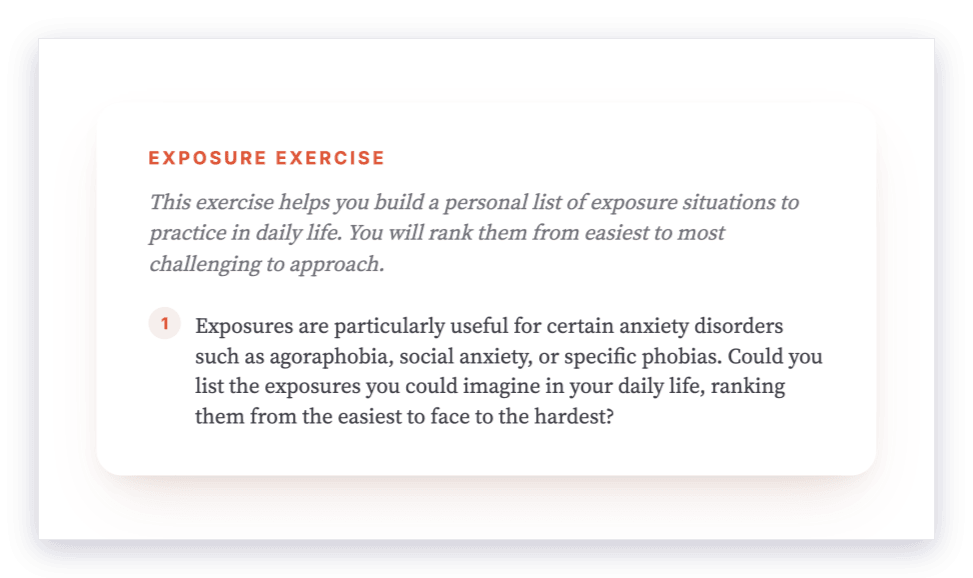
The exercise presents one carefully framed question. Patients are first reminded of the specific anxiety presentations for which exposures are most useful, agoraphobia, social anxiety, and specific phobias, giving a clear clinical anchor before the task begins. They are then asked to list the exposures they could imagine encountering in their daily life, ranked from the simplest to confront all the way to the hardest.
That single question does a great deal of work. It activates autobiographical memory, not abstract category knowledge. It asks the patient to think in terms of their routine, their street, their social situations. The ranking requirement forces implicit comparison and SUDS-style calibration without imposing numerical scoring, making the process accessible even to patients who struggle with rating scales. The result is a personally generated, roughly graduated list the clinician can turn into a proper exposure hierarchy at the next appointment.
The image above lists the exercise question as it appears in the tool. It is a static preview only. The full guided experience, with patient-facing instructions and space to write answers, is completed by the patient autonomously in the app between sessions, not in this image.
This exercise is available to patients through the patient app of SessionFuel, the mobile application reserved for the patients of clinicians who use SessionFuel: the clinician assigns it directly from their SessionFuel workspace, and the patient completes it on their phone, on their own, between two consultations.
Clinical library
750+ clinical tools
A library built with and for clinicians, ready to use in session and extend between appointments.
Access all the toolsSeveral resource types
Psychoeducation handouts
Understand at a glance
Interactive exercises
To do and fill in
Interactive programs
A structured path
Audios
Meditation and relaxation
Psychometric tests
Automatic scoring
Use it with your patients
Share this tool in the mobile app and follow the work between sessions.
Integrating This as Between-Session Homework
This exercise is best assigned once psychoeducation about exposure has been introduced and the patient understands, at least broadly, why approaching feared situations matters. Resources like Habituation: PDF Worksheet, Tools and Exercises for Clinical Practice or The Cycle of Avoidance: PDF Worksheet, Tools and Exercises for Clinical Practice make good preparatory supports before sending this homework.
Patient profile: Suitable for adults and adolescents working on agoraphobia, social anxiety disorder, or any specific phobia. It also pairs naturally with patients enrolled in a structured program such as Practicing Exposure Therapy: A Structured Clinical Program.
How to introduce it: Frame the task straightforwardly. Tell the patient you are asking them to spend ten minutes, before the next session, listing the situations they tend to avoid or find difficult, starting with the ones that feel most manageable. Mentioning that there are no wrong answers, and that the list does not commit them to anything yet, reduces resistance considerably.
What to do with what the patient brings back: The completed list becomes raw material for the session. You can use it to identify gaps in the gradient (items clustered at one end), spot safety behaviours embedded in the descriptions, and co-construct a more precise fear hierarchy together. It also gives you early information about how the patient conceptualises their own avoidance, which may open doors to safety behavior work or, for socially anxious patients, to the Clark & Wells Model of Social Anxiety: PDF Worksheet, Tools and Exercises. For patients whose list reveals strong intolerance of the uncertain aspects of exposure, Fear of Uncertainty: PDF Worksheet, Tools and Exercises for Exposure Practice can extend the conversation productively.
Key takeaway: The therapeutic value of this exercise lies not only in the list produced, but in the act of generating it. A patient who has already named and ranked their feared situations between sessions arrives at the next appointment meaningfully closer to starting.
After debriefing this list, tracking actual exposure attempts with the Graded Exposure Self-Report: Tracking Anxiety Progress exercise gives patients a structured way to monitor their own progression session by session.
Patient mobile app
Your session continues in your patients' pocket
Use with a patientYour resources, available everywhere
The handouts, exercises, programs and audios above: you choose which ones to make available to your patients, in the mobile app dedicated to them.
Psychoeducation handoutsInteractive exercisesInteractive programsAudiosPsychometric tests
And far more than a library
The app goes well beyond resources, to support your patients every day:
Standardized tests
Therapy journal
Gamification
Wellbeing challenges
Introspection prompts
Therapist homework
Related categories
Explore other clinical resources by category.

Anxiety
Clinical hub for anxiety disorders: CBT and ACT worksheets, psychoeducation sheets, and exercises for assessment and treatment across the anxiety spectrum.

Exposure
Exposure therapy clinical resources for practitioners: worksheets, hierarchies, and psychoeducation tools for anxiety, PTSD, OCD, and avoidance-based presentations.

CBT
CBT worksheets, cognitive restructuring exercises & behavioral tools for clinicians. Evidence-based resources for every phase of cognitive behavioral therapy.

Trauma
Clinical hub on trauma and PTSD: assessment, differential diagnosis, treatment phases, and printable resources for practitioners. 155 chars.

Mood
Evidence-based worksheets and clinical tools for mood disorders: CBT, ACT, and positive psychology resources for psychologists and therapists.

Identity
Clinical resources for self-identity work in therapy: CBT, ACT, schema tools for clinicians addressing self-concept, core beliefs, and identity disruption.