
Clinical picture. M., a 34-year-old software developer, presented with marked avoidance of professional speaking situations; he had declined two project presentations in the preceding month and attributed this to "freezing up." The clinician introduced the fear ladder as a structured worksheet, asking M. to anchor his SUDS scale to a concrete calm memory (walking his dog, rated 0) and to his worst panic episode during a team meeting (rated 100). Together they populated eight rungs, placing "reading a short prepared text aloud to a trusted colleague" at 20 and "presenting project findings to a team of eight" at 65. Over four weeks M. worked through the lower rungs between sessions; by the third week he spontaneously re-rated the colleague rung at 8, which the clinician used to illustrate how repeated approach, rather than avoidance, had revised his threat estimate. He remained cautious about higher rungs but reported that having a visible, ordered list reduced the sense that all speaking situations were equally overwhelming.
Exposure Hierarchy: Fear Ladder PDF Worksheet, Tools and Exercises
A printable PDF worksheet with worked fear ladders, SUDS calibration, and step-by-step climbing guidance to make graded exposure concrete in session.
Clinical vignettes
Building a Ladder for Social Anxiety
Graded Exposure After Road Traffic Accident
Clinical picture. T., a 51-year-old nurse, was referred six months after a rear-end collision; she had stopped driving entirely and was relying on colleagues for lifts, which was affecting her work schedule and self-efficacy. During the case conceptualisation session the clinician introduced the fear ladder framework, explaining the distinction between in-vivo and imaginal rungs so that T. could give informed assent to each step. The initial ladder placed "looking at a photograph of a car similar to the one involved" at SUDS 30 and "driving past the accident location" at 90; imaginal replay of the collision memory was rated 70 and positioned mid-ladder, after sitting in a stationary car as a passenger. T. completed the first two rungs at home before the next session and noted that her SUDS dropped from 30 to 12 after three brief exposures to the photograph, which helped her accept the rationale that the anxiety itself was time-limited. Progress stalled at the imaginal rung, prompting the clinician to schedule that step within a session rather than as homework, with the ladder adjusted accordingly.
When patients hear "we'll list your feared situations and rank them," they typically picture a quick brainstorm followed by one act of courage. That misalignment surfaces fast: rungs are too vague to expose to, SUDS ratings cluster arbitrarily in the 60-80 range, and safety behaviors slip through undetected. This fear ladder PDF worksheet gives you a ready-made visual structure to correct those problems before the first exposure attempt.
Use this resource with your patients
Handout, exercises and materials ready to use, right inside SessionFuel.
Why the Fear Ladder Is Harder to Explain Than It Looks
Graded exposure sits among the most replicated interventions across the anxiety spectrum, yet hierarchy-building is where the work most reliably derails. Three problems recur in practice.
First, patients equate vagueness with flexibility. "Social situations" or "driving scenarios" feel like workable starting points until the exposure session arrives and nothing is crisply defined. Filmability, describing a scene precisely enough that someone could record it, clicks much faster when the patient sees a concrete example than when you explain the principle verbally.
Second, SUDS calibration is abstract without genuine anchoring. Patients compress the upper range, assigning 75s to situations that, once they have a real 100 anchor, belong at 45. That compression leads directly to starting too high and an early collapse of confidence in the protocol.
Third, safety behaviors go undetected. A patient can report completing an exposure that was, functionally, a managed escape. Without a shared, visible list of what counts as a crutch, the cycle of avoidance continues even inside the supposedly corrective task. This is the learning-block mechanism Craske et al. formalized in the inhibitory learning model: safety behavior use during exposure selectively prevents the formation of new extinction associations.
What the Fiche Contains: A Visual Scaffold for the Hierarchy
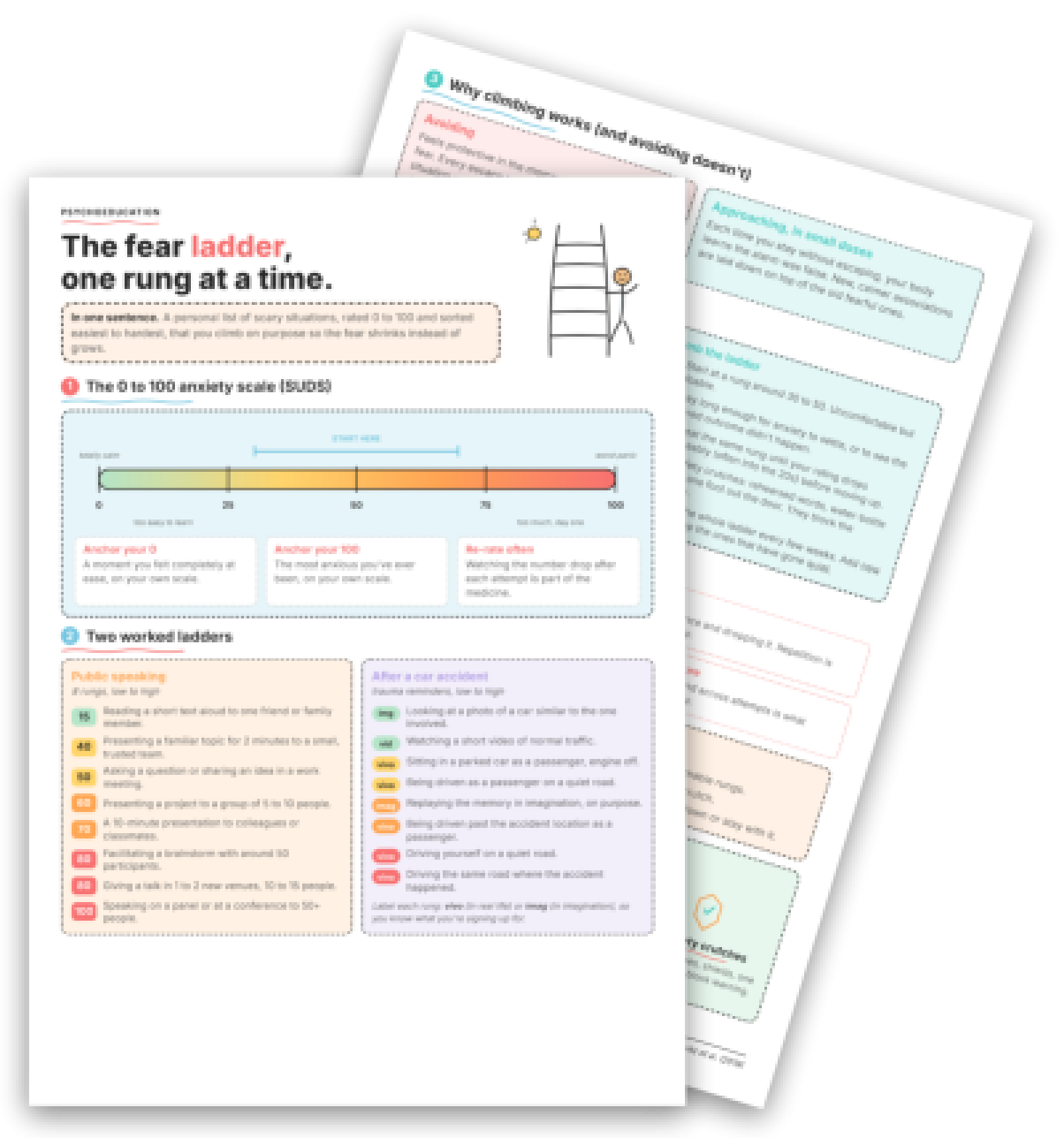
The fiche PDF opens with a one-sentence definition, then moves through five numbered panels. Panel 1 presents the SUDS scale (0 to 100) with two anchor-setting prompts: "A moment you felt completely at ease, on your own scale" and "The most anxious you've ever been, on your own scale." This is the calibration conversation made visible before a single situation is ranked.
Panel 2 provides two fully worked ladders. The public speaking hierarchy runs eight rungs, from reading aloud to one trusted person (SUDS 15) up to a 50-person conference panel (SUDS 100). The post-accident ladder labels each step explicitly as vivo (in real life) or imag (in imagination), making the distinction between in-vivo and imaginal exposure immediately legible for patients with trauma-related PTSD-spectrum avoidance. Having a calibrated comparator on paper shortens the time patients spend second-guessing their own ratings, and it models the level of specificity you are asking for in their own list.
Panel 3 contrasts avoidance and approach in plain mechanistic language, consolidating the counter-conditioning psychoeducation you have already delivered verbally. Panels 4 and 5 cover building and climbing the ladder step by step, then catalogue the four most common derailments: starting too high, doing a single exposure and stopping, escaping at peak anxiety, and interpreting a SUDS wobble as failure. A final "To discuss in session" checklist flags three specific moments when the patient should bring the fiche back, including when a rung pushes SUDS above 90 or when a safety crutch is suspected.
Used as a shared visual during the session rather than a self-guided handout, the fiche makes the hierarchy-building conversation faster and more precise. The patient leaves with a reference that holds the vocabulary you built together.
> Key takeaway: The fiche is a visual support that facilitates the explanation of graded exposure in session; it is not a workbook the patient completes alone, but a scaffold both clinician and patient look at together before the first exposure attempt.
750+ clinical tools
A library built with and for clinicians, ready to use in session and extend between appointments.
Access all the toolsWhen and How to Introduce the Fiche
The natural entry point is after psychoeducation on avoidance maintenance and before drafting the first hierarchy. If you use the Changing Avoidance worksheet or the Confronting Avoidance ACT tool to establish why avoidance sustains fear, this fiche takes the next logical step.
For social anxiety, you might introduce it with: "Let's use this as a map for the next phase. We'll look at the worked example together, then build your version." For trauma-related avoidance, the vivo/imag labeling in the second ladder makes the in-vivo versus imaginal distinction concrete before the protocol even begins, reducing session-level distress from ambiguity. For patients who need broader context first, the Fear Psychoeducation program and the Exposure Therapy structured program provide the scaffolding that makes the ladder feel less arbitrary.
A few practical notes: calibrate SUDS anchors in session before the patient takes the fiche home; uncalibrated ratings undermine every rung. Pair the fiche with the Graded Exposure List exercise for between-session hierarchy drafting, and with the Graded Exposure Self-Report to track SUDS trends across attempts. The Comfort, Stretch and Panic Zones worksheet offers a useful companion frame when patients struggle to locate that productive middle range, the rung around SUDS 30-50 where the learning actually happens.
The fiche does not replace clinical judgment on pacing. What it does is anchor every hierarchy conversation in shared, visible language, and leave the patient with a reference concrete enough to use between sessions.
Use it with your patients
Share this tool in the mobile app and follow the work between sessions.
Sources
- Wolpe, J. (1969). The Practice of Behavior Therapy. Pergamon Press.
- Antony, M. M., Swinson, R. P. (2000). Phobic Disorders and Panic in Adults: A Guide to Assessment and Treatment. American Psychological Association.
- Foa, E. B., Rothbaum, B. O. (1998). Treating the Trauma of Rape: Cognitive-Behavioral Therapy for PTSD. Guilford Press.
Your session continues in your patients' pocket
Use with a patientYour resources, available everywhere
The handouts, exercises, programs and audios above: you choose which ones to make available to your patients, in the mobile app dedicated to them.
And far more than a library
The app goes well beyond resources, to support your patients every day:
Related categories
Explore other clinical resources by category.

Anxiety
Clinical hub for anxiety disorders: CBT and ACT worksheets, psychoeducation sheets, and exercises for assessment and treatment across the anxiety spectrum.

Trauma
Clinical hub on trauma and PTSD: assessment, differential diagnosis, treatment phases, and printable resources for practitioners. 155 chars.

Understand
Clinical hub for the therapeutic aim 'Understand': worksheets and tools to build patient insight across CBT, ACT, schema therapy and more.

Exposure
Exposure therapy clinical resources for practitioners: worksheets, hierarchies, and psychoeducation tools for anxiety, PTSD, OCD, and avoidance-based presentations.

CBT
CBT worksheets, cognitive restructuring exercises & behavioral tools for clinicians. Evidence-based resources for every phase of cognitive behavioral therapy.

Mood
Evidence-based worksheets and clinical tools for mood disorders: CBT, ACT, and positive psychology resources for psychologists and therapists.