
Clinical picture. T., a woman in her late thirties, completed a course of trauma-focused CBT following a road traffic collision that had left her with persistent intrusions, avoidance of driving, and a strong belief that she had been negligent. In the final session, the clinician introduced the Therapy Blueprint as a structured written summary: together they mapped the events and maintaining behaviours from the past, recorded the techniques that had reduced symptom charge, and noted the belief shifts T. herself could articulate. T. was initially sceptical about the value of a written document, describing it as "just a piece of paper," but engaged more fully once she recognised her own words reflected back in each section. At a three-month follow-up she reported re-reading the blueprint after a nightmare cluster around the collision anniversary, which helped her reframe the flare as temporary rather than as evidence of relapse.
Therapy Blueprint for PTSD: PDF Worksheet, Tools and Exercises
A printable PDF fiche, clinical tools, and relapse-prevention exercises to consolidate PTSD treatment and give patients a concrete, lasting self-management map.
Clinical vignettes
Blueprint as Anchor at Discharge
Relapse Prevention in Complex Presentation
Clinical picture. M., a man in his mid-fifties with a prolonged history of occupational trauma, had made steady gains in prolonged exposure over six months but expressed anxiety about what would happen once sessions ended. The clinician used the Blueprint worksheet to consolidate treatment: the "past" section named the specific avoidance patterns and suppression strategies that had maintained his symptoms for years, while the "present" section recorded, in concrete language, which exposures had been completed and which hot-spot updates had shifted his appraisal of personal responsibility. Crucially, the "future" section included a brief personalised plan for high-risk periods, identifying sleep deterioration and work anniversary dates as early warning signs. M. left the final session with the document and instructions to treat any symptom worsening as information requiring a structured review of the blueprint rather than an immediate return to crisis thinking.
The end of a trauma-focused treatment is clinically precarious. The memory has lost charge, avoidance has dropped, beliefs have shifted, and yet patients often leave without a single coherent written account of what happened, what helped, and what to do when symptoms flare six months from now. This fiche PDF addresses exactly that gap: a structured consolidation support the clinician completes alongside the patient to build their personal PTSD blueprint before termination.
Use this resource with your patients
Handout, exercises and materials ready to use, right inside SessionFuel.
Why PTSD Consolidation Resists Verbal Explanation
Closing a trauma protocol is rarely clean. Patients who have genuinely worked through the Ehlers & Clark cognitive model can articulate the then vs. now distinction fluently in session and lose it entirely under a new stressor three months later. The problem is partly structural: the same updating processes that reduced intrusions can leave the patient without a stable conscious account of how things changed. When that account lives only in episodic memory, it is fragile.
Verbal recaps in the final session tend to be thin. Clinicians often find themselves re-explaining why safety behaviours kept PTSD alive, or rehearsing belief shifts that took weeks to consolidate, because the patient has no external reference to return to at 2 a.m. What is missing is a visual anchor that holds the entire formulation, past, present, and future, in a single frame.
This is also where the specific properties of traumatic memories make a purely oral handover inadequate. A printed, structured map is far more resilient than a verbal summary when stress erodes retrieval.
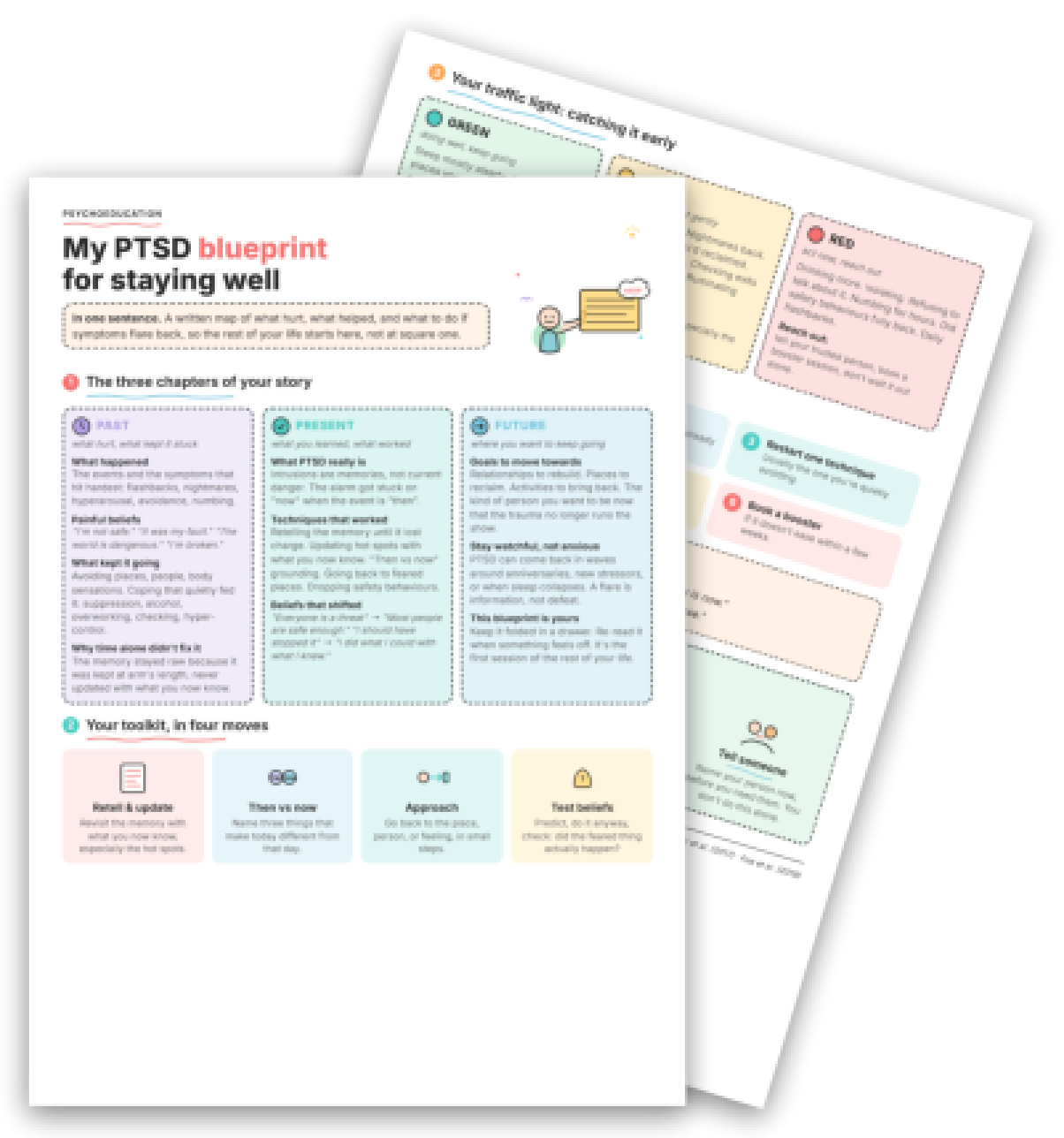
What the Fiche Contains: A Four-Panel Visual Blueprint
The fiche is organised around four numbered sections designed to be completed collaboratively in session, not filled in by the patient alone. It functions as a visual support for psychoeducation, not a self-report questionnaire.
Section 1, "The three chapters of your story", maps the treatment arc across three explicit columns:
- Past: the events and hardest-hitting symptoms (flashbacks, hyperarousal, numbing), the painful beliefs ("It was my fault," "I'm broken"), and the avoidance and coping patterns that maintained PTSD
- Present: what PTSD actually is ("Intrusions are memories, not current danger"), techniques that worked, and beliefs that shifted
- Future: goals, relationships to rebuild, and the explicit note that "a flare is information, not defeat"
The three-column layout makes the full treatment journey legible at a glance in a way no verbal summary can. A patient can scan it when dysregulated and immediately locate what is relevant.
Section 2 presents the toolkit in four moves: Retell & update, Then vs. now, Approach, and Test beliefs. The stimulus discrimination frame is embedded visually in the then | now format, making it easy to locate quickly under stress.
Section 3 is a traffic light for early detection: Green (routine intact, places reclaimed), Amber (nightmares returning, reclaimed situations being avoided again, body braced), Red (daily flashbacks, full return of safety behaviours, isolation). Each colour carries a concrete action prompt. This is the section most directly useful for relapse prevention planning.
Section 4 gives the six-step flare plan, from "Notice, don't judge" to "Book a booster." The phrase "A flare is not a relapse" appears both here and in the Phrases panel, repeating the single most important reframe at the moment it is most needed.
> Key clinical use: The fiche is a visual support that facilitates the consolidation conversation in session; the clinician completes it with the patient, pointing to specific panels to anchor the formulation, and the patient leaves with the completed document as a concrete, portable reference.
750+ clinical tools
A library built with and for clinicians, ready to use in session and extend between appointments.
Access all the toolsWhen and How to Propose the Fiche
This is a termination-phase tool, most useful after the main cognitive and exposure work is complete: the memory has been updated, the hot spots addressed, the common reactions to trauma largely resolved. It pairs naturally with any protocol grounded in the Ehlers & Clark model or CPT (Resick et al., 2017), and sits in the same consolidation logic as the Therapy Blueprint for OCD or the Therapy Blueprint for Panic.
A workable introduction: "Before we close, I'd like us to build a map of your treatment together, what hit hardest, what shifted, and what to do if things get rough again. You'll keep this." That framing makes it a joint exercise rather than a discharge form.
Work through Section 1 collaboratively, drawing directly from the case formulation. The Past column is often the hardest: naming what maintained PTSD (suppression, alcohol, hyper-control) requires the distance that treatment has already built, and patients sometimes underestimate how much avoidance was operating. If a patient struggles to populate Section 3, that clinical observation is useful in itself, amber signs they cannot yet name are worth one more session.
For patients with complex PTSD, or those whose avoidance extends heavily to somatic cues, consider supplementing Section 2 with grounding technique practice before the blueprint feels genuinely complete. You can also point to EMDR negative and positive cognitions work or the rewind technique as complementary tools for patients still carrying residual hot spots.
The fiche does not replace the therapeutic frame. It gives the patient a concrete, printed record that the work was real, the tools are known, and the path back is mapped.
Use it with your patients
Share this tool in the mobile app and follow the work between sessions.
Sources
- Ehlers, A., Clark, D. M., Hackmann, A., McManus, F., & Fennell, M. (2005). Cognitive therapy for post-traumatic stress disorder: Development and evaluation. Behaviour Research and Therapy, 43, 413-431.
- National Institute for Health and Care Excellence (NICE) (2018). Post-traumatic stress disorder (NICE guideline NG116).
- Oxford Centre for Anxiety Disorders and Trauma (OxCADAT). Resources for cognitive therapy for PTSD: Theoretical and treatment papers.
Your session continues in your patients' pocket
Use with a patientYour resources, available everywhere
The handouts, exercises, programs and audios above: you choose which ones to make available to your patients, in the mobile app dedicated to them.
And far more than a library
The app goes well beyond resources, to support your patients every day:
Related categories
Explore other clinical resources by category.

Trauma
Clinical hub on trauma and PTSD: assessment, differential diagnosis, treatment phases, and printable resources for practitioners. 155 chars.

Build awareness
Clinical worksheets and tools to build awareness in therapy: cognitive distortions, schemas, emotions, ACT and CBT resources for practitioners.

Process trauma
Clinical resources to process trauma: worksheets, psychoeducation, and exercises for trauma-focused practitioners working with PTSD and complex presentations.

Prevent relapse
Prevention as a therapeutic aim: clinical framing, risk stratification, and printable resources for relapse prevention and early intervention in mental health.

CBT
CBT worksheets, cognitive restructuring exercises & behavioral tools for clinicians. Evidence-based resources for every phase of cognitive behavioral therapy.

Anxiety
Clinical hub for anxiety disorders: CBT and ACT worksheets, psychoeducation sheets, and exercises for assessment and treatment across the anxiety spectrum.