
Clinical picture. A. is a 34-year-old accountant who completed 16 sessions of ERP for contamination-related OCD, presenting initially with hand-washing rituals averaging two hours daily and extensive avoidance of public spaces. In the final two sessions, the clinician introduced the Therapy Blueprint as a structured review exercise, inviting A. to document, in his own words, the appraisals that had sustained the loop (notably "touching this surface means I will make my family ill") and the three ERP responses he had found most transferable. A. identified avoidance of petrol stations and selective attention to bodily sensations as the two maintainers he considered his personal early-warning signs. At a three-month follow-up, he reported consulting the blueprint once after a work-related stress spike; he described it as orienting him back to what he already knew rather than prompting him to seek an additional session.
Therapy Blueprint for OCD: PDF Worksheet, Tools and Exercises
A printable PDF worksheet that turns the end of OCD therapy into a personal manual: gains consolidated, relapse plan written, and crisis contact named.
Clinical vignettes
Blueprint Consolidates Gains in Contamination OCD
Blueprint Supports Relapse Planning in Harm OCD
Clinical picture. M. is a 28-year-old graduate student treated for harm-intrusion OCD, which had centred on fears of acting on unwanted thoughts toward a younger sibling and had led to significant reassurance-seeking from her partner. Near the end of a 20-session course, the clinician proposed completing the Therapy Blueprint collaboratively, with M. writing the section on the OCD loop herself and the clinician offering reflective questions rather than dictated content. M. struggled initially to articulate the "meaning" step in her own loop, but doing so in writing appeared to consolidate the distinction between intrusion and intent that had been discussed verbally throughout therapy. She chose to keep the completed sheet with her university notes rather than at home, a practical decision that reflected her own contextual risk assessment. The clinician noted that the act of authorship, not the document itself, seemed to carry the therapeutic weight.
Termination in OCD work is clinically delicate. Patients end therapy having learnt a great deal, yet much of that learning lives scattered across session notes, memory, and partially internalised scripts. When a spike returns six months later, what they reach for is rarely ERP logic, it is the old ritual. This PDF worksheet is designed to close that gap: a structured end-of-therapy manual the patient builds with you, covering what OCD did, what they learned, and exactly what to do if it tries to come back.
Use this resource with your patients
Handout, exercises and materials ready to use, right inside SessionFuel.
Why ending OCD therapy without a written blueprint puts patients at risk
Relapse in OCD is not a sign of treatment failure; it is a predictable feature of the disorder's course. What determines whether a brief resurgence becomes a full setback is largely whether the patient can access, quickly and under anxiety, the functional knowledge they developed during treatment. Oral consolidation in a final session rarely achieves this. Under spike conditions, working memory narrows, appraisals like "I must be 100% sure" or "having this thought means I want it" slip back in unchallenged, and the maintaining cycle described by Salkovskis (1985) restarts.
The problem for the clinician is that summarising an entire course of ERP verbally, in a last session, produces acquiescence, not retention. Patients nod. They leave with nothing tangible. The worksheet replaces that conversation with a co-constructed document the patient owns, can re-read, and has genuinely helped write.
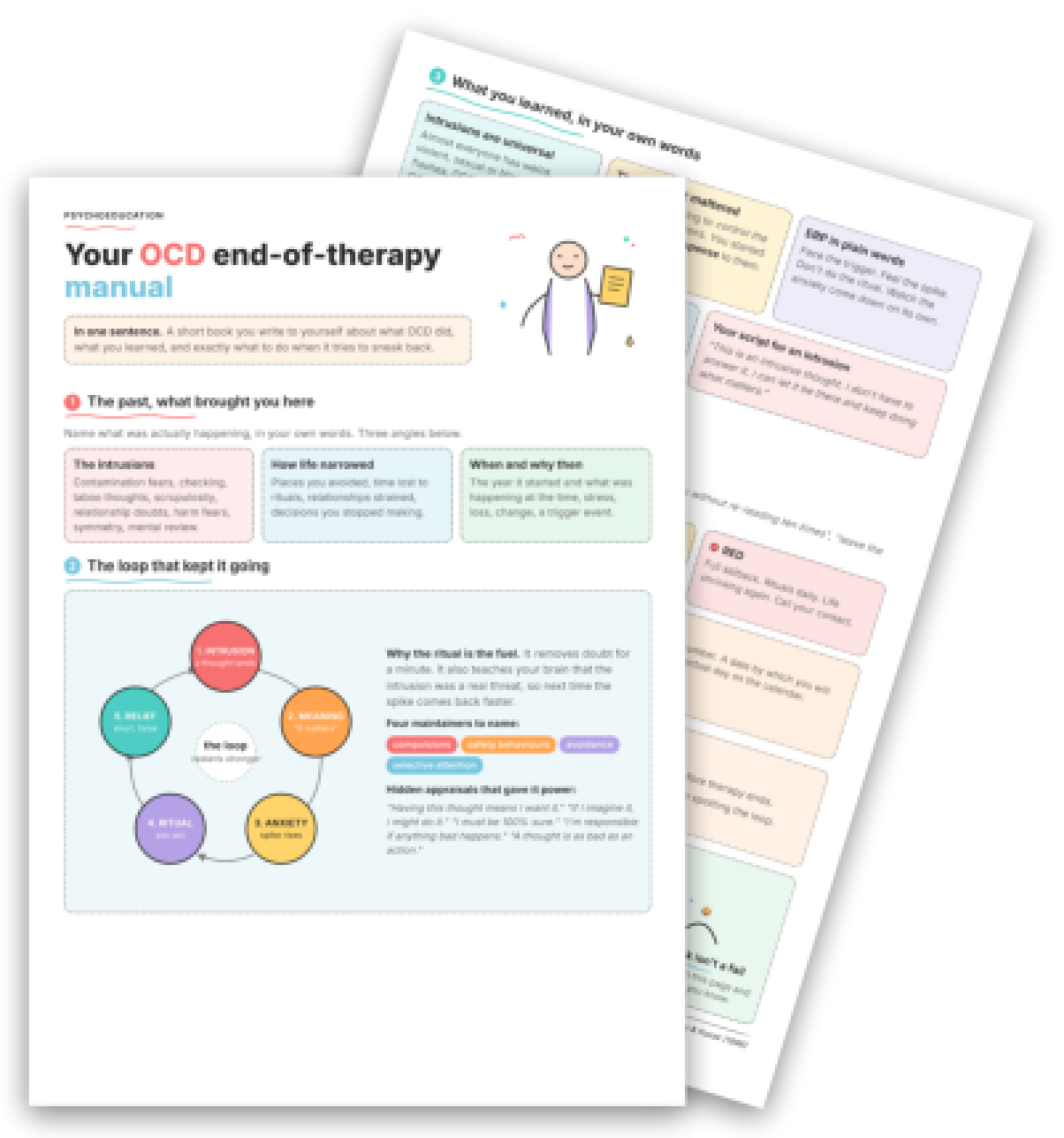
What the fiche contains: a four-section visual manual
The fiche PDF is structured as a personal workbook across four numbered panels, each asking the patient to write in their own words rather than consume pre-packaged content.
- Section 1 (The past) prompts the patient to name the intrusions, describe how life narrowed (avoidance, rituals, lost decisions), and identify when and why symptoms emerged.
- Section 2 (The loop) presents the six-step OCD maintenance cycle visually, from intrusion through meaning, anxiety, ritual, and false relief back to a stronger restart. Four maintainers are named explicitly: compulsions, safety behaviours, avoidance, and selective attention. The hidden appraisals that gave the loop power are listed for recognition, not as homework.
- Section 3 (What you learned) consolidates the core therapeutic shifts: that intrusions are universal, that ERP means facing the trigger, tolerating the spike, and not doing the ritual. The patient writes their own "script for an intrusion", a formulation the fiche frames as: "This is an intrusive thought. I don't have to answer it."
- Section 4 (The relapse plan) uses a green/amber/red traffic light structure. Goals are written in behavioural terms, not feeling-states. The if-then format is explicit: "If I notice I'm checking the door more than once, then I deliberately leave without checking." A crisis contact, with a named person and a concrete date by which the patient will act, closes the section.
> Key takeaway: the fiche is a visual support that facilitates the explanation of OCD maintenance and relapse prevention in session; it is not a questionnaire the patient fills in alone, but a framework you use together to consolidate the entire treatment arc and leave the patient with a concrete reference document.
The visual layout does something a verbal summary cannot: it shows the loop structure as a diagram, making the reinforcement logic of rituals immediately graspable, and it places the relapse plan and crisis contact on the same page as the coping script, so everything is retrievable at once.
750+ clinical tools
A library built with and for clinicians, ready to use in session and extend between appointments.
Access all the toolsWhen and how to introduce the fiche
Propose the worksheet in the penultimate or final two sessions, once the patient has completed their main exposure hierarchy and can reflect with some distance on their treatment. It pairs naturally with a debrief of OCD compulsion progress and with any prior work on intrusive thoughts or checking patterns.
A useful introduction: "We've done a lot of work together. I want to help you write something you can come back to, not notes about therapy, but a document about you and OCD, in your own words." This framing distinguishes the exercise from a homework task and positions the patient as the expert on their own case.
Work through sections 1 and 2 together in session, particularly the maintenance cycle, since many patients with OCD still need the role of safety behaviours and reassurance-seeking made explicit visually. Sections 3 and 4 can be drafted between sessions and brought back for discussion, especially the if-then plan, which benefits from being tested out loud before therapy ends.
For patients with high intolerance of uncertainty or a history of frequent checking, attend closely to section 4: the red-zone contact must be a real name and a real date, not a vague intention. The fiche explicitly flags this: "not 'soon', an actual day on the calendar." That specificity is the difference between a safety net and a reassurance prop.
The worksheet also serves as a preparation tool for lapse and relapse management work. Combined with OCD obsessional thought restructuring exercises completed earlier in treatment, it gives the patient a full self-use toolkit rather than a dependency on continued sessions.
The fiche does not replace ongoing care for complex or comorbid presentations, but it gives every OCD patient something most leave without: a written account of what happened to them, what they learned, and exactly what to do next time.
Use it with your patients
Share this tool in the mobile app and follow the work between sessions.
Sources
- National Institute for Health and Care Excellence (NICE) (2005). Obsessive-Compulsive Disorder and Body Dysmorphic Disorder: Treatment (CG31).
Your session continues in your patients' pocket
Use with a patientYour resources, available everywhere
The handouts, exercises, programs and audios above: you choose which ones to make available to your patients, in the mobile app dedicated to them.
And far more than a library
The app goes well beyond resources, to support your patients every day:
Related categories
Explore other clinical resources by category.
Anxiety
Clinical hub for anxiety disorders: CBT and ACT worksheets, psychoeducation sheets, and exercises for assessment and treatment across the anxiety spectrum.

Build awareness
Clinical worksheets and tools to build awareness in therapy: cognitive distortions, schemas, emotions, ACT and CBT resources for practitioners.

Prevent relapse
Prevention as a therapeutic aim: clinical framing, risk stratification, and printable resources for relapse prevention and early intervention in mental health.

CBT
CBT worksheets, cognitive restructuring exercises & behavioral tools for clinicians. Evidence-based resources for every phase of cognitive behavioral therapy.

Trauma
Clinical hub on trauma and PTSD: assessment, differential diagnosis, treatment phases, and printable resources for practitioners. 155 chars.

Mood
Evidence-based worksheets and clinical tools for mood disorders: CBT, ACT, and positive psychology resources for psychologists and therapists.