
Clinical picture. M., a 34-year-old accountant, presented with contamination-related OCD; his central obsession held that touching door handles in public buildings would cause him to transmit illness to his elderly mother. In session, the clinician introduced the four-question exercise, asking M. first to articulate the thought precisely, then to state the reasoning he used to sustain it. M. identified a chain of catastrophic inference: touching equals contamination, contamination equals transmission, transmission equals harm, therefore he must avoid or decontaminate. When prompted to examine whether this reasoning was supported by verifiable facts, he acknowledged that none of his contacts had ever fallen ill following his visits, and that his decontamination rituals had never been tested against any measurable outcome. By the fourth question he was able to draft an alternative formulation: discomfort after touching a handle is real, but the causal chain he had constructed was not grounded in evidence and could be held more loosely.
OCD Obsessional Thoughts: A Guided Cognitive Restructuring Exercise
A structured four-question tool helping patients deconstruct the reasoning behind obsessional thoughts and build more flexible, evidence-based thinking.
Clinical vignettes
Contamination Doubt Meets Structured Questioning
Symmetry Obsession and Reasoning Flexibility
Clinical picture. T., a 27-year-old student, reported compulsive symmetry checking that was adding roughly two hours to her daily routine; she described a firm belief that leaving objects asymmetrical would cause an unspecified but serious negative event. The clinician offered the structured exercise as between-session written work, framing it as an opportunity to examine the logic behind the belief rather than to challenge the distress directly. Completing question two, T. wrote that she "just knew" asymmetry was dangerous, and at question three she noted, unprompted, that this amounted to a feeling presented as a fact. Her response to the fourth question was cautious but clinically relevant: she proposed that tolerating asymmetry could be treated as an experiment rather than a concession, and she agreed to trial this framing with one low-stakes object before the next appointment.
The clinical challenge: when obsessional reasoning feels watertight
Obsessional thinking in OCD is rarely experienced by the patient as irrational. That is precisely what makes it clinically stubborn. The patient does not simply have a thought, they have a reasoning structure that defends it, a set of implicit arguments that make the obsession feel logical, even necessary. Challenging it verbally, in conversation alone, rarely lands. The clinician names the distortion; the patient nods, then returns the following week with the same loop running.
Part of what resists oral explanation is the invisibility of the patient's own reasoning. Until they are asked to write it out explicitly, that reasoning remains automatic, unexamined, and fused with the thought itself. This is the gap this exercise addresses: not the obsession in the abstract, but the specific logic the patient has constructed around it. Clinicians familiar with the Recognizing OCD: PDF Worksheet, Tools and Exercises fiche will recognize how much the maintaining loop depends on exactly this kind of unchallenged appraisal. The Intrusive Thoughts, Images, and Impulses: PDF Worksheet, Tools and Exercises fiche maps the appraisal traps that feed that loop, this exercise is where the patient begins dismantling their own version of them.
Use this resource with your patients
Handout, exercises and materials ready to use, right inside SessionFuel.
What the exercise contains: four steps into the reasoning
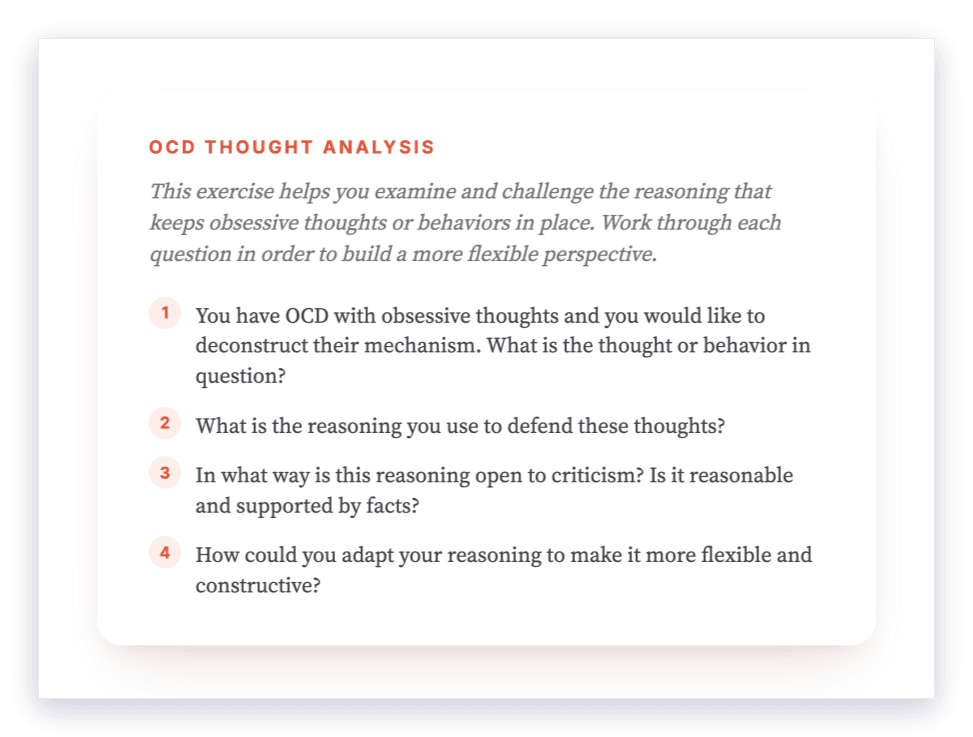
The exercise opens by grounding the patient in their specific reality: which thought or behavior are they working on? This first question prevents vagueness. The patient must name the obsession concretely, not gesture toward it.
The second question asks for the reasoning they use to defend these thoughts, the internal argument, the "because." This step is clinically significant. Most patients have never been asked to articulate why the obsession makes sense to them. Writing it down creates the first moment of distance between the patient and their own logic.
The third question turns that reasoning into an object of examination: is it criticizable? Is it reasonable? Is it actually supported by facts? This is the restructuring pivot, close in spirit to the Socratic Questioning: PDF Worksheet, Tools and Exercises for CBT Practice approach, and to the evidence-weighing at the core of the Fact or Opinion: PDF Worksheet, Tools and Exercises for Clinical Practice and Fact or Interpretation: CBT PDF Worksheet, Tools and Exercises tools.
The fourth question builds forward: how could this reasoning be made more flexible and constructive? Not "correct," not "positive", flexible. This framing matters clinically. It does not ask the patient to dismiss their concern but to loosen the grip of all-or-nothing certainty, much as the All-or-Nothing Thinking: PDF Worksheet, Tools and Exercises fiche teaches.
This exercise is available to patients through the mobile application that is the dedicated patient-side interface of SessionFuel: once you assign it, your patient completes the four questions directly on their phone, in their own time, between sessions.
The image above lists the four exercise questions in order, with a short introductory sentence as the patient will read it. It is a static preview for you as a clinician. The full guided experience, with patient-facing instructions, space to write, and the complete interactive format, is what the patient encounters on their own in the app, not what this image shows.
750+ clinical tools
A library built with and for clinicians, ready to use in session and extend between appointments.
Access all the toolsIntegrating it as between-session homework
This exercise is best assigned to patients who have already begun to develop some insight into their OCD pattern, those past the purely ego-syntonic phase, who can tolerate looking at their obsession from a slight distance. It is not suited to a patient still fully fused with their thoughts and unable to consider them as mental events rather than facts. For those patients, the Distancing and Decentering: PDF Worksheet, Tools and Exercises fiche may be a productive first step.
When introducing the assignment between two sessions, be concrete: name the obsession you have already discussed together, and frame the exercise as an experiment in writing down the reasoning, not in getting it right. The goal is observation, not self-correction. Patients sometimes fear the exercise will feel like trying to argue themselves out of something urgent. Framing it as curiosity, "let's see what logic you find when you write it out", reduces that resistance.
What the patient brings back is the real clinical material. The written reasoning in question two often reveals cognitive distortions that were not yet visible in session: emotional reasoning, arbitrary inference, catastrophizing, or rigid "should" statements. The self-critique in question three shows you how much metacognitive flexibility the patient already has. And the reformulation in question four, imperfect as it often is the first time, becomes the working material for the next session.
Key insight: The clinical value of this exercise is not in the answers themselves but in the act of making the obsessional reasoning explicit and writable, the moment the patient becomes an observer of their own argument rather than its captive.
Use it with your patients
Share this tool in the mobile app and follow the work between sessions.
Articulation with complementary tools
For patients where the obsessional reasoning connects to deeper demanding standards or rigid rules, pairing this exercise with the Evaluating Demanding Standards: PDF Worksheet, Tools and Exercises or the Rigid Rules and Demandingness: A Guided Clinical Exercise exercise adds useful depth. Where compulsive behavior is prominent alongside the obsession, the OCD Compulsions: Defining a Measurable Stopping Criterion exercise addresses the behavioral side directly. And where reassurance-seeking maintains the loop, the Checking, Certainty, and Doubt: PDF Worksheet, Tools and Exercises fiche helps clinicians map that specific maintaining process with patients. For broader cognitive restructuring scaffolding, the Challenging Automatic Thoughts: PDF Worksheet, Tools and Exercises and the Five-Column Thought Record: PDF Worksheet, Tools and Exercises remain reliable companions across the work.
Your session continues in your patients' pocket
Use with a patientYour resources, available everywhere
The handouts, exercises, programs and audios above: you choose which ones to make available to your patients, in the mobile app dedicated to them.
And far more than a library
The app goes well beyond resources, to support your patients every day:
Related categories
Explore other clinical resources by category.

Anxiety
Clinical hub for anxiety disorders: CBT and ACT worksheets, psychoeducation sheets, and exercises for assessment and treatment across the anxiety spectrum.

Emotions
Clinical resources on emotion regulation: worksheets, coping tools, CBT, REBT, and ACT exercises for therapists working across diagnoses and age groups.

Behaviours
Clinical hub for behaviors in therapy: worksheets and tools for coping, eating disorders, CBT formulation, and maladaptive behavioral patterns.

Cognition
Printable cognitive therapy worksheets and clinical tools for therapists: CBT, ACT, schema work, defusion, distortions, and belief restructuring.

Restructure
Clinical hub for cognitive restructuring worksheets: distortion identification, belief disputation, ABC model, and schema work for evidence-based practice.

CBT
CBT worksheets, cognitive restructuring exercises & behavioral tools for clinicians. Evidence-based resources for every phase of cognitive behavioral therapy.