
Clinical picture. A, a 34-year-old primary school teacher with no prior psychiatric history, presented reporting months of distress after a recurrent image of striking a pupil flashed through her mind during a moment of classroom frustration. She had begun avoiding one-to-one contact with children and had not disclosed the thought to anyone, convinced it confirmed she was dangerous. The clinician introduced psychoeducation on intrusive thoughts, normalising the content by situating it within prevalence data and explaining the ordinary-versus-obsession pathway. A identified, with some relief, that her distress stemmed entirely from the meaning she had assigned to the thought rather than from any impulse or intent. Over the following two weeks she reported reduced avoidance, though residual shame was noted and flagged for continued work.
Intrusive Thoughts, Images, and Impulses: PDF Worksheet, Tools and Exercises
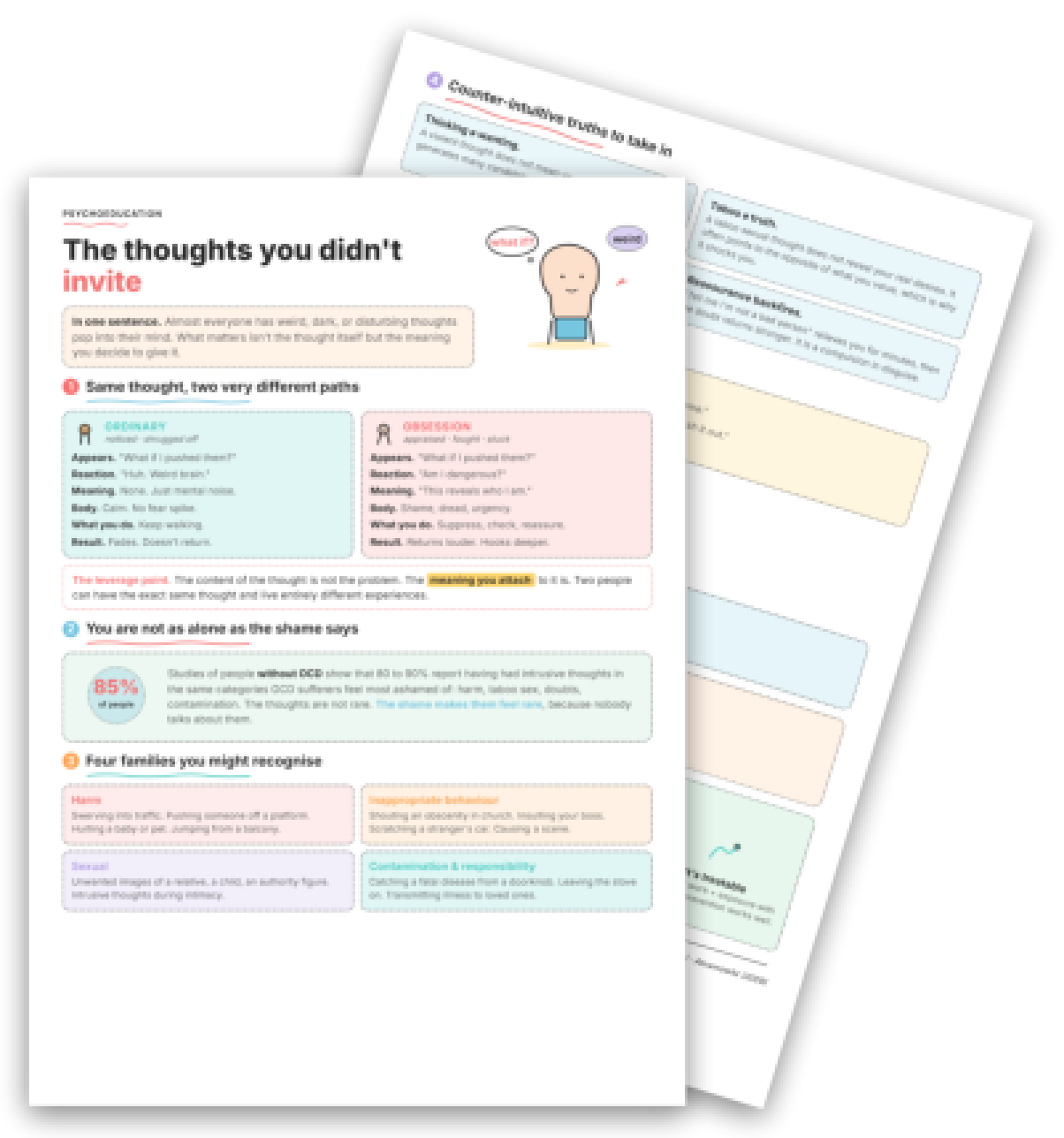
A visual psychoeducation fiche PDF to help clinicians explain appraisal traps, the suppression paradox, and normalization data clearly during session.
Clinical vignettes
Harm Intrusion Misread as Character Flaw
Taboo Sexual Intrusion and Reassurance Seeking
Clinical picture. M, a man in his late forties referred for generalised anxiety, disclosed mid-session that he had been experiencing unwanted sexual images involving a family member during moments of stress. He described an entrenched pattern of mental reviewing and repeated reassurance-seeking from his partner, which he recognised was not helping. Using the informational sheet as a shared reference point, the clinician walked M through the four thought families and the leverage-point framing, underscoring that the presence of a taboo image carries no implication of desire or intent. M was able to articulate for the first time that his reviewing behaviour was amplifying, not resolving, the distress. This reframe opened space for a discussion of response-prevention strategies in the sessions that followed.
When a patient describes an unwanted image of pushing someone off a platform, they often scan your face before you've said a single word. You can explain thought-action fusion in careful, clinical terms, and three minutes later they'll ask you whether it means they're dangerous. The gap between intellectual acknowledgment and genuine appraisal shift is exactly where this fiche PDF earns its place in session.
Use this resource with your patients
Handout, exercises and materials ready to use, right inside SessionFuel.
Why Intrusive Thoughts Are So Hard to Explain Without a Visual
The problem isn't patient intelligence or motivation. It's that shame activates before psychoeducation lands. By the time the patient has described the intrusion out loud, the appraisal mechanism is already running: "The fact that I thought this reveals who I am." Rachman's cognitive model (1997), refined by Clark (2004), locates the maintenance of obsessional distress in exactly that interpretive step, not in the thought content itself. But oral explanations of this distinction tend to dissolve the moment the session ends.
Two additional clinical traps compound the problem. Normalization statements ("many people have thoughts like this") often land as polite reassurance rather than factual reframe, because the patient has no reference point for how common these intrusions actually are. And when you describe the suppression paradox, most patients have already spent months or years fighting the thought, so hearing that suppression feeds the loop can read as yet another failure on their part, rather than a structural explanation of what's maintaining the cycle.
A support visuel breaks this impasse. When the patient sees the mechanism drawn out, rather than heard, the interpretive step becomes externalizable, examinable, and separable from self-concept.
What the Fiche Contains: A Visual Walk Through the Appraisal Loop
The fiche opens with a side-by-side comparison that is the structural core of the resource: "Same thought, two very different paths." The same intrusion appears in both columns ("What if I pushed them?"), but the two trajectories, one labeled Ordinary and one Obsession, diverge at the meaning step. The Ordinary column ends in "Fades. Doesn't return." The Obsession column ends in "Returns louder. Hooks deeper." No jargon, no commentary: the patient sees why meaning attachment is the leverage point, not the thought itself.
The second panel anchors normalization in data: 85% of people without OCD report intrusions in exactly the categories that OCD patients feel most ashamed of, including harm, taboo sexual content, contamination, and moral doubt. This number, displayed visually, does more clinical work than a verbal statement because it sits on the page, available for the patient to return to.
The fiche then maps four families of intrusive content (harm, inappropriate behavior, sexual, contamination and responsibility) before moving to appraisal traps, named and defined: thought-action fusion, inflated responsibility, need to control thoughts, moral character fusion. Clinicians working within CBT or ERP frameworks will recognize the Clark and Abramowitz (2009) lineage immediately. For patients struggling with OCD or reassurance-seeking loops, seeing these traps named and listed in print is often the first time the mechanism has felt legible to them.
A short reframes panel offers concrete cognitive alternatives ("The shock I feel is proof this thought goes against my values"), alongside a four-step practice sequence: notice it, name it, let it stay, return to what you were doing. This maps cleanly onto ACT defusion work and can serve as a bridge to exposure response prevention hierarchies later in care.
The closing section, "To discuss in session," flags three clinical escalation markers, including daily intrusion duration exceeding one hour and reassurance-seeking with short-lived relief, which supports collaborative monitoring between appointments.
> Key point: The fiche is a visual support that facilitates the explanation of intrusive thoughts in session. It is not a self-guided questionnaire. The clinician leads the walk-through; the patient takes it home as a concrete reference point, not a homework form.
750+ clinical tools
A library built with and for clinicians, ready to use in session and extend between appointments.
Access all the toolsHow and When to Propose the Fiche
This resource fits early in psychoeducation, typically once the patient has disclosed at least one intrusion type and before any exposure or defusion work begins. It is particularly indicated for patients who present with OCD, health anxiety, or intolerance of uncertainty and who have already developed a shame-laden relationship to their thought content.
A useful introduction: "I'd like to show you something that explains what's been happening with these thoughts. It's not about labeling you, it's about making the mechanism visible so we can work with it." Walking through the Ordinary versus Obsession panel together, pausing at the meaning step, and asking the patient where they recognize themselves tends to generate more clinical movement than a conceptual explanation alone.
For patients with checking behaviors or entrenched cognitive distortions, the appraisal traps panel can become a reference point across multiple sessions: "Which of these traps got activated this week?" The fiche doesn't replace structured thought monitoring or OCD-specific restructuring exercises, but it creates the conceptual foundation both require to be usable.
One contraindication worth naming: for patients in acute decompensation or with limited reality testing, the normalization content ("85% of people have these thoughts") can occasionally be co-opted into minimization of genuine clinical risk. In those contexts, hold the fiche until the formulation is clearer.
The fiche leaves the patient with a map of the loop, a number that counters isolation, and a four-step practice that asks nothing except to let the thought be there. That is precisely the foothold that defusion and ERP work need to take hold.
Use it with your patients
Share this tool in the mobile app and follow the work between sessions.
Sources
- Clark, D. A. (Ed.) (2004). Intrusive Thoughts in Clinical Disorders: Theory, Research, and Treatment. Guilford Press.
Your session continues in your patients' pocket
Use with a patientYour resources, available everywhere
The handouts, exercises, programs and audios above: you choose which ones to make available to your patients, in the mobile app dedicated to them.
And far more than a library
The app goes well beyond resources, to support your patients every day:
Related categories
Explore other clinical resources by category.

Anxiety
Clinical hub for anxiety disorders: CBT and ACT worksheets, psychoeducation sheets, and exercises for assessment and treatment across the anxiety spectrum.

Cognition
Printable cognitive therapy worksheets and clinical tools for therapists: CBT, ACT, schema work, defusion, distortions, and belief restructuring.

Understand
Clinical hub for the therapeutic aim 'Understand': worksheets and tools to build patient insight across CBT, ACT, schema therapy and more.

Build awareness
Clinical worksheets and tools to build awareness in therapy: cognitive distortions, schemas, emotions, ACT and CBT resources for practitioners.

CBT
CBT worksheets, cognitive restructuring exercises & behavioral tools for clinicians. Evidence-based resources for every phase of cognitive behavioral therapy.
Trauma
Clinical hub on trauma and PTSD: assessment, differential diagnosis, treatment phases, and printable resources for practitioners. 155 chars.