
Clinical picture. R., a 47-year-old secondary school teacher, was referred following six months of persistent high-pitched tinnitus after a viral ear infection. He described checking the sound repeatedly throughout the day and had begun sleeping with the television on, convinced the ringing signalled permanent nerve damage. The clinician introduced the informational sheet on tinnitus and the brain's filtering mechanism, walking R. through the step-by-step model of how internal noise is normally suppressed and how a threat appraisal can override that filter. R. paused at the diagram showing two people with identical tinnitus loudness, one distressed and one largely unaffected, and noted that this reframe was the first explanation he had received that felt consistent with his experience. Over the following two sessions he reported marginally less checking behaviour, though he remained vigilant about sleep.
What Causes Tinnitus? PDF Worksheet, Tools and Exercises for Clinicians
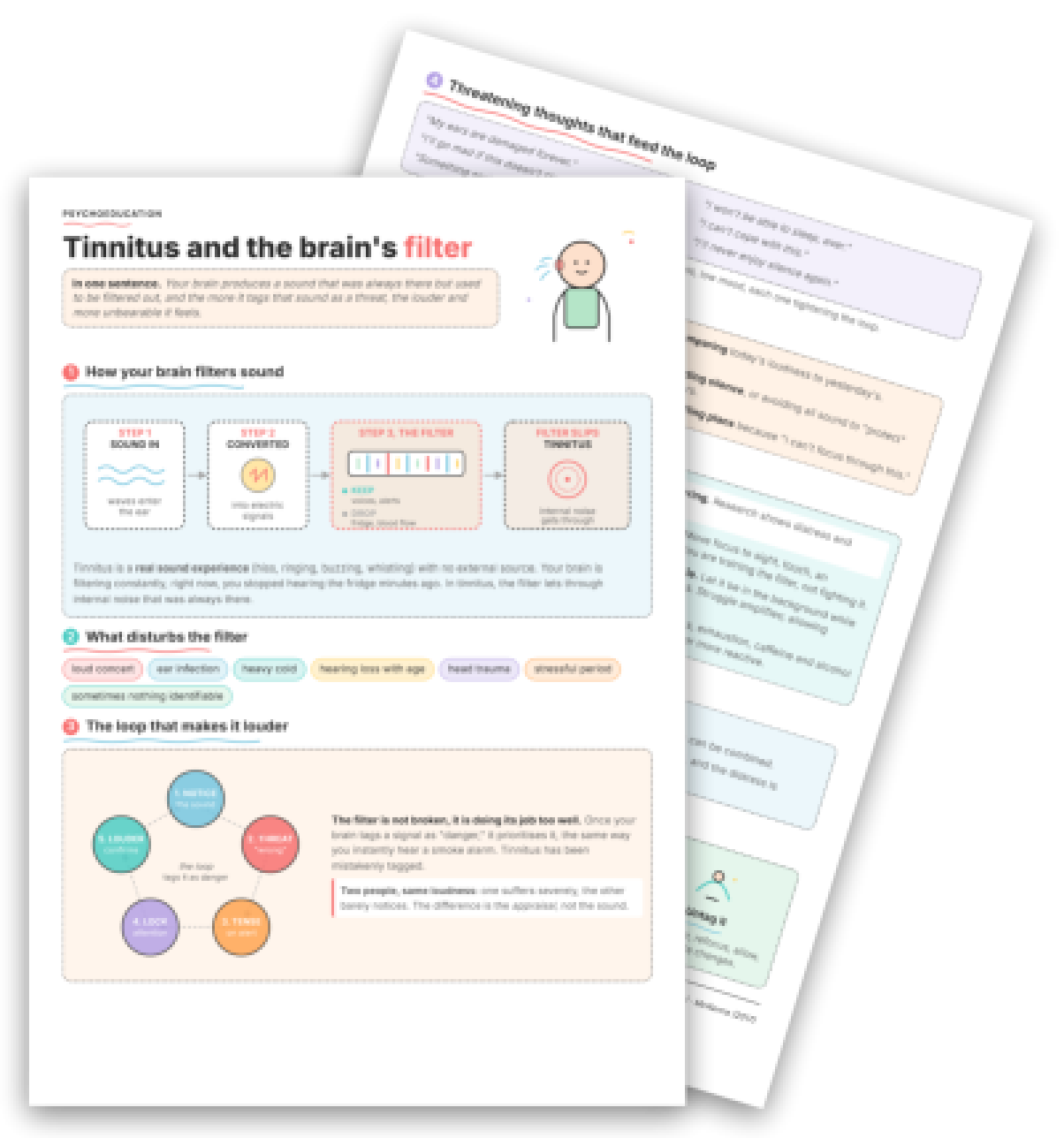
A visual psychoeducation fiche explaining the brain's filtering mechanism, the threat-tagging loop, and what actually reduces tinnitus distress in clinical practice.
Clinical vignettes
Reframing Tinnitus as a Filter Error
Identifying Safety Behaviours in Chronic Tinnitus
Clinical picture. M., early 60s, presented with tinnitus of approximately four years' duration following gradual age-related hearing loss; audiological investigations had found no treatable pathology. She had developed a routine of comparing the perceived loudness each morning and kept a daily log, which she believed would help her detect a worsening trend. During a session focused on the psychoeducation sheet, the clinician drew her attention to the section on behaviours that maintain the threat loop, and M. recognised her monitoring log as a checking behaviour rather than a coping strategy. She agreed to trial a two-week pause on the diary; at review she reported no increase in distress and described the tinnitus as somewhat less intrusive, attributing this tentatively to reduced attentional focus rather than any change in the sound itself.
Patients presenting with tinnitus typically arrive with a purely audiological frame, expecting tests, devices, and cures. Getting them to shift toward a neurophysiological and cognitive model is one of the harder psychoeducation tasks in clinical work, and an oral explanation alone rarely holds. This PDF worksheet is a structured visual support that makes the transition from "broken ear" to "brain filter" tangible in a single session.
Use this resource with your patients
Handout, exercises and materials ready to use, right inside SessionFuel.
Why the Brain Filter Model Resists Oral Explanation
The core clinical problem is not conceptual complexity; it is credibility. When you tell a patient that their distress is driven by appraisal rather than loudness, the almost universal response is polite scepticism. The sound feels external, physical, and urgent. Jastreboff's neurophysiological model, and the CBT work that followed, established clearly that two patients with identical audiometric profiles can have radically different suffering levels, and that the determining factor is how the nervous system tags the signal. Conveying that distinction without a visual representation is slow and often unconvincing.
The other sticking point is the maintenance loop. Patients readily grasp that they notice the sound. They do not readily see how their checking, their online searches, and their protective silence-avoidance are actively keeping the loop alive. A verbal list of behaviours lands very differently from a diagram showing the sequence. The Cognitive Behavioral Model of Tinnitus fiche addresses the full formulation; this one targets the upstream psychoeducation: why the sound exists and what drives the suffering.
What the Fiche Contains: a Visual Psychoeducation Tool
The fiche is structured in eight numbered panels, designed to be walked through with the patient in session rather than handed over as homework.
- Panel 1 shows a three-step sequence, from acoustic signal entering the ear, to neural conversion, to the brain's filter: a visual split between sounds the filter keeps (voices, alerts) and sounds it drops (fridge hum, blood flow). A clear label marks where the filter "slips" to produce tinnitus. Paired with the How We Hear Sounds fiche, this sets up a clean anatomy before moving to mechanism.
- Panel 2 lists what disturbs the filter: loud noise, infection, hearing loss, head trauma, stressful periods, and, critically, "sometimes nothing identifiable". That last item does real clinical work; it pre-empts the attribution spiral.
- Panel 3 shows the five-step amplification loop: notice → threat tag → tension → locked attention → louder. The visual makes it obvious that selective attention is a structural step in the loop, not a character flaw.
- Panels 4 and 5 list threatening thoughts ("I'll go mad if this doesn't stop") and behaviours that feed the loop, including compulsive checking, loudness comparisons, safety behaviours like constant masking, and avoidance patterns driven by catastrophic prediction.
- Panel 6 covers what actually helps: reappraisal, attentional shifting, decatastrophizing predictions, and the ACT-adjacent instruction to "allow, don't wrestle". The sleep guidance here pairs naturally with a sleep hygiene handout.
- Panels 7 and 8 address the most common confusions, including the "loudness ≠ suffering" distinction, and close with a four-point summary the patient keeps as a reference.
> Key point: The fiche is a visual support that facilitates the in-session explanation; it is not a self-report questionnaire. The clinician talks through each panel, the patient has something to look at, and they leave with a reference that names the mechanism and the direction of work.
750+ clinical tools
A library built with and for clinicians, ready to use in session and extend between appointments.
Access all the toolsWhen and How to Introduce It
This fiche fits naturally into the second or third session, once the anamnèse is complete and the patient has expressed their theory of the problem. Before presenting it, a useful framing is: "I'd like to show you what the research says about how tinnitus actually works, because it changes where we focus the work." That positions the shift without discrediting the patient's audiological concern.
It is particularly well-suited to patients who are stuck in high medical consumption (repeat ENT consultations, audiometry, scanning) without finding relief, and to those presenting with comorbid health anxiety features. The Theory A / Theory B framework pairs well if the patient is intellectually engaged with the idea of testing competing explanations.
Debrief by returning to Panel 3 and asking which step in the loop the patient recognises most. That single question tends to produce the most clinically useful material. The body stress response fiche can extend the discussion of the tension step, and habituation tools provide the next conceptual bridge.
A note on contraindications: with patients in acute audiological distress who have not yet had a medical assessment, pair this fiche with a clear verbal acknowledgement that organic causes warrant investigation. The psychoeducation is not a substitute for an ENT referral; it is what comes after one.
The fiche does not replace the therapeutic frame. It makes one genuinely difficult explanation faster, more credible, and something the patient can return to between sessions.
Use it with your patients
Share this tool in the mobile app and follow the work between sessions.
Sources
- Jastreboff, P. J., Hazell, J. W. P. (2004). Tinnitus Retraining Therapy: Implementing the Neurophysiological Model. Cambridge University Press.
- McKenna, L., Handscomb, L., Hoare, D. J., Hall, D. A. (2014). A scientific cognitive-behavioral model of tinnitus: novel conceptualizations of tinnitus distress. Frontiers in Neurology, 5, 196.
- National Institute for Health and Care Excellence (NICE) (2020). Tinnitus: assessment and management (NG155).
Your session continues in your patients' pocket
Use with a patientYour resources, available everywhere
The handouts, exercises, programs and audios above: you choose which ones to make available to your patients, in the mobile app dedicated to them.
And far more than a library
The app goes well beyond resources, to support your patients every day:
Related categories
Explore other clinical resources by category.

Health
Somatic health clinical resources for practitioners: worksheets, psychoeducation, and exercises for somatic symptom disorder, chronic pain, and more.

Understand
Clinical hub for the therapeutic aim 'Understand': worksheets and tools to build patient insight across CBT, ACT, schema therapy and more.

Build awareness
Clinical worksheets and tools to build awareness in therapy: cognitive distortions, schemas, emotions, ACT and CBT resources for practitioners.

CBT
CBT worksheets, cognitive restructuring exercises & behavioral tools for clinicians. Evidence-based resources for every phase of cognitive behavioral therapy.
Anxiety
Clinical hub for anxiety disorders: CBT and ACT worksheets, psychoeducation sheets, and exercises for assessment and treatment across the anxiety spectrum.
Trauma
Clinical hub on trauma and PTSD: assessment, differential diagnosis, treatment phases, and printable resources for practitioners. 155 chars.