
Clinical picture. A, a woman in her late thirties, presented with a six-month history of recurring fear that a benign-feeling abdominal sensation indicated colorectal cancer; she had attended her GP four times and undergone two negative investigations during this period. The clinician introduced the psychoeducational worksheet in session, walking through the four maintaining loops and inviting A to map her own pattern onto the diagram. A quickly identified that each reassurance consultation relieved her anxiety for roughly twenty-four hours before doubt resurfaced, and that she had begun daily abdominal palpation, which consistently produced new sensations she then read as threatening. By the end of the session she could articulate, in her own words, why the checking was sustaining rather than resolving her distress, which opened the door to a behavioural experiment targeting the palpation habit.
What Keeps Health Anxiety Going: PDF Worksheet, Tools and Exercises
A visual PDF worksheet mapping the four maintenance loops of health anxiety, with tools and exercises clinicians can use in session to make psychoeducation concrete and lasting.
Clinical vignettes
Reassurance Seeking After Clear Investigations
Symptom Scanning Amplified by Online Search
Clinical picture. M, a man in his mid-forties with no prior psychiatric history, was referred following repeated negative cardiac workups; he described spending up to ninety minutes each evening searching symptom databases after noticing chest tightness during the day. The clinician used the worksheet to name the scanning-to-threat-reading sequence, pointing specifically to the section illustrating how attentional narrowing onto the body amplifies sensations that would otherwise pass unnoticed. M recognised the pattern of the "two hours deep" example and noted that his chest tightness was reliably worse on evenings when he had searched online, not better. This concrete link between the checking loop and symptom intensity provided a workable rationale for a time-limited agreement to delay searching, which M accepted with moderate but not complete confidence.
Patients with health anxiety frequently leave the GP reassured and return to your consulting room just as distressed. Explaining why, verbally, tends to produce polite nodding rather than genuine recognition. This fiche PDF gives you a visual anchor for that explanation, mapping the four interlocking loops that sustain the disorder long after every test has come back clear.
Use this resource with your patients
Handout, exercises and materials ready to use, right inside SessionFuel.
Why health anxiety's maintenance is so hard to explain at the oral stage
The core clinical difficulty is that each maintaining behaviour feels rational. Checking a mole, googling a symptom, seeking a second opinion: none of these strike the patient as pathological. The problem is the cycle they create, not the individual act. Describing that cycle in words alone tends to flatten it into a list of bad habits rather than an interconnected system.
A second barrier is attentional narrowing. As Salkovskis's model makes clear, once selective attention is locked onto the body, new sensations appear constantly. The patient cannot yet see that scanning and re-scanning generates the very findings it fears. Without something to look at, this process stays abstract.
Safety behaviours in health anxiety also carry a particular sting: reassurance provides genuine short-term relief, which makes the checking and certainty loop highly resistant to change. The patient who hears "checking maintains the problem" but has never seen the mechanism drawn out rarely connects theory to their own Tuesday-night Googling.
What the fiche contains, and why a visual layout clarifies the model
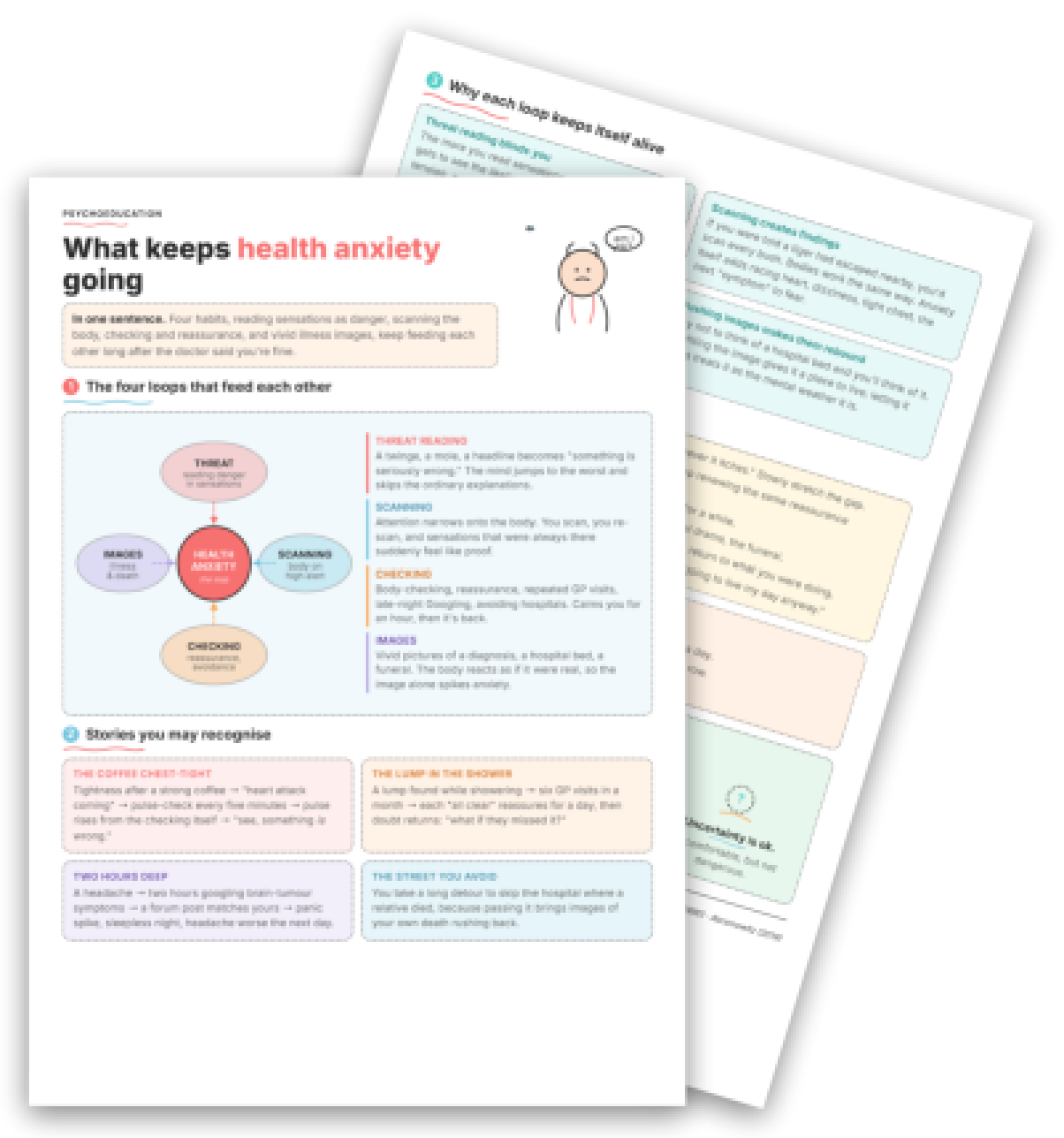
The fiche organises the Salkovskis and Warwick model around four named loops arranged in a circular diagram labelled "the loop": Threat Reading, Scanning, Checking, and Images. The diagram shows Health Anxiety at the centre, fed simultaneously by all four processes. This is the structural move that verbal explanation misses: patients can see the loops pointing at each other, not simply stacked one above the other.
Each loop gets a short clinical gloss. "A twinge, a mole, a headline becomes 'something is seriously wrong.' The mind jumps to the worst and skips the ordinary explanations" describes threat reading. "Palpating a spot makes it sore, which then confirms the fear" names the checking trap with enough precision to land with patients who have lived it.
The fiche then adds four brief vignettes (the coffee chest-tightness spiral, the shower lump, the two-hour Google deep-dive, the avoided hospital street) and a plain-language explanation of why each loop sustains itself. A "Where you can step in" panel translates this into six concrete behavioural targets: scheduling and tapering checks, setting a reassurance-limit rule with loved ones, capping symptom searches, approaching avoided situations in graded steps. The final "To discuss in session" block gives the patient three specific red-flag situations to bring back, which structures your debrief naturally.
Pair this fiche with the CBT Model of Health Anxiety for a complete formulation session, or use it alongside Theory A / Theory B to begin shifting the patient's explanatory model.
> Key point: The fiche is a visual support that facilitates the explanation in session. It is not a questionnaire the patient fills in alone. The clinician uses it to show the loop, name the mechanisms, and leave the patient with a concrete reference to take home.
750+ clinical tools
A library built with and for clinicians, ready to use in session and extend between appointments.
Access all the toolsWhen and how to introduce the fiche
This fiche fits naturally in an early psychoeducation session, once the presenting pattern is established but before you begin exposure or response-prevention work. It works particularly well with patients who have accumulated multiple GP visits or specialist referrals and feel confused about why reassurance keeps wearing off.
You can frame it simply: "I'd like to show you a diagram of what keeps this kind of worry running, because it explains something important about why the checks don't help long-term." This positions the fiche as an explanation, not a confrontation.
For patients whose presentation includes prominent intrusive illness imagery, the Images panel opens a direct route to thought suppression dynamics and defusion work. For those where the driver is primarily intolerance of uncertainty, the "Uncertainty is ok" reminder panel offers a shared vocabulary for later sessions.
One limit worth noting: patients in acute medical crisis or awaiting active diagnostic workup need this fiche deferred. Introducing a maintenance model before genuine medical uncertainty is resolved risks rupturing the alliance. Once the medical picture is stable, the fiche's opening sentence ("long after the doctor said you're fine") can anchor the conversation precisely.
The reassurance-seeking exercise pairs well as a between-session homework tool once the fiche has been debriefed, moving from psychoeducation into targeted behavioural change.
Use it with your patients
Share this tool in the mobile app and follow the work between sessions.
Sources
- Salkovskis, P. M., Warwick, H. M. C., Deale, A. C. (2003). Cognitive-Behavioral Treatment for Severe and Persistent Health Anxiety (Hypochondriasis). Brief Treatment and Crisis Intervention, 3(3), 353-367.
- Abramowitz, J. S., Braddock, A. E. (2008). Psychological Treatment of Health Anxiety and Hypochondriasis: A Biopsychosocial Approach. Hogrefe Publishing.
- Abramowitz, J. S., Braddock, A. E. (2011). Hypochondriasis and Health Anxiety. Hogrefe Publishing.
- Centre for Clinical Interventions (CCI). Helping Health Anxiety - Module 6: Reducing Checking and Reassurance Seeking. Western Australian Department of Health.
Your session continues in your patients' pocket
Use with a patientYour resources, available everywhere
The handouts, exercises, programs and audios above: you choose which ones to make available to your patients, in the mobile app dedicated to them.
And far more than a library
The app goes well beyond resources, to support your patients every day:
Related categories
Explore other clinical resources by category.
Anxiety
Clinical hub for anxiety disorders: CBT and ACT worksheets, psychoeducation sheets, and exercises for assessment and treatment across the anxiety spectrum.

Understand
Clinical hub for the therapeutic aim 'Understand': worksheets and tools to build patient insight across CBT, ACT, schema therapy and more.

Build awareness
Clinical worksheets and tools to build awareness in therapy: cognitive distortions, schemas, emotions, ACT and CBT resources for practitioners.

CBT
CBT worksheets, cognitive restructuring exercises & behavioral tools for clinicians. Evidence-based resources for every phase of cognitive behavioral therapy.

Trauma
Clinical hub on trauma and PTSD: assessment, differential diagnosis, treatment phases, and printable resources for practitioners. 155 chars.

Mood
Evidence-based worksheets and clinical tools for mood disorders: CBT, ACT, and positive psychology resources for psychologists and therapists.