
Clinical picture. R., a 41-year-old secondary school teacher, presented with chronic sleep-onset insomnia and a longstanding habit of mentally repeating "stop thinking" whenever work-related rumination surfaced at night. The clinician introduced the informational sheet on thought suppression, walking R. through the distractor-scanner model and the in-session white-bear exercise; R. counted six intrusions in thirty seconds and recognised the pattern immediately. The clinician reframed the nightly struggle as a suppression loop rather than a character deficit, and invited R. to practise an allowing stance by acknowledging thoughts as passing weather rather than problems to solve. Over the following two weeks R. reported that sleep onset was somewhat easier, though residual rumination persisted; the shift in frame appeared to reduce the secondary distress around the thoughts more than their raw frequency.
Thought Suppression and Intrusive Thoughts: PDF Worksheet, Tools and Exercises
A printable psychoeducation fiche helping clinicians explain the suppression paradox in session, with visual tools, exercises, and ready-to-use phrases for CBT and ACT work.
Clinical vignettes
Suppression Loop in Insomnia
Craving Suppression in Relapse Prevention
Clinical picture. M., a 34-year-old in outpatient treatment for alcohol use disorder, described a pattern of telling herself "don't think about drinking" whenever an urge arose at social events, which she said only made the urge feel more urgent. During a session focused on relapse prevention, the clinician used the thought-suppression psychoeducation sheet to illustrate how the scanner mechanism keeps a suppressed thought primed, particularly under social stress. M. was struck by the section on cravings and noted that her self-instruction had likely been amplifying the very signal she wanted to silence. The clinician and M. practised labelling urges as mental weather and redirecting attention to behavioural engagement rather than thought control. M. remained cautious about the approach, though she agreed to test it at a low-risk family gathering before drawing conclusions.
Explaining the suppression rebound to patients rarely lands the first time. They know intellectually that fighting a thought tends to backfire, yet they keep fighting. This PDF worksheet on thought suppression and intrusive thoughts gives you a concrete visual support to use in session, so the mechanism clicks rather than just being heard.
Use this resource with your patients
Handout, exercises and materials ready to use, right inside SessionFuel.
Why the Suppression Paradox Resists Verbal Explanation
Patients who deal with intrusive thoughts, images, and impulses or with the compulsive checking common in OCD presentations often arrive with years of failed suppression behind them. Explaining Wegner's ironic process theory verbally puts the clinician in an awkward position: the concept is counterintuitive, and patients tend to nod without truly revising their relationship to the thought.
The core difficulty is bidirectional. On the patient side, suppression feels like doing something, and relinquishing it feels like giving up control. On the practitioner side, conveying the scanner-distractor split, the load-dependence of the rebound, and the ACT-inflected move from fighting to allowing, all in a single mid-session explanation, is cognitively dense. Without a visual anchor, the concept evaporates between appointments.
> Key takeaway: This fiche is a visual support that makes the suppression mechanism explicit in session. It is not a self-administered questionnaire; it is a psychoeducation tool you walk through together, so the patient leaves with a concrete reference rather than a remembered summary.
What the Fiche Contains
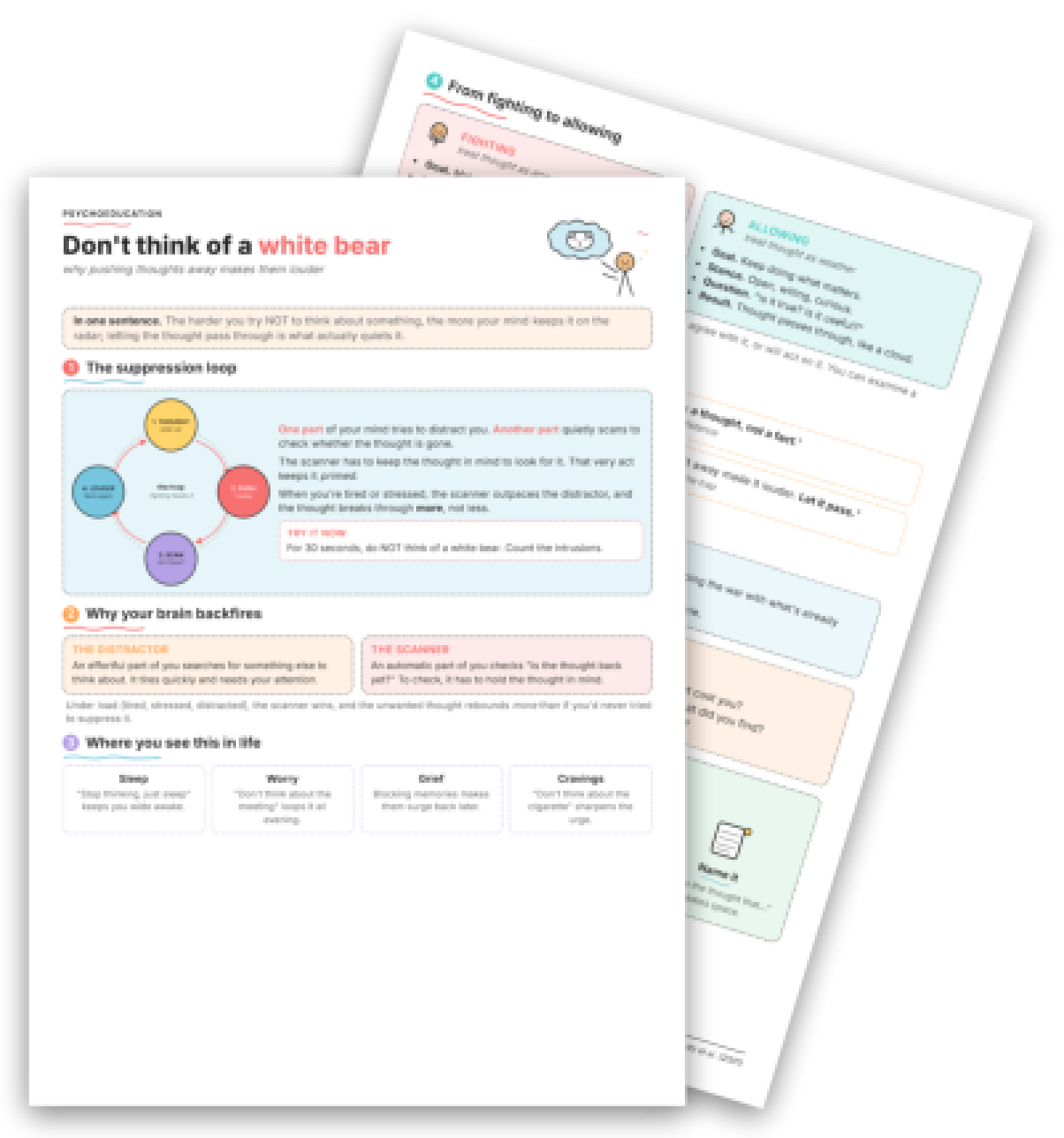
The fiche opens with a single-sentence distillation: "The harder you try NOT to think about something, the more your mind keeps it on the radar." From there it moves through six structured panels.
Panel 1 diagrams the suppression loop as a four-step cycle (thought appears, push it away, scan for it, louder rebound) and includes an embedded experiment: "For 30 seconds, do NOT think of a white bear. Count the intrusions." Run this live in session. Patients experience the paradox in under a minute, which does more clinical work than any verbal explanation.
Panel 2 names and differentiates the two cognitive processes: the distractor (effortful, tires quickly) and the scanner (automatic, holds the thought in memory to check for its absence). The visual layout places them side by side, showing immediately why the scanner wins under cognitive load, exactly the condition in which rumination and overthinking tend to spike.
Panel 3 anchors the mechanism in four recognisable life domains: sleep, worry, grief, and cravings. This makes the fiche immediately usable beyond anxiety work, whether you are working on safety behaviors or on the stopping criteria of OCD compulsions.
Panel 4 presents a two-column comparison, fighting versus allowing, structured around stance, question, and result. This maps directly onto ACT defusion work and the broader ACT hexaflex without requiring the patient to know either framework by name.
Panels 5 and 6 provide ready-made defusion phrases ("I'm noticing the thought that...", "It can be here. I don't have to fight it.") and correct three common misconceptions: that allowing means agreeing, that it means flooding oneself, and that distraction is a viable long-term strategy. A closing block of session discussion questions rounds out the fiche.
750+ clinical tools
A library built with and for clinicians, ready to use in session and extend between appointments.
Access all the toolsWhen and How to Introduce It in Session
The fiche fits naturally in the early-to-middle phase of treatment, once you have a working formulation and the patient has already identified a thought they have been fighting. It is not a first-session tool; the white-bear experiment requires enough alliance for the patient to engage playfully rather than defensively.
Introduce it simply: "I want to show you something about what the mind does when we try to block a thought. There is a short experiment on this page; let's try it together." Patients who have been dealing with thought-action fusion or automatic thoughts that seem to surge under stress typically find the experiment validating rather than alarming.
In the debrief, ask which of the phrases to try on feels genuinely usable and which feels foreign. That question alone generates clinically rich material about the patient's relationship to cognitive distance. For profiles with high intolerance of uncertainty, spend extra time on the distractor-scanner split: the scanner is not a character flaw but a load-dependent automatic process, and naming it as such reduces shame.
The fiche does not replace exposure work or the broader cognitive restructuring of the thoughts sustaining distress. It builds the conceptual ground that makes those interventions coherent.
Use it with your patients
Share this tool in the mobile app and follow the work between sessions.
Sources
- Wegner, D. M. (1989). White Bears and Other Unwanted Thoughts: Suppression, Obsession, and the Psychology of Mental Control. Viking.
Your session continues in your patients' pocket
Use with a patientYour resources, available everywhere
The handouts, exercises, programs and audios above: you choose which ones to make available to your patients, in the mobile app dedicated to them.
And far more than a library
The app goes well beyond resources, to support your patients every day:
Related categories
Explore other clinical resources by category.

Anxiety
Clinical hub for anxiety disorders: CBT and ACT worksheets, psychoeducation sheets, and exercises for assessment and treatment across the anxiety spectrum.

Trauma
Clinical hub on trauma and PTSD: assessment, differential diagnosis, treatment phases, and printable resources for practitioners. 155 chars.

Mood
Evidence-based worksheets and clinical tools for mood disorders: CBT, ACT, and positive psychology resources for psychologists and therapists.

Cognition
Printable cognitive therapy worksheets and clinical tools for therapists: CBT, ACT, schema work, defusion, distortions, and belief restructuring.

Understand
Clinical hub for the therapeutic aim 'Understand': worksheets and tools to build patient insight across CBT, ACT, schema therapy and more.

Build awareness
Clinical worksheets and tools to build awareness in therapy: cognitive distortions, schemas, emotions, ACT and CBT resources for practitioners.