
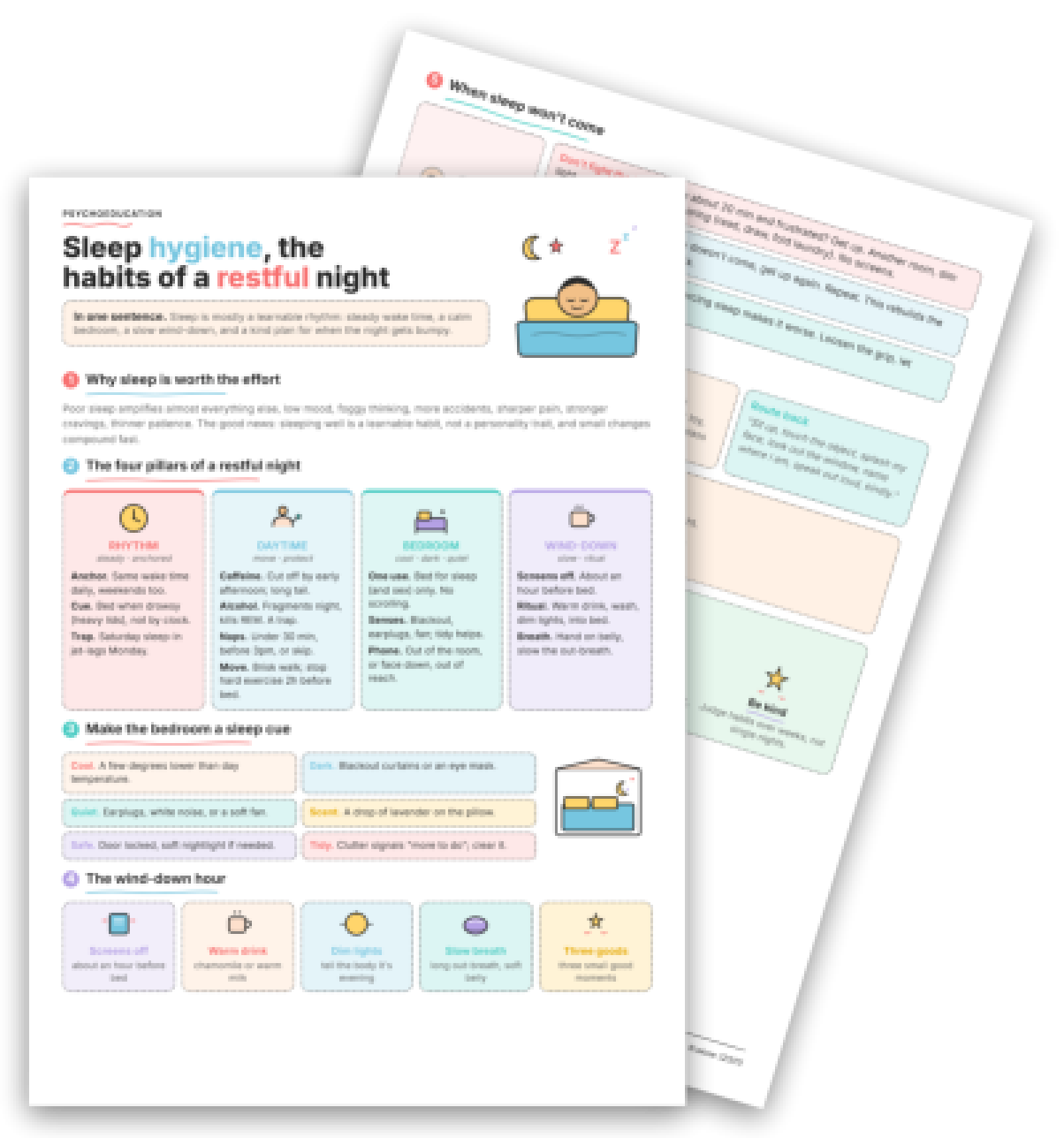
Clinical picture. A, a man in his late forties, presented with a six-month history of sleep-onset difficulties and daytime fatigue, in the context of a depressive episode being managed with low-dose antidepressant therapy. He reported variable bedtimes ranging from 10 pm to 1 am and frequent weekend lie-ins extending to mid-morning, which he believed were helping him recover lost sleep. The clinician introduced the Sleep Hygiene Guidelines worksheet during session, focusing on the rhythm pillar, and worked with A to identify a fixed 6:30 am wake time he could realistically maintain across the week. A was initially resistant to giving up weekend sleep-ins, but after reviewing the concept of social jet lag in the worksheet, he agreed to a two-week trial. At follow-up he reported falling asleep faster and feeling less groggy on Monday mornings, though sleep quality remained variable.
Sleep Hygiene: PDF Worksheet, Tools and Exercises for Clinical Practice
A structured PDF worksheet with visual tools and concrete exercises to explain healthy sleep habits clearly and build lasting behavioral change in session.
Clinical vignettes
Anchoring Wake Time in Persistent Insomnia
Wind-Down Routine for Hyperarousal at Bedtime
Clinical picture. R, a woman in her mid-thirties with generalised anxiety disorder, described lying in bed for over an hour most nights, mind racing through the next day's demands, with her phone on the nightstand and the bedroom light on until she felt tired enough to sleep. The clinician shared the informational worksheet and drew her attention to the wind-down hour section, collaboratively sketching a simple sequence: screens off at 9:30 pm, a warm drink, dimmed lights, and two or three slow diaphragmatic breaths before getting into bed. R noted that the sheet made the steps feel concrete rather than vague, and she taped a brief version to her bathroom mirror as a prompt. After three weeks she reported the pre-sleep rumination had not disappeared but was noticeably shorter, and she felt less dread about going to bed.
In session, explaining sleep hygiene verbally tends to produce one outcome: the patient nods, goes home, and scrolls until midnight. This PDF worksheet gives you a structured visual support to make the psychoeducation land in the room, not just in the air.
Use this resource with your patients
Handout, exercises and materials ready to use, right inside SessionFuel.
Why sleep hygiene is so hard to convey orally
When sleep disturbance operates as a maintenance factor, whether in generalized anxiety, depression, burnout, or PTSD, patients rarely lack information. They have heard "limit caffeine" and "avoid screens." What they lack is a coherent picture of how the behavioral determinants of sleep interact as a system. An oral explanation tends to fragment into a list of disconnected rules, each graspable on its own but losing the cumulative logic that makes behavioral change in sleep actually work.
The other obstacle is attributional: many patients arrive having silently decided that poor sleep is a personality trait, something about them that is simply broken. Addressing that belief verbally, in the same breath as practical advice, is hard. A visual support can hold both pieces at once, without you having to do all the carrying.
750+ clinical tools
A library built with and for clinicians, ready to use in session and extend between appointments.
Access all the toolsWhat the fiche contains: a visual map of the sleep system
The worksheet opens with a grounding reframe stated as fact: "Sleep is mostly a learnable rhythm: steady wake time, a calm bedroom, a slow wind-down, and a kind plan for when the night gets bumpy." That sentence is not decoration. It does targeted work on the helplessness narrative before the patient has read a single behavioral recommendation.
The structural core is a four-pillar layout: RHYTHM, DAYTIME, BEDROOM, and WIND-DOWN. Each pillar is a compact visual block naming a core principle, a behavioral anchor, and a named trap. The visual four-block structure does something an oral walkthrough cannot: it shows at a glance that no single rule is sufficient and that the pillars reinforce each other. You can point to RHYTHM to explain stimulus control and circadian anchoring; move to DAYTIME to name caffeine's extended half-life alongside alcohol's fragmentation of REM; shift to WIND-DOWN to walk through the parasympathetic ramp-down, all without losing the systemic thread.
Section five addresses the sleep effort paradox directly. The fiche names it plainly: "Trying harder is the problem." This is the same perpetuating mechanism that the CBT model of insomnia places at the center of maintenance. Patients who have been white-knuckling through sleepless nights often respond more readily to seeing that sentence on paper than to hearing it spoken.
Section six introduces imagery rescripting for nightmares, including a concrete bedside kit and a written "route back" after waking. This makes the fiche directly usable alongside trauma-focused work, as a complement to common reactions to trauma or grounding techniques you may already be using.
A closing "To discuss in session" box offers three built-in debrief starters, including: "When alcohol or screens at night feel like the only way to switch off." These prompts surface avoidance and maladaptive coping without the clinician having to construct the question from scratch.
> Key takeaway: The fiche is a visual psychoeducation support designed to be walked through with the patient in session. It is not a self-help checklist they complete alone at home.
Use it with your patients
Share this tool in the mobile app and follow the work between sessions.
When and how to introduce the fiche in session
The worksheet fits from the second or third session onward, once the functional assessment has established sleep as an aggravating or maintenance factor. It is particularly well-placed with patients presenting with burnout, mood disorders where the depression cycle is active, anxiety disorders, or those engaged in behavioral activation work where sleep quality is eroding daytime engagement.
A neutral framing avoids pathologizing: "I'd like to walk through a map of how sleep actually works, because the different pieces interact in ways most people haven't been told about." This positions the fiche as information rather than critique.
Use the four-pillar structure as a guided conversation: ask which blocks feel already in place, which feel difficult, and which the patient has never considered. The visual layout makes it easy to prioritize together rather than overwhelming with simultaneous demands.
One calibration worth noting: for patients with extreme sleep-related hypervigilance, introducing the full fiche too early can inadvertently increase monitoring. With these patients, the insomnia disorder framework and stimulus control principles may need a more gradual approach before the complete worksheet is shared.
The fiche does not replace a full CBT-I protocol or a nightmare disorder assessment. It builds the conceptual foundation that makes deeper behavioral work possible.
Your session continues in your patients' pocket
Use with a patientYour resources, available everywhere
The handouts, exercises, programs and audios above: you choose which ones to make available to your patients, in the mobile app dedicated to them.
And far more than a library
The app goes well beyond resources, to support your patients every day:
Related categories
Explore other clinical resources by category.
Anxiety
Clinical hub for anxiety disorders: CBT and ACT worksheets, psychoeducation sheets, and exercises for assessment and treatment across the anxiety spectrum.
Trauma
Clinical hub on trauma and PTSD: assessment, differential diagnosis, treatment phases, and printable resources for practitioners. 155 chars.
Mood
Evidence-based worksheets and clinical tools for mood disorders: CBT, ACT, and positive psychology resources for psychologists and therapists.
Health
Somatic health clinical resources for practitioners: worksheets, psychoeducation, and exercises for somatic symptom disorder, chronic pain, and more.

Understand
Clinical hub for the therapeutic aim 'Understand': worksheets and tools to build patient insight across CBT, ACT, schema therapy and more.

Build skills
Skill-building resources for clinicians: printable worksheets and exercises for coping, assertiveness, and communication skills training in therapy.