
Clinical picture. M., a 44-year-old teacher, presented with chronic insomnia of roughly 18 months, initially triggered by a period of professional burnout that had since resolved. She described lying awake for what she estimated as four to five hours each night, checking her phone clock repeatedly and cataloguing how exhausted she would feel the next day. The clinician introduced the psychoeducation sheet on the cognitive-behavioral model, walking through the five-stage cycle and inviting M. to locate herself within it. She identified scanning and distortion as her dominant steps, and noted with some surprise that her original stressor had disappeared while the loop had continued on its own momentum. By the end of the session she could articulate, in her own words, that her nightly clock-checking was maintaining arousal rather than solving anything, which gave a coherent rationale for the behavioral strategies to be introduced in subsequent sessions.
Cognitive Behavioral Model of Insomnia: PDF Worksheet, Tools and Exercises
A visual PDF worksheet clinicians can use in session to explain the insomnia maintenance cycle, with tools and exercises grounded in Harvey, Espie, and Morin's CBT framework.
Clinical vignettes
Naming the Loop, Not the Sleeplessness
Safety Behaviours Reframed Early
Clinical picture. R., a 31-year-old graduate student, sought help after six months of difficulty initiating sleep, accompanied by a rigid pre-bed routine he had built up to "guarantee" rest: going to bed at 9 p.m., avoiding all social plans after 7 p.m., and napping for 90 minutes each afternoon. During the second session the clinician shared the informational sheet and focused specifically on the section covering safety behaviours, asking R. to read the list aloud and mark any he recognised. He identified early bedtimes, napping, and cancelling exercise as habitual responses, and the sheet's framing of these as fuel rather than fixes visibly shifted his stance. He remained cautious about changing anything quickly, which the clinician normalised, and they agreed to target one behaviour as a first small experiment rather than overhauling his routine at once.
Patients presenting with chronic insomnia almost always arrive with a misconception that shapes everything: they believe their sleep is broken. Explaining verbally that the original trigger is long gone and that a self-sustaining cognitive-behavioral loop now drives the problem rarely shifts that belief in a single session. This PDF worksheet gives you a concrete visual support to make Harvey's (2002) maintenance model legible in session, without a whiteboard and without losing fifteen minutes to a diagram you're drawing from scratch.
Use this resource with your patients
Handout, exercises and materials ready to use, right inside SessionFuel.
Why the CBT Model of Insomnia Is Hard to Explain Out Loud
The core clinical challenge is that patients experience their insomnia as a physiological failure, not as a learned loop. When you describe the role of arousal, selective attention, and sleep misperception verbally, you're asking them to hold four interacting variables in mind simultaneously while they're sitting with sleep debt and hypervigilance. Most of them track one or two stages and lose the thread.
The maintaining-process logic is also counterintuitive: safety behaviours they experience as helpful (going to bed early, daytime naps, monitoring the clock) are precisely what sustain the cycle. That paradox, familiar to any CBT practitioner from the CBT Maintaining Processes worksheet framework, tends to land much harder when a patient can see the loop drawn rather than hear it described. The same applies to the trying-to-sleep paradox: effort intensifies arousal, which delays sleep, which fuels the next night's anticipatory worry, feeding directly into what the fiche calls "tomorrow's worry fuel."
Oral psychoeducation alone also misses the misperception gap. Patients whose subjective experience is "I slept two hours" when a sleep diary shows five hours need a named concept, not just reassurance. Without a shared vocabulary anchored to a visual, that gap is difficult to revisit across sessions.
What the Fiche Contains, a Visual Map of the Maintenance Cycle
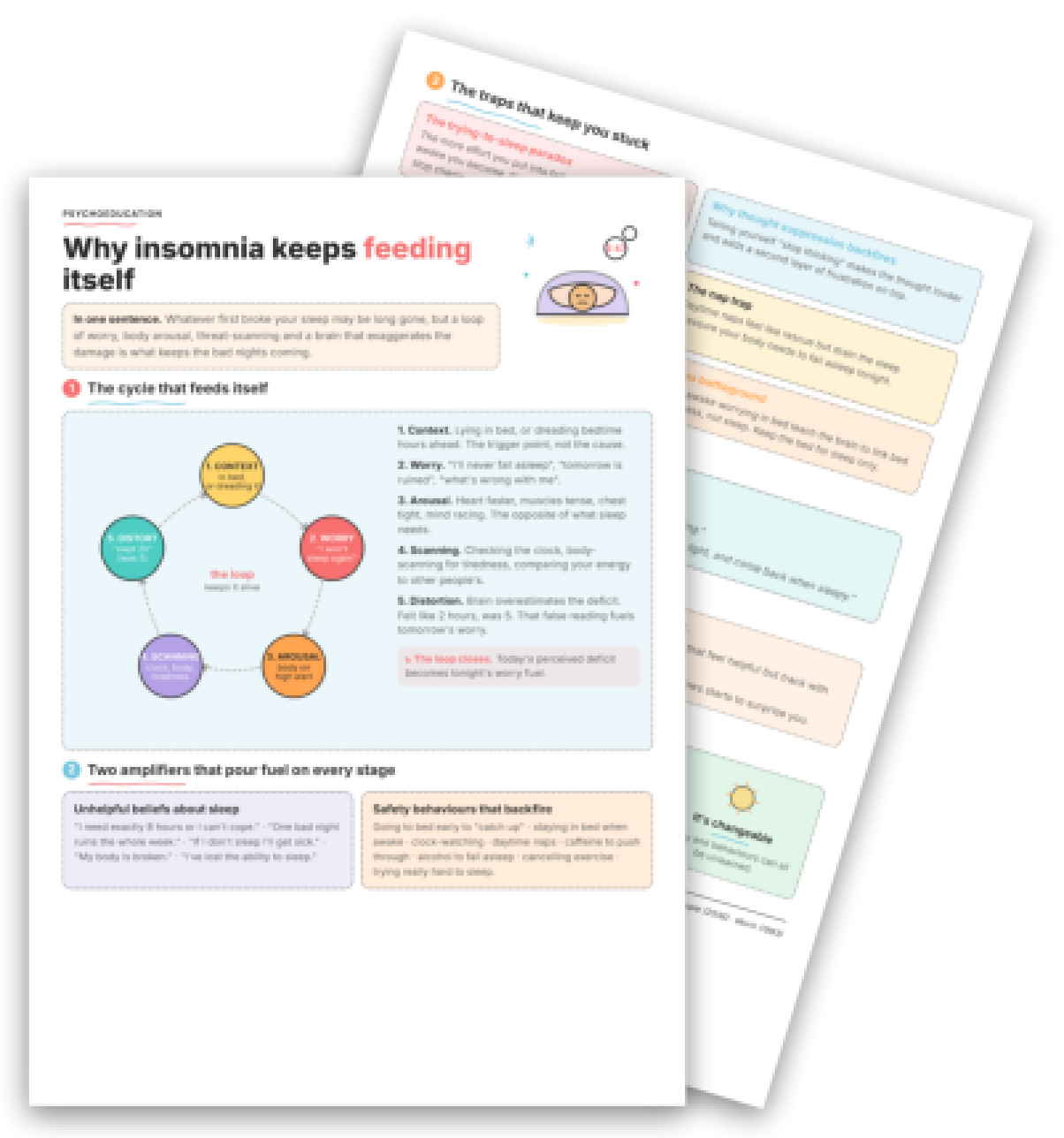
The fiche PDF is structured across six panels, each targeting a distinct layer of the model. The first and most clinically dense panel presents the five-stage self-feeding loop: Context (being in bed or dreading it), Worry ("I'll never fall asleep," "tomorrow is ruined"), Arousal (tachycardia, muscle tension, racing thoughts), Scanning (clock-checking, body-scanning, social comparison of energy levels), and Distortion (the brain overestimating the sleep deficit). The circular arrow that closes the diagram makes explicit that the loop is self-reinforcing, not dependent on a new external stressor.
> Key point: the fiche is a visual support that facilitates the in-session explanation of the maintenance model; it is not a questionnaire the patient completes alone, but a structured psychoeducation tool the clinician uses as a shared reference point.
The second panel isolates two amplifiers: unhelpful beliefs about sleep ("I need exactly eight hours or I can't cope," "my body is broken") and the safety behaviours that backfire. This maps directly onto the Adaptive vs Maladaptive Coping worksheet logic and makes it straightforward to connect to your existing formulation. Panel three names six specific cognitive-behavioral traps: the trying-to-sleep paradox, thought suppression rebound, the misperception gap, the nap trap, clock-watching, and bed-as-battleground (stimulus control rationale). Panel four offers four ready-to-use cognitive reframes ("My job right now is not to sleep, it's to lie still and let the body do its thing"), and panel five lists three discussion prompts explicitly flagged to discuss in session, covering anticipatory worry, safety behaviour monitoring, and the subjective-objective sleep gap. The closing panel condenses the model into four take-home anchors.
Together, the six panels do something a verbal explanation struggles to achieve: they show the patient that the loop is changeable, because each of its five stages is named, bounded, and addressable.
750+ clinical tools
A library built with and for clinicians, ready to use in session and extend between appointments.
Access all the toolsWhen and How to Introduce the Fiche
This resource fits best from session two onward, once the anamnèse is complete and you have enough data to point to the patient's specific entry points into the loop. Introducing it earlier risks over-loading a first contact that still needs alliance-building.
For patients whose insomnia co-occurs with generalized anxiety, rumination, or intolerance of uncertainty, the Worry and Arousal stages of the loop will likely be the most charged; you can orient the session debrief there first. For patients whose presentation is dominated by safety behaviours (the ones who have reorganized their entire schedule around sleep), panel two gives you the clearest entry point without immediately challenging their sense of agency.
A low-labeling introduction that works well: "I'd like to show you a diagram that maps what keeps insomnia going once it's started, because the cause that triggered it is often no longer the issue." Walk through the loop together, asking the patient to identify which stages they recognize, then move to the amplifiers. The Worry and Attention Capture exercise and the Changing Avoidance worksheet can serve as structured between-session complements once the loop is named.
One limitation to keep in mind: for patients with a strong somatic focus or limited insight into cognitive processes, the Autonomic Nervous System worksheet may need to precede this fiche to establish a basic physiological frame. For comorbid presentations with significant mood symptoms, articulating the model with anxiety psychoeducation content or the CBT Cognitive Model worksheet will help build a more complete formulation.
The fiche does not replace the clinical formulation; it makes the explanation of one specific model clear enough that the patient leaves with a shared language and a concrete visual trace of the work.
Use it with your patients
Share this tool in the mobile app and follow the work between sessions.
Sources
- Morin, C. M. (1993). Insomnia: Psychological Assessment and Management. The Guilford Press.
Your session continues in your patients' pocket
Use with a patientYour resources, available everywhere
The handouts, exercises, programs and audios above: you choose which ones to make available to your patients, in the mobile app dedicated to them.
And far more than a library
The app goes well beyond resources, to support your patients every day:
Related categories
Explore other clinical resources by category.

Cognition
Printable cognitive therapy worksheets and clinical tools for therapists: CBT, ACT, schema work, defusion, distortions, and belief restructuring.

Health
Somatic health clinical resources for practitioners: worksheets, psychoeducation, and exercises for somatic symptom disorder, chronic pain, and more.

Understand
Clinical hub for the therapeutic aim 'Understand': worksheets and tools to build patient insight across CBT, ACT, schema therapy and more.

Build awareness
Clinical worksheets and tools to build awareness in therapy: cognitive distortions, schemas, emotions, ACT and CBT resources for practitioners.

CBT
CBT worksheets, cognitive restructuring exercises & behavioral tools for clinicians. Evidence-based resources for every phase of cognitive behavioral therapy.

Anxiety
Clinical hub for anxiety disorders: CBT and ACT worksheets, psychoeducation sheets, and exercises for assessment and treatment across the anxiety spectrum.