
Clinical picture. M., a 47-year-old secondary school teacher, presented with a six-month history of high-pitched bilateral tinnitus following a viral illness, accompanied by significant sleep disruption and anticipatory anxiety about worsening symptoms. She had developed an elaborate bedtime routine involving multiple masking devices and habitual volume-checking, which she described as the only way to feel any control. The clinician introduced the maintenance-loop worksheet, walking through how attentional threat-tagging and safety behaviours widen the auditory filter rather than narrowing it. M. recognised her own pattern in the "11pm, two paths" section, noting that the nights she stopped fighting were paradoxically quieter. By the following session she had dropped one masking device and reported that the tinnitus, though unchanged in intensity, occupied less of her attention.
What Keeps Tinnitus Going: PDF Worksheet, Tools and Exercises
A visual psychoeducation tool and PDF worksheet to explain the tinnitus maintenance loop, drop safety behaviours, and shift patients from fighting the sound to letting it be.
Clinical vignettes
Psychoeducation Shifts the Fighting Stance
Body Tension as a Maintaining Factor
Clinical picture. R., a 61-year-old retired engineer, was referred for low mood and irritability secondary to chronic tinnitus of three years' duration; he attributed the persistence of symptoms entirely to an undetected physical cause. During a psychoeducation session the clinician used the worksheet's four-loop diagram to map R.'s specific pattern, which centred less on thoughts and more on the body channel: chronic jaw clenching, shallow breathing, and persistent cervical tension. R. was initially sceptical that his physical state could influence perceived tinnitus volume, but agreed to track the correlation between tension levels and symptom intensity over two weeks. His diary showed a consistent relationship, which opened space for a behavioural experiment targeting somatic arousal rather than the sound itself.
Explaining the tinnitus maintenance cycle verbally tends to produce polite nodding rather than genuine insight. Patients understand that stress "makes it worse," but they rarely see why their own attempts to silence the noise are keeping the volume up. This fiche PDF gives you a visual scaffold to make that mechanism concrete, right there in the session.
Use this resource with your patients
Handout, exercises and materials ready to use, right inside SessionFuel.
Why the Tinnitus Loop Is So Hard to Explain at the Bedside
The central clinical difficulty is not the audiology, it is the counter-intuitive direction of causality. Patients arrive with a plausible folk model: the sound is the problem, fear is the consequence, and relief means quieting the sound. The actual CBT model of tinnitus, as articulated in the work of McKenna, Hallam, and Cima et al. (2012), reverses this entirely: threat appraisal and the resulting attentional narrowing are what sustain the percept in conscious awareness, not the signal strength itself.
Oral explanation alone rarely dislodges that folk model. Patients hear "it's not dangerous" and translate it as dismissal. They hear "attention amplifies it" and think you are blaming their anxiety. Without a visual that shows the loop as a loop, each component feeding the next, the concept stays abstract. The fiche closes that gap.
A second clinical snag is safety behaviour recognition. The cycle of avoidance in tinnitus is particularly opaque because the behaviours look sensible: sleeping with a fan, avoiding silence, repeatedly checking whether the ringing is still there. Patients do not spontaneously flag these as maintaining factors. Seeing them named side by side in a diagram makes it much easier to start the conversation.
What the Fiche Contains, and What the Visual Does
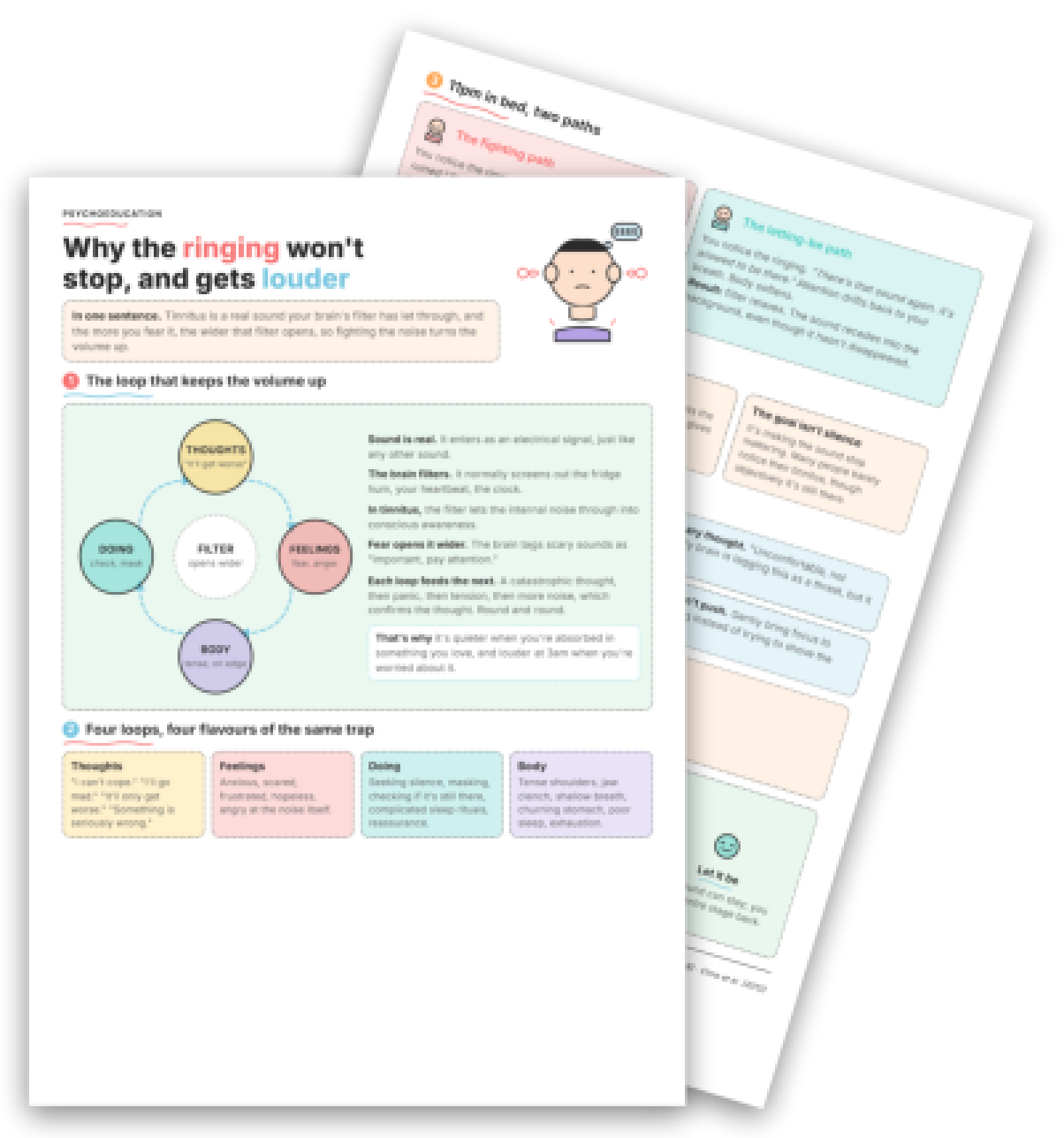
The fiche is built around five numbered sections, each targeting a different clinical hinge point.
Section 1 presents the core maintenance diagram: FILTER opens wider → THOUGHTS → FEELINGS → BODY → DOING, with an explicit caption explaining that the brain tags threatening sounds as "important, pay attention," which widens the perceptual filter. This is the same mechanism you would find in selective attention models and in the CBT model of tinnitus, now rendered as a single, scannable loop patients can point to.
Section 2 unpacks four loops (thoughts, feelings, body, doing), listing concrete examples of each: catastrophic appraisals such as "I'll go mad" alongside somatic markers (jaw clench, shallow breath) and overt safety behaviours (checking, masking, elaborate sleep rituals). Having all four domains visible simultaneously helps patients recognise their own flavour of the trap without you having to name it for them.
Section 3 is the most clinically versatile panel: 11pm in bed, two paths. It traces the fighting path (panic → tighter muscles → filter wide open → tinnitus screams) against the letting-be path (sound allowed to stay → body softens → filter narrows). You can use it to introduce habituation without invoking the word, and to preview what ACT-informed acceptance looks like before you introduce any formal framework.
Section 4 names three counter-intuitive truths, including the key point that thought suppression is a form of monitoring: "To check it's gone, your brain has to keep listening for it." Section 5 then maps four levers: dropping one safety behaviour, loosening catastrophic thoughts, lowering background arousal, and shifting attention without pushing.
A "To discuss in session" checklist closes the fiche, flagging three specific triggers for in-session follow-up: checking behaviour, elaborate sound setups at bedtime, and persistent "it'll only get worse" appraisals.
> Key point: the fiche is a visual support that facilitates the explanation in session; it is not a questionnaire the patient fills in alone. The loop diagram, the two-path comparison, and the four-domain grid show what oral explanation cannot, that the maintenance is circular, not linear, and that the patient's coping is part of the loop.
750+ clinical tools
A library built with and for clinicians, ready to use in session and extend between appointments.
Access all the toolsWhen and How to Introduce It
The fiche fits best at the psychoeducation phase, typically sessions two or three, after the initial case formulation and before any exposure or cognitive work. It pairs naturally with the Cognitive Behavioral Model of Tinnitus if you use that as a formulation tool, and complements What Causes Tinnitus? and How We Hear Sounds if the patient needs audiological grounding first.
A straightforward introduction: "Before we talk about what to do differently, I'd like to show you something about how the noise keeps its grip. This diagram often makes the mechanism clearer than I can in words alone." Point to the loop in Section 1, ask which of the four domains (Section 2) feels most familiar, then move to the two paths.
Profiles most likely to benefit: patients with high health anxiety around the tinnitus, strong checking behaviour, or intolerance of uncertainty about progression. It also works well with patients who have already tried masking devices or sleep apps without relief, the fiche explains exactly why those strategies can paradoxically maintain the problem.
One limit worth noting: patients with significant hearing loss may need the audiology framed more carefully alongside Section 1, to avoid the impression that the signal itself is irrelevant. The companion resource How We Hear Sounds handles that distinction.
Debrief by asking which panel surprised them most. The answer usually tells you where the maintaining cognition is strongest, and where to start the CBT maintaining processes work that follows.
Use it with your patients
Share this tool in the mobile app and follow the work between sessions.
Sources
- McKenna, L., Handscomb, L., Hoare, D. J., Hall, D. A. (2014). A scientific cognitive-behavioral model of tinnitus: novel conceptualizations of tinnitus distress. Frontiers in Neurology, 5, 196.
- McKenna, L., Baguley, D., McFerran, D. (2021). Living with Tinnitus and Hyperacusis. Sheldon Press.
- Fuller, T., Cima, R., Langguth, B., Mazurek, B., Vlaeyen, J. W., Hoare, D. J. (2020). Cognitive behavioural therapy for tinnitus. Cochrane Database of Systematic Reviews, 1, CD012614.
Your session continues in your patients' pocket
Use with a patientYour resources, available everywhere
The handouts, exercises, programs and audios above: you choose which ones to make available to your patients, in the mobile app dedicated to them.
And far more than a library
The app goes well beyond resources, to support your patients every day:
Related categories
Explore other clinical resources by category.
Anxiety
Clinical hub for anxiety disorders: CBT and ACT worksheets, psychoeducation sheets, and exercises for assessment and treatment across the anxiety spectrum.

Cognition
Printable cognitive therapy worksheets and clinical tools for therapists: CBT, ACT, schema work, defusion, distortions, and belief restructuring.

Health
Somatic health clinical resources for practitioners: worksheets, psychoeducation, and exercises for somatic symptom disorder, chronic pain, and more.

Understand
Clinical hub for the therapeutic aim 'Understand': worksheets and tools to build patient insight across CBT, ACT, schema therapy and more.

Build awareness
Clinical worksheets and tools to build awareness in therapy: cognitive distortions, schemas, emotions, ACT and CBT resources for practitioners.

CBT
CBT worksheets, cognitive restructuring exercises & behavioral tools for clinicians. Evidence-based resources for every phase of cognitive behavioral therapy.