
Clinical picture. R., a woman in her mid-thirties, presented with recurrent low mood and a pattern of withdrawing from colleagues after perceived slights at work. In the second session, the clinician introduced the CBT informational sheet to make sense of a recent incident in which a manager had not greeted her in the corridor. Working through the four-corner loop together, R. was able to identify the automatic thought ("She's dismissing me"), a tightness in her chest, and the subsequent behaviour of avoiding the shared kitchen for the rest of the day. She noted, with some surprise, that a parallel situation involving her father had generated the same physical sensation. Naming the loop did not resolve her distress, but it gave her a shared language for the work ahead and reduced some of the sense that her reactions were arbitrary.
CBT Overview: PDF Worksheet, Tools and Exercises for Clinical Practice
A printable PDF worksheet, clinical tools and exercises to explain the CBT model visually in session and build a shared therapeutic language from the first consultations.
Clinical vignettes
Mapping the Loop in Early Sessions
Differentiating Belief Layers Over Time
Clinical picture. T., a man in his late forties referred for generalised anxiety, initially described his worry as "just the way I am." The clinician used the three-layer diagram on the informational sheet to distinguish his surface automatic thoughts ("I will forget something critical") from a mid-level rule ("If I stop checking, things will go wrong") and a deeper core belief ("I am fundamentally unreliable"). Seeing the layers laid out visually helped T. shift from self-blame toward a more curious stance about where the rule had come from. Progress was gradual, though by session six he could sometimes catch the automatic thought before the checking behaviour began.
Explaining the CBT model verbally in a first or second session tends to produce polite nodding rather than genuine understanding. The patient hears "thoughts influence feelings," agrees, and walks out with nothing to anchor it to their own experience. This CBT overview PDF worksheet exists precisely to close that gap: it functions as a visual support that makes the model legible, concrete, and personally relevant while the clinician is still in the room.
Use this resource with your patients
Handout, exercises and materials ready to use, right inside SessionFuel.
Why the CBT Loop Resists a Purely Verbal Explanation
The central difficulty is structural. The model is circular, not linear, and most patients default to a sequential, cause-and-effect reading: something happens, then they feel bad. The bidirectional reinforcement between thoughts, feelings, body, and behaviour is genuinely counter-intuitive, especially when the patient is inside the loop and not observing it.
Two other sticking points appear regularly. First, the link between early experiences and present-day beliefs remains abstract until it is drawn. A patient who intellectually accepts that childhood shapes adult cognition will still struggle to see how a core belief like "I am unlovable" is currently filtering a neutral event through an automatic thought about being rejected. Second, the three-layer hierarchy of cognitive distortions and underlying beliefs, surface automatic thoughts, mid-level rules and assumptions, deep core beliefs, collapses into undifferentiated "negative thinking" without a clear visual scaffold.
The fiche addresses both problems by turning the model into something a patient can see, point to, and take home.
750+ clinical tools
A library built with and for clinicians, ready to use in session and extend between appointments.
Access all the toolsWhat the Fiche Contains: A Visual Scaffold for the Full CBT Model
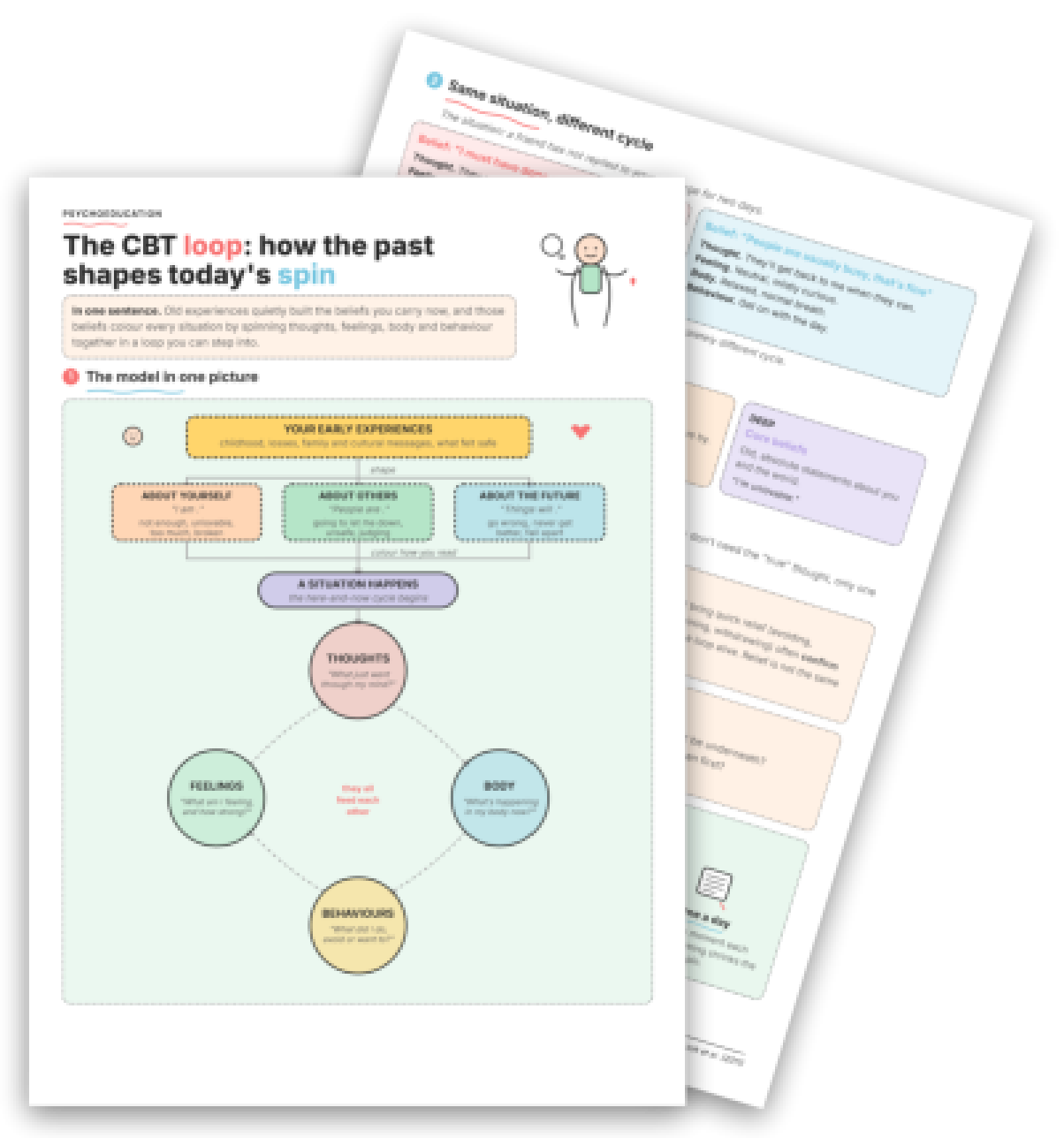
The worksheet is structured in four numbered panels, each designed for in-session use rather than solo completion.
- Panel 1 presents the full longitudinal model as a layered diagram: early experiences shape core beliefs about self ("I am not enough"), others ("People will let me down"), and the future ("Things will go wrong"), which then colour every here-and-now cycle of thoughts, feelings, body sensations, and behaviours feeding each other.
- Panel 2 runs the same situation, "a friend has not replied to your message for two days", through two contrasting belief filters, showing how the identical trigger produces completely different cognitive, affective, somatic, and behavioural outcomes. This side-by-side format does in one glance what ten minutes of dialogue cannot.
- Panel 3 maps the three layers of thinking: automatic thoughts ("They hate me"), rules and assumptions ("If I say no, they'll reject me"), and core beliefs ("I'm unlovable"), with the explicit framing that the deeper the layer, the older and more absolute the statement.
- Panel 4 names four intervention points, offers pocket reframes ("This is a thought, not a fact", "What would I tell a friend right now?"), flags safety behaviours as loop-maintainers rather than solutions, and closes with three discussion prompts designed to be used directly in session.
> Key point: This fiche is a visual support that facilitates the explanation of the CBT model in session. It is not a questionnaire to assign as homework. The clinician uses it to externalise and map the patient's own material onto a shared structure, then leaves it with the patient as a concrete reference point.
The vocabulary is precise without being technical, which makes it compatible with longitudinal case formulation work and with cognitive case formulation approaches from Beck onwards.
Use it with your patients
Share this tool in the mobile app and follow the work between sessions.
How and When to Introduce This Worksheet in Your Practice
Timing. The fiche fits naturally in sessions two to four, once an initial anamnesis is complete but before the therapeutic focus has narrowed to a specific symptom cluster. At this stage, a clear psychoeducational map gives the patient a framework to organise what they have already shared and what they will continue to explore.
Suitable profiles. It works across a wide range of presentations: generalised anxiety, depressive episodes, low self-esteem, relational difficulties driven by maladaptive schemas. It is particularly useful with patients who intellectualise well but have difficulty connecting cognition to somatic or behavioural experience, because Panel 1 makes the body corner of the loop explicit from the start.
Introducing it. A low-threshold framing: "I'd like to show you a diagram that explains how I understand what you're going through. It will take about five minutes, and I'd like to map one of your recent situations onto it together." This positions the fiche as a collaborative tool, not a didactic handout.
Debriefing. After walking through Panel 2 with a real example from the patient's week, Panel 4's discussion prompts serve as a ready-made debrief: which corner feels most accessible? Where is a safety behaviour quietly keeping the loop alive? These questions connect directly to the next steps, whether that means downward arrow work to reach the core belief, automatic thought restructuring, or tracing a belief back to its origins.
One limit to name. With patients in acute crisis or very early in the therapeutic alliance, a model overview can feel premature or intellectually distancing. In those cases, hold the fiche for a subsequent session once enough relational safety exists. For patients already familiar with CBT concepts, it still serves as a useful core belief self-reflection anchor rather than a pure introduction.
The fiche does not replace the formulation conversation; it makes that conversation faster, clearer, and more likely to leave a genuine imprint.
Your session continues in your patients' pocket
Use with a patientYour resources, available everywhere
The handouts, exercises, programs and audios above: you choose which ones to make available to your patients, in the mobile app dedicated to them.
And far more than a library
The app goes well beyond resources, to support your patients every day:
Related categories
Explore other clinical resources by category.

Anxiety
Clinical hub for anxiety disorders: CBT and ACT worksheets, psychoeducation sheets, and exercises for assessment and treatment across the anxiety spectrum.

Mood
Evidence-based worksheets and clinical tools for mood disorders: CBT, ACT, and positive psychology resources for psychologists and therapists.

Relationships
Clinical worksheets and tools on relational functioning: attachment, schemas, assertiveness, and communication skills for therapists. Printable PDF resources.

Cognition
Printable cognitive therapy worksheets and clinical tools for therapists: CBT, ACT, schema work, defusion, distortions, and belief restructuring.

Understand
Clinical hub for the therapeutic aim 'Understand': worksheets and tools to build patient insight across CBT, ACT, schema therapy and more.

Build awareness
Clinical worksheets and tools to build awareness in therapy: cognitive distortions, schemas, emotions, ACT and CBT resources for practitioners.