
Clinical picture. R., a 34-year-old software engineer, presented with generalised anxiety and recurrent low mood following a negative performance review. He minimised the review intellectually but reported a persistent, diffuse sense of dread he could not account for. The therapist introduced the downward arrow technique using a printed worksheet, starting from R.'s surface thought: "I made errors in the codebase." Through four successive descents, guided by the question "if that were true, what would it mean about you?", R. arrived at the core belief "I am fundamentally incompetent." He noted, with some surprise, that arguing against the original surface thought had never touched this layer, and the pair agreed to make the core belief the explicit focus of subsequent sessions.
Downward Arrow Technique: PDF Worksheet, Tools and Exercises
A visual PDF worksheet with tools and exercises to elicit core beliefs in session, layer by layer, turning an oral explanation into a shared clinical map.
Clinical vignettes
Uncovering a Core Inadequacy Belief
Descent From Parenting Guilt
Clinical picture. M., a 41-year-old primary school teacher and mother of two, sought consultation for persistent guilt and irritability she attributed to a recent conflict with her nine-year-old. She described the surface thought as "I lost my temper and frightened her," which felt factual and manageable, yet left her feeling disproportionately distressed. The clinician walked through the downward arrow on paper together with M., redirecting each answer that drifted toward anticipated social judgement back to the question "and what would that mean about you, specifically?" The chain ran through "I damage the people I love" to the core belief "I am harmful by nature." M. found the exercise confronting but reported that naming the belief clearly reduced some of its ambient power, and consented to schema-focused work targeting it.
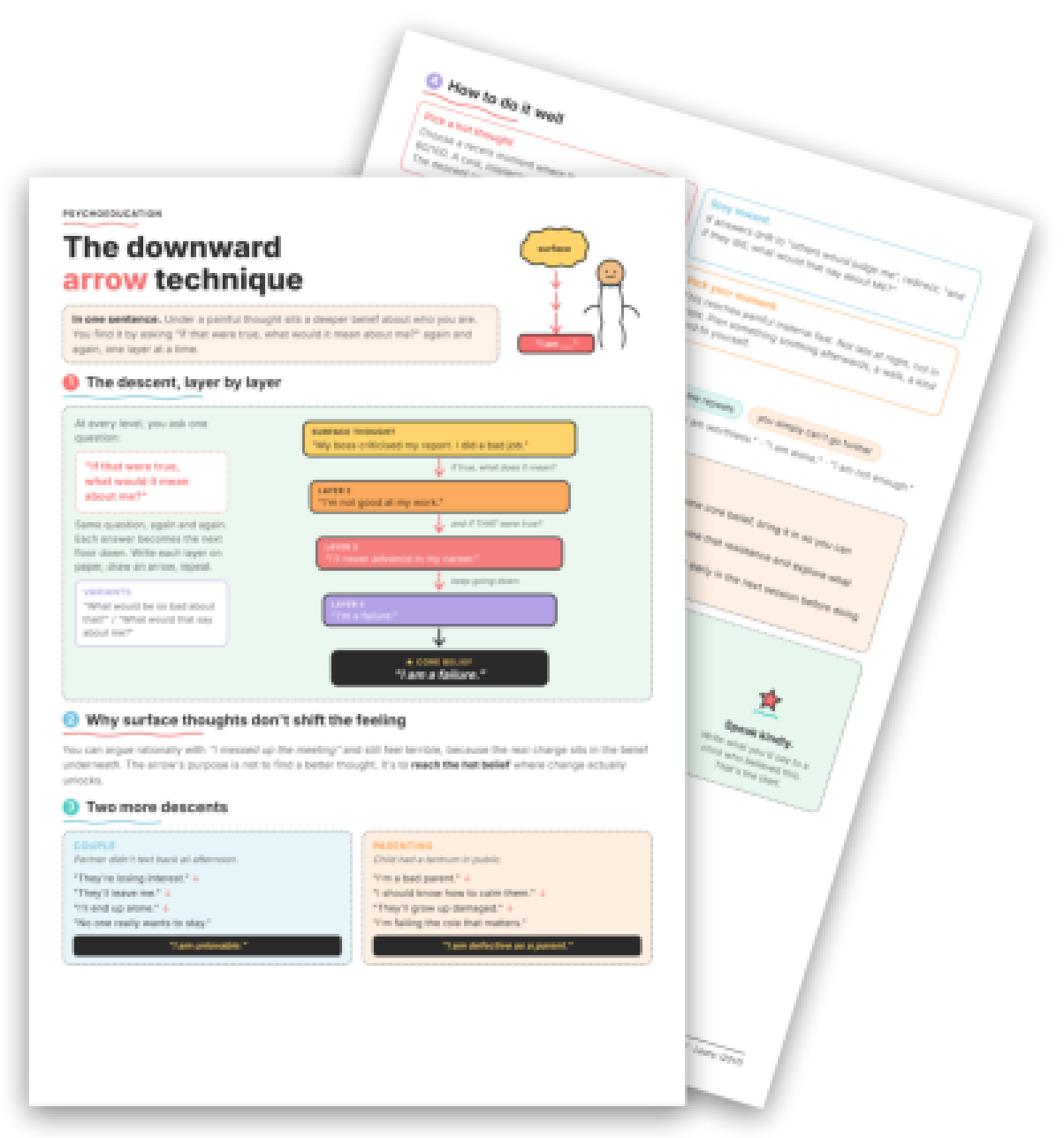
Patients can acknowledge that their distress runs deeper than one bad event without being able to locate where it runs. Explaining the downward arrow technique orally tends to produce polite nodding, then blank responses the moment you ask the first "and if that were true, what would it mean about you?" This fiche PDF gives the technique a visual structure you can use as a shared in-session guide, so the chain stays visible and the descent stays on track.
Use this resource with your patients
Handout, exercises and materials ready to use, right inside SessionFuel.
Why the descent stalls without a visual anchor
The technical difficulty is not conceptual. Most patients grasp quickly that a surface thought like "I messed up the meeting" carries emotional weight that a cognitive reframe does not resolve. What derails the process are two predictable moves: premature disputing, where the patient argues with each layer before the chain is complete, and lateral drift toward social judgment ("others would think less of me") rather than the inward question the technique requires.
Without something written down, both therapist and patient lose track of which floor they are on. The technique is grounded in TCC and schema therapy, Young's work on maladaptive schemas documents exactly the global "I am ___" formulations the descent is designed to surface, as seen clearly in presentations involving defectiveness or shame, but in oral-only delivery, the conceptual map disappears the moment the patient leaves the room. A printed worksheet holds the chain.
What the fiche contains, and what the visual layout adds
The worksheet is built around one iterative question: "If that were true, what would it mean about me?" Laid out as a literal vertical descent with printed arrows between layers, the structure shows the patient exactly where they are in the chain and holds earlier answers stable while they move deeper, something an oral walk-through cannot do.
Five sections structure the content:
- The descent, layer by layer: the core question at every level, plus two variant prompts ("What would be so bad about that?" / "What would that say about me?") for when the standard phrasing stalls.
- A worked example: the sequence from "My boss criticised my report" through four layers to "I am a failure", printed as a readable chain patients can follow step by step.
- Two further clinical vignettes in couple and parenting contexts, where abandonment-related beliefs frequently surface alongside defectiveness schemas.
- How to do it well: four practical rules, including choosing a thought with emotional intensity above 60/100, staying inward rather than social, withholding disputation until the bottom is reached, and planning something soothing afterwards given how quickly the technique reaches charged material.
- Signs you have reached the bottom: a global "I am ___" formulation, an emotional surge, thematic repetition across different triggers.
A closing "To discuss in session" block flags three clinical indicators worth raising early: repeated landing on the same core belief, resistance mid-descent, and lingering distress after the exercise.
> Key takeaway: the fiche is a visual support that facilitates the in-session explanation of the downward arrow technique; it is not a self-directed questionnaire. The printed arrows and layered layout make the abstract chain concrete and leave the patient with a physical map of their own descent to take home.
750+ clinical tools
A library built with and for clinicians, ready to use in session and extend between appointments.
Access all the toolsWhen and how to introduce it
The fiche fits naturally into a case formulation phase, once the therapeutic alliance is solid and the patient has basic familiarity with the connection between thoughts, emotions, and behavior. Presenting it before automatic thoughts are identified means there is nothing to descend from.
A low-barrier introduction: "I'd like us to take one thought that bothered you this week and follow it down, one level at a time, to see what belief is sitting underneath. I'll ask the same question at each step, and we'll write each layer on this sheet together." The printed worksheet then structures the dialogue: you read the prompt, the patient responds, you write the answer in the corresponding layer, draw the arrow together, and descend.
The completed sheet becomes an immediate take-home anchor. Once the bottom belief is named, subsequent sessions can address it directly: replacing the negative core belief, examining the evidence for an alternative, or using Tracing the Origin of a Negative Thought to Its Core Belief to situate the belief historically. For patients prone to dissociation or in active crisis, the technique reaches painful material fast and should be deferred until greater stabilisation is in place.
The fiche does not replace the clinical framework; it makes one technically demanding technique legible, in session and afterwards.
Use it with your patients
Share this tool in the mobile app and follow the work between sessions.
Sources
- Burns, D. D. (1980). Feeling Good: The New Mood Therapy. William Morrow and Company.
- Beck, A. T., Rush, A. J., Shaw, B. F., Emery, G. (1979). Cognitive Therapy of Depression. Guilford Press.
- Neenan, M., Dryden, W. (1999). When Laddering and the Downward Arrow Can Be Used as Adjuncts to Inference Chaining in REBT Assessment. Journal of Rational-Emotive and Cognitive-Behavior Therapy.
- Neenan, M., Dryden, W. (2021). The Downward Arrow Technique. Routledge.
- Wenzel, A. (2012). Modification of Core Beliefs in Cognitive Therapy. InTech.
Your session continues in your patients' pocket
Use with a patientYour resources, available everywhere
The handouts, exercises, programs and audios above: you choose which ones to make available to your patients, in the mobile app dedicated to them.
And far more than a library
The app goes well beyond resources, to support your patients every day:
Related categories
Explore other clinical resources by category.

Identity
Clinical resources for self-identity work in therapy: CBT, ACT, schema tools for clinicians addressing self-concept, core beliefs, and identity disruption.

Relationships
Clinical worksheets and tools on relational functioning: attachment, schemas, assertiveness, and communication skills for therapists. Printable PDF resources.

Cognition
Printable cognitive therapy worksheets and clinical tools for therapists: CBT, ACT, schema work, defusion, distortions, and belief restructuring.

Understand
Clinical hub for the therapeutic aim 'Understand': worksheets and tools to build patient insight across CBT, ACT, schema therapy and more.

Build awareness
Clinical worksheets and tools to build awareness in therapy: cognitive distortions, schemas, emotions, ACT and CBT resources for practitioners.

Restructure
Clinical hub for cognitive restructuring worksheets: distortion identification, belief disputation, ABC model, and schema work for evidence-based practice.