
Clinical picture. T., a woman in her late 40s, presented with generalised anxiety and a growing preoccupation that her frequent name-blanks and tip-of-the-tongue moments signalled early cognitive decline. She had begun avoiding social situations where she might forget a colleague's name, reinforcing her distress. The clinician introduced the three-step memory model from the psychoeducational sheet, walking through encoding, storage, and retrieval as distinct processes, and invited T. to locate her own examples within that framework. T. identified that her blanks reliably occurred in busy, pressured moments, pointing toward retrieval difficulty under anxiety rather than storage failure. Over the following two sessions she reported modest but genuine reduction in her catastrophic appraisal of these lapses, and she resumed one previously avoided team meeting.
Memory: PDF Worksheet, Tools and Exercises for Clinical Practice
A visual psychoeducation worksheet clinicians can use in session to explain how memory actually works, normalize forgetting, and break the anxiety loop around memory complaints.
Clinical vignettes
Reframing Forgetting in Anxious Patient
Sleep Loss and Storage Confusion
Clinical picture. M., a man in his early 30s recovering from a depressive episode, reported that he studied for a work certification but retained almost nothing by the next morning, leading him to conclude his memory was permanently impaired. The clinician used the informational sheet to distinguish encoding and storage steps, drawing attention to the section noting that sleep loss disrupts consolidation rather than capacity. M. had been revising late at night on four to five hours of sleep and attributing the fadeout to a fixed deficit. Reframing the problem as a storage condition rather than a brain lesion shifted his stance from helplessness to problem-solving. He agreed to trial earlier study sessions with adequate sleep, and reported noticeably better retention within two weeks.
Patients who worry about their memory rarely need a referral to neuropsychology. They need a clear model they can hold onto. Explaining the three-step memory process at the whiteboard takes time, gets lost in the retelling, and leaves no trace. This PDF worksheet on memory gives you a structured visual support to anchor the explanation in session and send something concrete home.
Use this resource with your patients
Handout, exercises and materials ready to use, right inside SessionFuel.
Why Memory Complaints Are Hard to Address at the Oral Level
The presenting complaint is almost always catastrophic: "My memory is getting worse," "I'm scared something is wrong with my brain." What clinicians know, but patients rarely hear, is that the vast majority of everyday forgetting is functional, not structural. The difficulty is that saying so, without a model, sounds dismissive.
Patients also conflate three distinct processes. A name that vanishes two seconds after introduction is an encoding failure, not a storage problem. A tip-of-the-tongue block under exam pressure is a retrieval failure driven by anxiety. Blurring these together feeds health anxiety spirals and intolerance of uncertainty, and it makes any reassurance feel vague. Without a shared vocabulary, the psychoeducation doesn't hold between sessions.
There is also the worry loop: anxious monitoring of memory performance consumes exactly the attentional resources that encoding and retrieval need, which produces genuine lapses, which amplify the worry. Patients are often caught in it before they can name it.
What the Fiche Contains: A Step-by-Step Visual Model
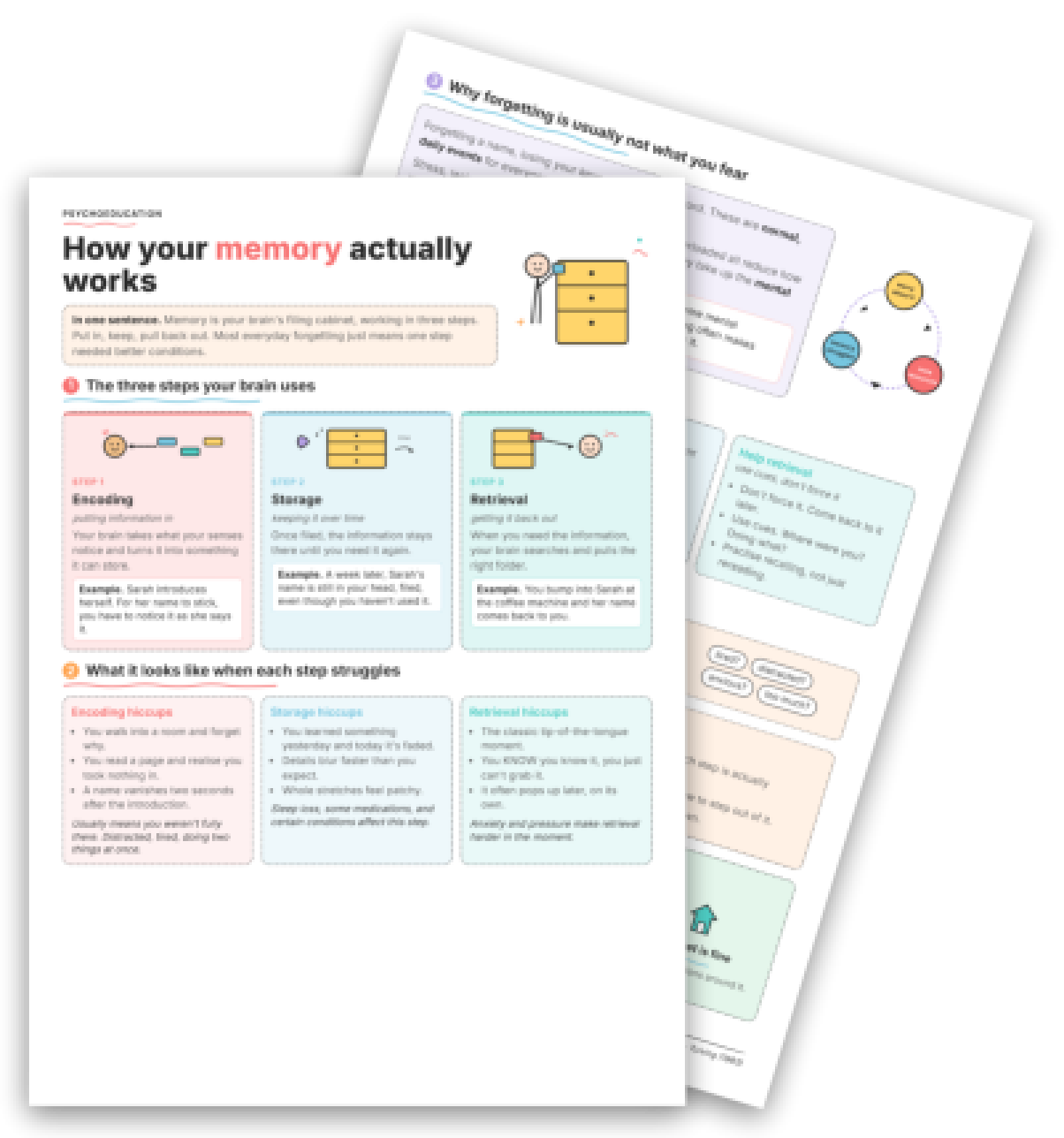
The worksheet is built around five numbered sections, each adding a layer to the explanation. Sections 1 and 2 carry the structural core: a three-step model (encoding, storage, retrieval) illustrated with a single concrete example per step, then a breakdown of what struggling looks like at each stage.
The visual layout does work that oral explanation cannot. Encoding failures, storage failures, and retrieval failures appear in three distinct columns, making it immediately apparent to the patient that "you walked into a room and forgot why" (encoding) is a categorically different event from "the tip-of-the-tongue moment" (retrieval). A clinician can point rather than explain.
Section 3 names the worry loop explicitly, showing it as a closed cycle: "worry about it → uses resources → memory struggles." Seeing the loop drawn out often produces more recognition than several minutes of verbal explanation. Section 4 maps practical strategies onto each step, sorted exactly as the model is, so patients leave knowing which step to target. The closing reframe in section 5 is the pivot: "Instead of 'my memory is broken,' ask: which step is struggling right now, and what's pulling on it?"
The worksheet also carries three discussion prompts at the bottom, flagging when to bring a memory concern back to session, including "when forgetting feels new, frequent, or different in a way that's hard to shake on your own." These cues help the patient know what warrants clinical follow-up, which matters in GAD presentations where every symptom becomes a feared signal.
> Key point: The fiche is a visual support that facilitates the in-session explanation of memory ; it is not a self-administered questionnaire. The clinician guides the reading, points to the schema, and leaves the patient with a concrete reference, not a homework task.
750+ clinical tools
A library built with and for clinicians, ready to use in session and extend between appointments.
Access all the toolsWhen and How to Introduce the Fiche
This worksheet fits naturally in the early-to-mid phase of any formulation where memory complaints appear as a secondary concern: burnout, chronic anxiety, PTSD, depression with cognitive fog, or any presentation where sleep disruption is significant. It also belongs early in work with patients whose health anxiety has fixed on cognitive symptoms.
You can introduce it without pathologising: "Let me show you a model of how memory actually works. It might reframe some of what you've been noticing." Walk through sections 1 and 2 together, pausing where the patient recognises their own pattern. Section 3 tends to land hardest; give it room.
One practical limit: for patients with genuine neurocognitive concerns or objective decline on screening, this fiche is supportive but not sufficient. In those cases, pair it with the Strategies for Memory Problems worksheet and consider a neuropsychological assessment pathway. For patients whose rumination about forgetting dominates the clinical picture, the fiche opens the door to cognitive restructuring work on the worry loop itself.
Debrief by asking which step resonated most. The answer usually tells you where the clinical focus belongs: encoding difficulties point to attentional load and chronic stress; retrieval failures under pressure connect directly to anxiety management and the broader formulation.
The fiche does not replace the therapeutic frame. It makes a genuinely complex mechanism clear in a few minutes, gives the patient something to revisit, and frees up session time for the formulation work that follows.
Use it with your patients
Share this tool in the mobile app and follow the work between sessions.
Sources
- Atkinson, R. C., & Shiffrin, R. M. (1968). Human Memory: A Proposed System and Its Control Processes. Academic Press (in K. W. Spence & J. T. Spence, Eds., The Psychology of Learning and Motivation, Vol. 2, pp. 89-195).
- Baddeley, A., Eysenck, M. W., & Anderson, M. C. (2025). Memory (4th ed.). Routledge.
- McDermott, K. B., & Roediger, H. L.. Memory (Encoding, Storage, Retrieval). Noba Project.
Your session continues in your patients' pocket
Use with a patientYour resources, available everywhere
The handouts, exercises, programs and audios above: you choose which ones to make available to your patients, in the mobile app dedicated to them.
And far more than a library
The app goes well beyond resources, to support your patients every day:
Related categories
Explore other clinical resources by category.

Anxiety
Clinical hub for anxiety disorders: CBT and ACT worksheets, psychoeducation sheets, and exercises for assessment and treatment across the anxiety spectrum.

Mood
Evidence-based worksheets and clinical tools for mood disorders: CBT, ACT, and positive psychology resources for psychologists and therapists.

Neurodevelopment
Clinical hub for neurodevelopmental disorders: psychoeducation, worksheets and intervention tools for ADHD, ASD, learning disorders and related conditions.

Cognition
Printable cognitive therapy worksheets and clinical tools for therapists: CBT, ACT, schema work, defusion, distortions, and belief restructuring.

Health
Somatic health clinical resources for practitioners: worksheets, psychoeducation, and exercises for somatic symptom disorder, chronic pain, and more.

Understand
Clinical hub for the therapeutic aim 'Understand': worksheets and tools to build patient insight across CBT, ACT, schema therapy and more.