
Clinical picture. M., a 34-year-old professional referred for recurrent low mood, described a cycle in which a single piece of critical feedback at work would reliably unravel several days of functioning. During session three, the clinician introduced the Fables of Faulty Thinking sheet and invited M. to read through the twelve traps quietly, then mark any that felt recognizable. M. circled magnification, disqualifying the positive, and all-or-nothing without prompting, remarking that seeing them listed made them feel "less like personality and more like habits." The clinician used this self-identification as a scaffold for the following session rather than moving immediately to restructuring. Over the next two weeks M. began labeling traps in her written thought records, which reduced the time she spent in ruminative loops, though global mood remained variable.
Fables of Faulty Thinking: PDF Worksheet, Tools and Exercises
A visual PDF worksheet presenting the twelve cognitive distortions, three diagnostic questions, and a structured catch-name-rewrite practice for use in CBT sessions.
Clinical vignettes
Naming the Trap Before the Session Ends
Psychoeducation as a Shared Reference Point
Clinical picture. T., a 52-year-old man seen in a brief-intervention context following a cardiac event, presented with marked health anxiety and persistent guilt about lifestyle choices preceding his diagnosis. The clinician offered the Fables of Faulty Thinking sheet as take-home reading between sessions one and two, asking T. to note any examples from his own week alongside each trap. He returned with personalization and catastrophizing heavily annotated, having connected them to specific moments of nighttime worry. This gave the subsequent session a concrete, patient-generated vocabulary rather than a therapist-imposed framework. Progress was modest and appropriate: T. reported fewer sleepless nights, though he continued to find emotional reasoning difficult to challenge without in-session support.
Naming cognitive distortions in session is rarely the problem; getting patients to genuinely recognise their own is another matter entirely. A verbal list of twelve distortions tends to produce polite nodding, not real identification. This PDF worksheet gives the concept a visual shape that oral explanation alone cannot, and it does so in a format designed to support your explanation during the session, not as a handout patients decode at home.
Use this resource with your patients
Handout, exercises and materials ready to use, right inside SessionFuel.
Why Cognitive Distortions Resist Explanation in Session
Even patients with solid psychological literacy routinely conflate overgeneralization with all-or-nothing thinking, or mistake emotional reasoning for a form of reliable intuition. Delivered verbally, the distinctions blur quickly. The deeper obstacle is structural: a patient who is inside a distortion cannot observe it from the inside. Beck's foundational work (1976) established that these patterns function as stress shortcuts, not deliberate errors, which is precisely why the patient who jumps to conclusions will not catch themselves doing it unless something interrupts the automaticity.
A standard psychoeducation approach asks you to carry the full explanatory load in real time while also tracking the patient's affect, monitoring alliance, and choosing when to pivot technique. A visual support redistributes that load. You can watch the patient's face as they scan the fiche rather than managing content delivery while simultaneously reading the room.
What the Fiche Contains: a Visual Map of the Twelve Traps
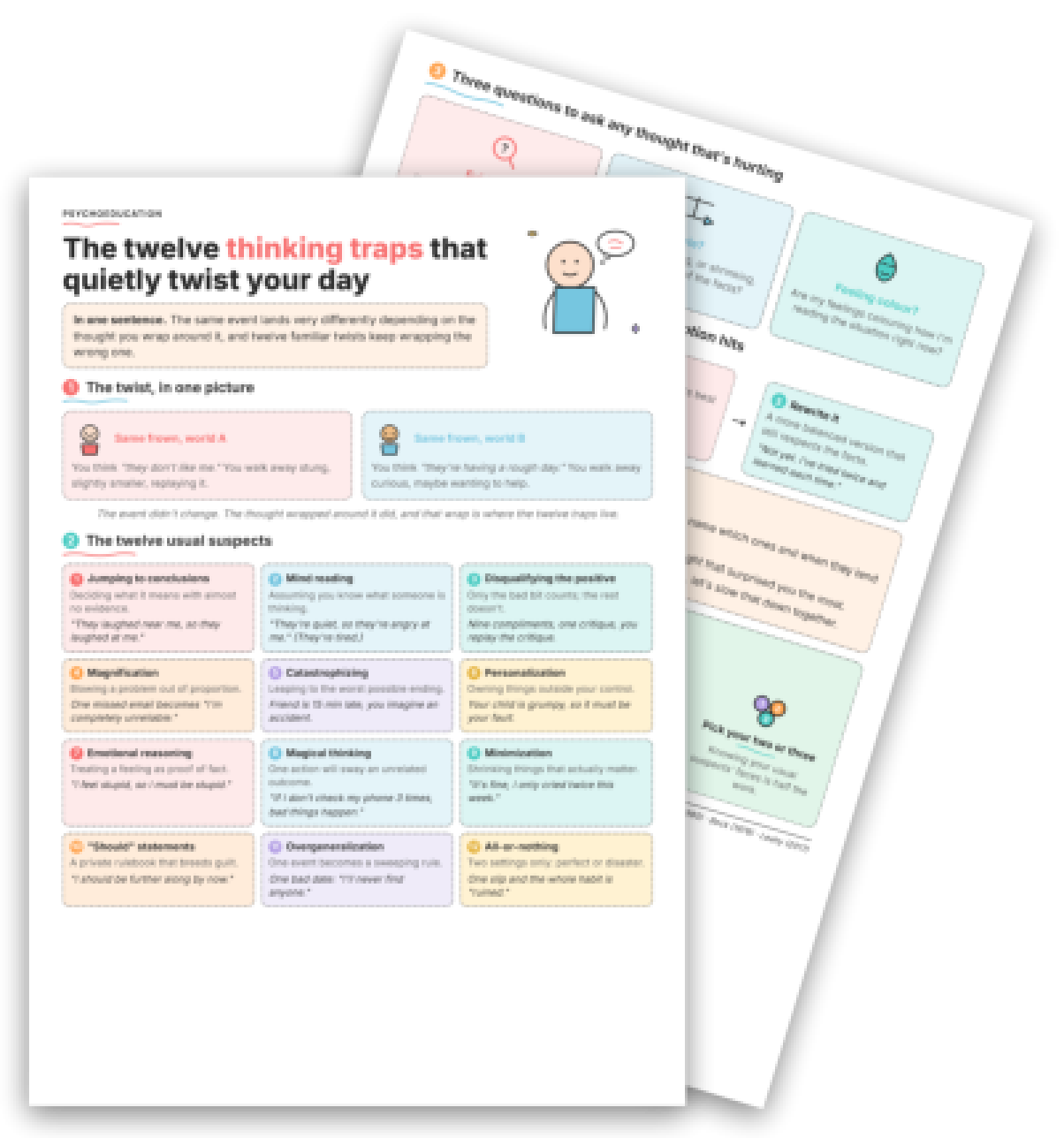
The fiche opens with a two-panel illustration that does the conceptual heavy lifting before any distortion is named. The same frown, two very different thoughts: "they don't like me" versus "they're having a rough day." The event is identical; the thought wrapped around it determines whether the patient walks away "stung, slightly smaller" or "curious, maybe wanting to help." That single image often lands faster in session than three minutes of socratic dialogue.
The twelve distortions follow, each given a short name, a one-sentence definition, and a concrete micro-example. The list covers the full CBT canon: mind reading, catastrophizing, personalization, disqualifying the positive, magical thinking, "should" statements, and five others. Crucially, they are presented as a typology the patient can scan for recognition, not as a taxonomy to memorise.
A third panel offers three diagnostic questions for any thought that is causing distress: Evidence? Scale? Feeling colour? These map directly onto the CBT cognitive model and onto the cognitive triangle, giving you a ready vocabulary to share with the patient without needing to construct one from scratch mid-session.
The fiche closes with a three-step practice: Catch it (write the thought in one sentence), Name it (identify which of the twelve fits), Rewrite it (produce a more balanced version that still respects the facts). A worked example is printed alongside: "I'll never get this right" becomes "Not yet. I've tried twice and learned each time." This is not a fill-in-the-blank exercise to assign as homework; it is a demonstration the clinician walks through with the patient using the fiche as an anchor.
> Key point: the fiche is a visual support for in-session explanation, not a self-directed questionnaire. Its value is in letting the patient see the structure of their own thinking at the moment you are describing it together, then leave with something concrete to return to between appointments.
A final "To discuss in session" block lists three ready-made prompts, including one that anticipates a common clinical stumble: "If naming the distortion felt like punishing yourself rather than noticing, let's slow that down together." This wording is worth borrowing verbatim.
750+ clinical tools
A library built with and for clinicians, ready to use in session and extend between appointments.
Access all the toolsWhen and How to Introduce the Fiche
The fiche fits naturally at the point in a TCC formulation when you are ready to move from identifying automatic thoughts to explaining the cognitive mechanisms sustaining them. For most presentations, that is session two or three, once the initial anamnesis is complete and the alliance is stable enough for some gentle confrontation.
A low-threshold framing to introduce it: "I'd like to show you something that might explain why certain thoughts keep doing the same damage, even when you know rationally they're not quite right." Avoid the word "distortion" before the patient has seen the fiche, since the term can feel pejorative on first contact. The fiche's own language, "stress shortcuts, not failings," is gentler and clinically accurate.
Profiles where it lands well:
- Patients with good introspective access who are stuck in knowing a thought is irrational without being able to shift it
- Presentations with prominent catastrophizing, mind reading, or overgeneralization, where labelling gives the patient a handle to grip
- Adolescents and young adults who respond to typologies and find naming reassuring
One contraindication worth noting: for patients in an acute decompensation or with fragile reality-testing, the typology format can feel like a verdict. In those contexts, defer the fiche and work with catching thoughts or the ABC model first.
Debrief by asking which two or three entries felt like recognition rather than description. That response, whether immediate or delayed, is clinically more informative than any self-report scale. The fiche does not replace the cognitive restructuring work that follows; it gives that work a shared language from the start.
Use it with your patients
Share this tool in the mobile app and follow the work between sessions.
Sources
- Beck, A. T., Rush, A. J., Shaw, B. F., Emery, G. (1979). Cognitive Therapy of Depression. Guilford Press.
- Burns, D. D. (1980). Feeling Good: The New Mood Therapy. William Morrow.
- Burns, D. D. (1989). The Feeling Good Handbook. HarperCollins.
Your session continues in your patients' pocket
Use with a patientYour resources, available everywhere
The handouts, exercises, programs and audios above: you choose which ones to make available to your patients, in the mobile app dedicated to them.
And far more than a library
The app goes well beyond resources, to support your patients every day:
Related categories
Explore other clinical resources by category.

Mood
Evidence-based worksheets and clinical tools for mood disorders: CBT, ACT, and positive psychology resources for psychologists and therapists.

Cognition
Printable cognitive therapy worksheets and clinical tools for therapists: CBT, ACT, schema work, defusion, distortions, and belief restructuring.

Understand
Clinical hub for the therapeutic aim 'Understand': worksheets and tools to build patient insight across CBT, ACT, schema therapy and more.

Build awareness
Clinical worksheets and tools to build awareness in therapy: cognitive distortions, schemas, emotions, ACT and CBT resources for practitioners.

Restructure
Clinical hub for cognitive restructuring worksheets: distortion identification, belief disputation, ABC model, and schema work for evidence-based practice.

CBT
CBT worksheets, cognitive restructuring exercises & behavioral tools for clinicians. Evidence-based resources for every phase of cognitive behavioral therapy.