
Clinical picture. T., a 9-year-old boy referred for generalized anxiety, presented with persistent beliefs that peers disliked him, which intensified markedly after minor playground incidents. During a session following a lunchtime argument, the clinician introduced the Belief-O-Meter worksheet and asked T. to rate the thought "Nobody likes me" on the 0-to-10 dial. He placed it at 9, then noted, unprompted, that on weekend mornings the same thought felt closer to a 4. The clinician used this contrast to introduce the idea that the number shifting across contexts was evidence the thought was not a fixed fact. T. began checking his rating at the start of subsequent sessions, which provided a concrete opening for examining situational triggers without requiring him to argue against the belief directly.
Belief-O-Meter for Children: PDF Worksheet, Tools and Exercises
A visual PDF worksheet and practical exercises to help child clinicians make the thought-belief distinction concrete and actionable in session.
Clinical vignettes
Rating Anxiety Thoughts After Social Conflict
Externalising a Performance-Related Belief
Clinical picture. M., an 11-year-old girl seen for test anxiety, reported the thought "I am going to fail" as feeling completely true each time an assessment approached, leaving her unable to start revision. The clinician introduced the Belief-O-Meter and first had M. rate low-stakes warm-up thoughts from the worksheet, which normalized the rating process and reduced self-consciousness. When M. then rated her performance belief, she assigned it an 8 and, guided by the detective questions on the sheet, identified that hunger and late-night rumination were pushing the number up. Over three sessions, tracking the dial gave M. a shared vocabulary with her clinician for monitoring belief intensity rather than treating the thought as a reliable prediction, and her pre-assessment rating had dropped to a 5 by the final session.
Getting a child to see that a thought is not the same as a fact is one of the most demanding tasks in child-focused CBT. The abstraction collapses quickly under pressure: children in acute distress cannot hold the concept verbally, and parents often cannot reinforce it between sessions. This PDF worksheet offers a visual anchor the clinician can work with directly in session, making the distinction concrete rather than theoretical.
Use this resource with your patients
Handout, exercises and materials ready to use, right inside SessionFuel.
Why the thought-belief distinction is so difficult to explain to children
With adults, a Socratic dialogue or a written thought record can carry the weight of cognitive restructuring. With children, especially those in the 8-14 range, oral explanation alone rarely transfers. The child agrees in the room, nods, and then fuses completely with "Nobody likes me" at school on Monday morning.
The core obstacle is developmental: children do not yet have reliable metacognitive distance. When a thought is distressing enough, it registers as 100% true. There is no perceived gradient. Saying "thoughts are not facts" is accurate but meaningless without a concrete tool that turns that principle into something the child can actually do.
A second difficulty is emotional flooding. High-arousal states flatten nuance. Children need a measurement ritual they can apply even when dysregulated, something that gives cognitive work a somatic and procedural handle.
What the worksheet contains: a visual tool to use alongside the child
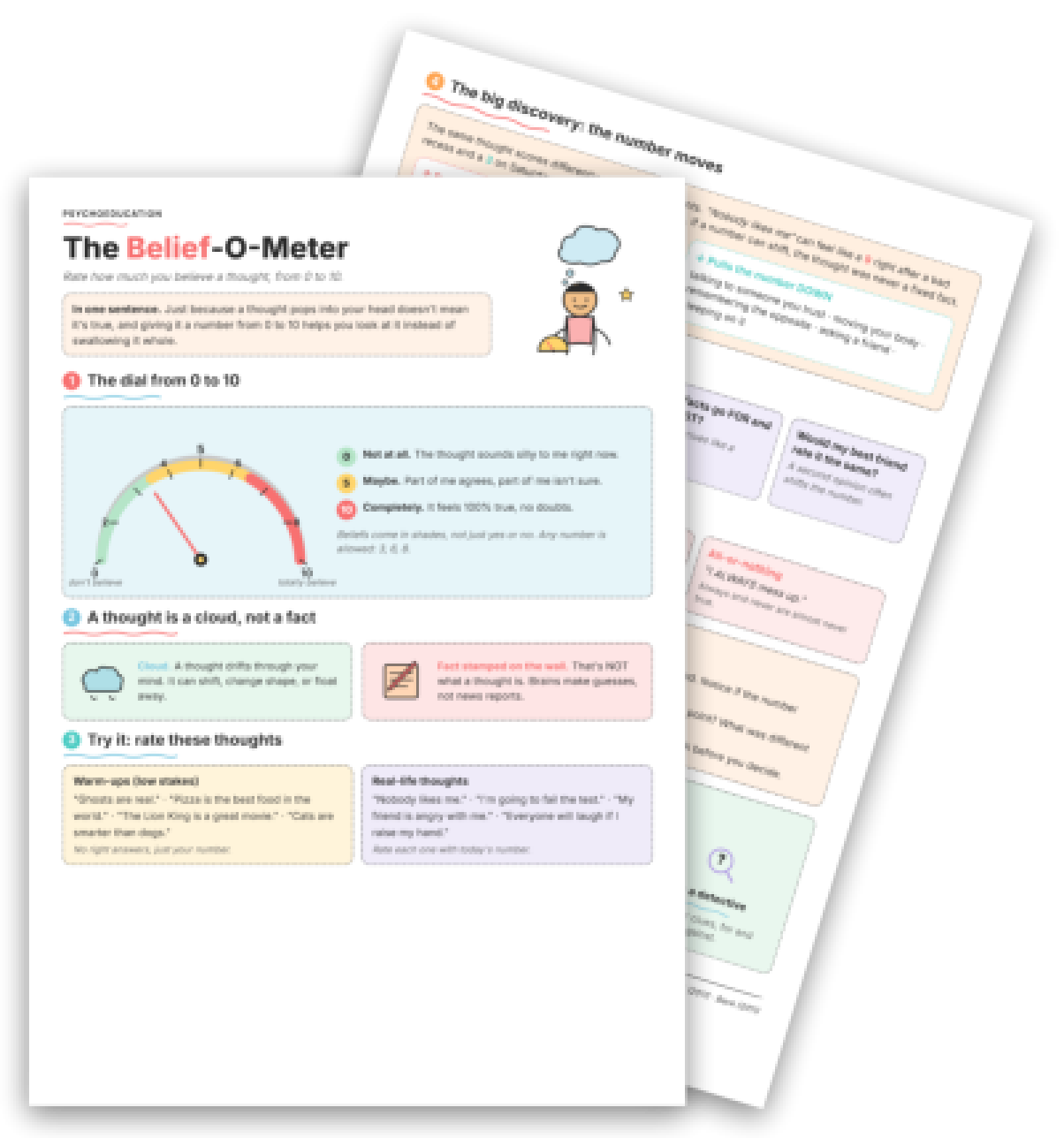
The Belief-O-Meter PDF worksheet structures this work across six clearly delineated panels the clinician can walk through with the child during the session itself.
- The 0-10 dial: anchored at 0 ("The thought sounds silly to me right now"), 5 ("Part of me agrees, part of me isn't sure"), and 10 ("It feels 100% true, no doubts"). The visual dial communicates immediately that belief exists on a continuum, not as a binary.
- Cloud vs. stamped fact: a simple two-image contrast that externalises the defusion concept. The fiche names it plainly: "A thought drifts through your mind. It can shift, change shape, or float away." This is a level of concreteness that an oral explanation of ACT cognitive defusion techniques cannot match on its own with a child.
- Graded practice items: the worksheet distinguishes low-stakes warm-up thoughts ("Ghosts are real," "Pizza is the best food in the world") from clinically relevant ones ("Nobody likes me," "Everyone will laugh if I raise my hand"). This graduated structure mirrors the hierarchy used in coping strategies for children and adolescents.
- The number moves: a panel showing that the same thought scores differently depending on context (after a bad recess vs. Saturday morning watching cartoons). This is the key psychoeducational pivot: "If a number can shift, the thought was never a fixed fact."
- Contextual modulators: visual lists of what pushes the number up (tired, hungry, just argued) and what pulls it down (talking to someone trusted, moving, sleeping on it).
- Detective questions and named distortions: the worksheet labels mind-reading, fortune-telling, and all-or-nothing thinking in child-accessible language, giving you a shared vocabulary to use across sessions.
> Key point: the Belief-O-Meter is a visual support that facilitates the in-session explanation of the thought-belief distinction. It is not a between-session questionnaire to fill in alone. The clinician walks through it with the child, and the child takes it home as a reference, not a task.
750+ clinical tools
A library built with and for clinicians, ready to use in session and extend between appointments.
Access all the toolsWhen and how to introduce this worksheet in session
This worksheet fits naturally from the second or third session, once the therapeutic alliance is established and the child has shared at least one recurring distressing thought. It works across presentations: social anxiety ("Everyone will laugh if I raise my hand"), low self-esteem, separation fears, and the kind of automatic thought patterns that sustain mild to moderate childhood depression.
To introduce it without pathologising, you can say something like: "I want to show you a measuring tool, a bit like a volume dial, but for thoughts. We'll use it on some easy thoughts first, then on one of yours." Starting with the warm-up items reduces defensiveness and models that the tool is playful, not clinical in a frightening sense.
Debrief by asking which thoughts the child found hardest to rate below 10, and why. The resistance itself becomes the clinical material. For children showing social anxiety symptoms or difficulty with growth-oriented thinking, pairing this worksheet with growth mindset work can reinforce the idea that cognitions are malleable.
One practical limit: children below 7-8 years, or those with significant intellectual disability, may need the scale collapsed to three points rather than ten. The cloud metaphor, however, tends to hold across a wide developmental range.
The worksheet does not replace the case formulation or the relational work; it sharpens the psychoeducational step, gives the child a repeatable procedure, and leaves a concrete object in their hands when they leave.
Use it with your patients
Share this tool in the mobile app and follow the work between sessions.
Sources
- Friedberg, R. D., & McClure, J. M. (2015). Clinical Practice of Cognitive Therapy with Children and Adolescents: The Nuts and Bolts. Guilford Press.
- Stallard, P. (2002). Think Good Feel Good: A Cognitive Behaviour Therapy Workbook for Children and Young People. Wiley.
- Stallard, P. (2005). A Clinician's Guide to Think Good Feel Good: Using CBT with Children and Young People. Wiley.
- Kendall, P. C., & Hedtke, K. A. (2006). Coping Cat Workbook. Workbook Publishing.
Your session continues in your patients' pocket
Use with a patientYour resources, available everywhere
The handouts, exercises, programs and audios above: you choose which ones to make available to your patients, in the mobile app dedicated to them.
And far more than a library
The app goes well beyond resources, to support your patients every day:
Related categories
Explore other clinical resources by category.

Anxiety
Clinical hub for anxiety disorders: CBT and ACT worksheets, psychoeducation sheets, and exercises for assessment and treatment across the anxiety spectrum.

Mood
Evidence-based worksheets and clinical tools for mood disorders: CBT, ACT, and positive psychology resources for psychologists and therapists.

Cognition
Printable cognitive therapy worksheets and clinical tools for therapists: CBT, ACT, schema work, defusion, distortions, and belief restructuring.

Build awareness
Clinical worksheets and tools to build awareness in therapy: cognitive distortions, schemas, emotions, ACT and CBT resources for practitioners.

Restructure
Clinical hub for cognitive restructuring worksheets: distortion identification, belief disputation, ABC model, and schema work for evidence-based practice.

ACT
Clinical hub for Acceptance and Commitment Therapy (ACT): worksheets, exercises, programs and audio resources for practitioners using the ACT model.