
Clinical picture. M., a 34-year-old with a several-year history of OCD centred on door-locking rituals, had plateaued in exposure work and struggled to articulate why certain attempts to resist compulsions succeeded while others did not. The clinician introduced the weekly progress check-in as structured homework between sessions, asking M. to rate compulsion control on the 1-to-10 frequency scale and then to write brief answers to each of the four prompts. M. returned the following week having scored himself a 4, noting that fatigue in the evening reliably eroded his resistance and that two mornings he had left the house after a single check without returning. Working from his written answers, the clinician and M. identified that his stopping criterion ("feeling certain") was functionally unmeetable, and they collaboratively reworded it to a behavioural anchor: one deliberate check, then walk away. At the next review his self-rated score rose to 6, and he described the concrete criterion as reducing the negotiation he had previously conducted with himself at the door.
OCD Compulsion Progress Check-In: A Self-Monitoring Exercise
Help OCD patients rate compulsion control, name obstacles and successes, and sharpen their stopping criterion as structured homework.
Clinical vignettes
Refining a Stopping Criterion for Checking
Naming Obstacles in Contamination OCD
Clinical picture. A., a 28-year-old presenting with contamination-related OCD and extensive hand-washing rituals, had been engaged in ERP for eight weeks with partial response. Her clinician introduced the self-monitoring check-in exercise as a between-session anchor, asking her to complete all four questions in writing before the next appointment. A. rated her compulsion control at 3 out of 10, attributing the low score mainly to situations involving public transport, which she had not previously flagged as a distinct trigger. Her written account of successes, however, revealed that she had twice tolerated touching a shared surface at work without washing, which she had not spontaneously reported. The clinician used the completed exercise to restructure the exposure hierarchy and to acknowledge the work-setting gains explicitly, while the stopping-criterion question led A. to replace "until my hands feel clean" with a timed limit of thirty seconds per wash. The exercise gave the session a shared, patient-generated data point rather than relying solely on clinician inquiry.
What makes OCD progress so hard to track clinically
Compulsion reduction is rarely linear, and patients with OCD frequently struggle to hold onto their own gains. Between sessions, two things tend to erode motivation: the absence of a structured way to measure progress, and a stopping criterion that remains vague or elastic. Without a concrete benchmark, patients cannot tell whether they are actually improving or simply having a good week by chance.
This difficulty is compounded by the nature of OCD itself. The OCD: PDF Worksheet, Tools and Exercises for Clinical Practice can help patients name their compulsions and obsessions in session, but naming is not the same as monitoring. Verbal check-ins during appointments capture a snapshot; what clinicians often miss is the granular texture of the week: when rituals were resisted, when they were not, and why. A structured autonomous exercise fills that gap.
Patients also tend to minimize successes and catastrophize setbacks. Without a frame that invites them to claim their wins explicitly, the small victories that sustain motivation simply disappear. The Celebrating Personal Successes: A Guided Clinical Exercise captures that principle well; this OCD progress check-in builds the same logic into a disorder-specific tool.
Use this resource with your patients
Handout, exercises and materials ready to use, right inside SessionFuel.
What this exercise contains
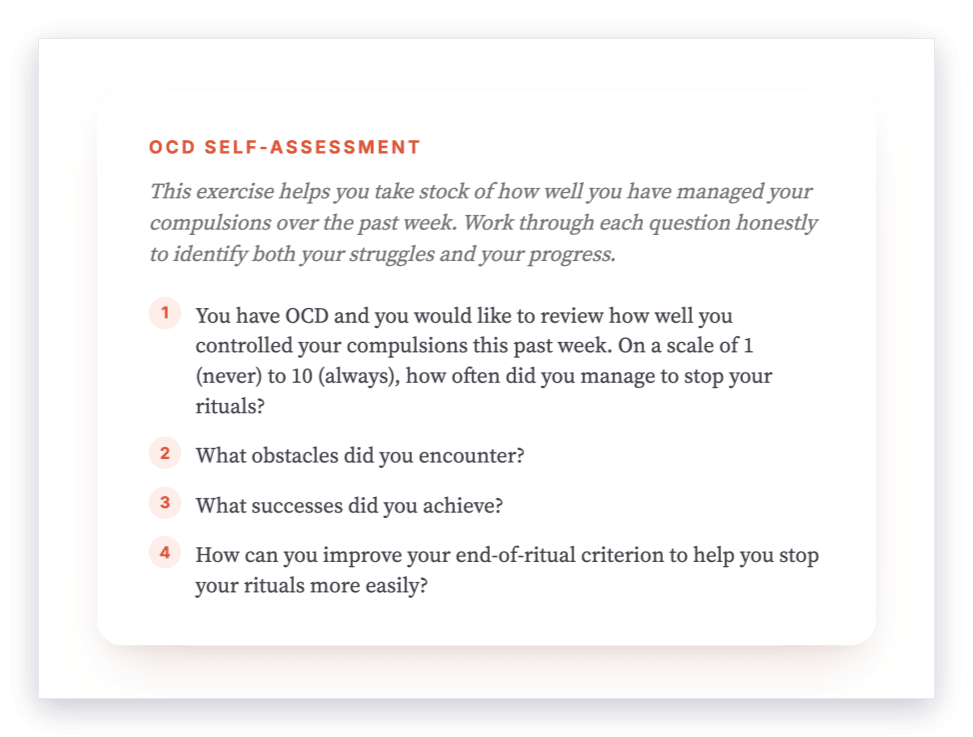
The exercise is built around four tightly sequenced questions. First, patients rate on a 1-to-10 scale how often they succeeded in stopping their rituals over the past week, giving a numerical anchor to an experience that otherwise stays impressionistic. Second, they name the specific obstacles they encountered. Third, they identify concrete successes: what worked, when, and how. Fourth, and crucially, they reflect on how they might refine their ritual-ending criterion to make stopping more achievable going forward.
That final question is the clinical keystone. It connects directly to the work developed in the OCD Compulsions: Defining a Measurable Stopping Criterion exercise, which helps patients build a clear, observable rule for when a compulsion can stop. Patients who have never articulated such a criterion often discover, through this check-in, that their rituals feel endless partly because no endpoint has ever been defined. The question makes that implicit problem explicit and actionable.
As a concrete clinical support, this exercise gives you material to work with: a number, a list of obstacles, a list of wins, and a stated intention for the coming week. That is a far richer starting point for your appointment than "it was an okay week."
This exercise is available to patients through the patient app of SessionFuel, the companion mobile application reserved for the patients of clinicians who use SessionFuel: you assign the exercise directly, and your patient completes it autonomously on their phone between sessions, at their own pace.
The image above lists the four questions in order. This is a static preview only. The full guided exercise, complete with patient-facing instructions and space to write answers, is experienced by the patient directly in the app, not in this image.
750+ clinical tools
A library built with and for clinicians, ready to use in session and extend between appointments.
Access all the toolsUse it with your patients
Share this tool in the mobile app and follow the work between sessions.
How to integrate it as between-session homework
This exercise suits patients who are already engaged in active compulsion reduction work, typically those partway through a CBT or Automatic Behaviors: A 4-Lesson Psychoeducation Program and who have at least a basic understanding of what their compulsions look like. It is not designed for assessment at intake; it assumes the patient already knows what a ritual is and is making deliberate efforts to interrupt it.
To introduce it, frame it plainly: "Between now and our next appointment, I would like you to reflect on how your week went with your compulsions. There are four short questions. Bring your answers back and we will use them to guide where we go next." Patients who are used to Anxiety Self-Monitoring: A Structured Progress Check-In will find the format familiar.
When the patient returns, the numerical rating opens the conversation without judgment: a 3 is not a failure, it is data. The obstacles named in question 2 point toward where Reassurance-Seeking: A Guided Clinical Exercise for Anxiety patterns or avoidance loops may still be operating. The successes named in question 3 become the foundation for reinforcing self-efficacy. And the answer to question 4 feeds directly back into refining the stopping criterion, which can then be tested in the next cycle of homework.
Key takeaway: A single numerical self-rating combined with named obstacles, claimed successes, and a refined stopping criterion gives you four concrete handles on OCD progress that a standard verbal check-in rarely surfaces.
For patients who also struggle with Checking, Certainty, and Doubt loops or who engage in Compulsive Control: A Guided Exercise for Anxiety Work patterns beyond classic rituals, this exercise pairs naturally with those tools as part of a broader between-session monitoring routine. Similarly, clinicians working on graded exposure alongside compulsion reduction may find it useful alongside the Exposure Debriefing: A Structured Self-Report Exercise to track both sides of the work simultaneously.
Your session continues in your patients' pocket
Use with a patientYour resources, available everywhere
The handouts, exercises, programs and audios above: you choose which ones to make available to your patients, in the mobile app dedicated to them.
And far more than a library
The app goes well beyond resources, to support your patients every day:
Related categories
Explore other clinical resources by category.
Anxiety
Clinical hub for anxiety disorders: CBT and ACT worksheets, psychoeducation sheets, and exercises for assessment and treatment across the anxiety spectrum.

CBT
CBT worksheets, cognitive restructuring exercises & behavioral tools for clinicians. Evidence-based resources for every phase of cognitive behavioral therapy.
Trauma
Clinical hub on trauma and PTSD: assessment, differential diagnosis, treatment phases, and printable resources for practitioners. 155 chars.
Mood
Evidence-based worksheets and clinical tools for mood disorders: CBT, ACT, and positive psychology resources for psychologists and therapists.

Identity
Clinical resources for self-identity work in therapy: CBT, ACT, schema tools for clinicians addressing self-concept, core beliefs, and identity disruption.

Emotions
Clinical resources on emotion regulation: worksheets, coping tools, CBT, REBT, and ACT exercises for therapists working across diagnoses and age groups.