
Clinical picture. A, a woman in her early thirties, presents with social anxiety disorder and has been avoiding initiating conversations with unfamiliar colleagues for several years. Following a planned exposure in which she greeted two coworkers she did not know, her clinician asked her to complete the structured debriefing form before the next session. She rated the difficulty at 6 out of 10 and her peak anxiety at 7, and noted that the discomfort had decreased noticeably by the end of the interaction. When asked whether she felt ready to attempt something harder, she identified greeting a coworker and briefly sustaining small talk as a plausible next step. This written account gave the clinician concrete data to validate her progress and agree on a graded next exposure without relying solely on in-session recall.
Exposure Debriefing: A Structured Self-Report Exercise
Help patients consolidate each exposure attempt, track anxiety ratings, and calibrate their readiness to progress in graded exposure work.
Clinical vignettes
Calibrating Progression in Social Anxiety
Tracking Habituation Across Repeated Exposures
Clinical picture. M, a man in his mid-forties, is being treated for contamination-related OCD and has been working through a graded exposure hierarchy targeting public door handles. After his third attempt at this item, he completed the debriefing form independently at home, rating difficulty at 4 and anxiety at 5, both down from ratings of 7 and 8 on his first attempt. He recorded that the exposure lasted roughly eight minutes and that he had managed to refrain from seeking reassurance afterward. In response to the final question, he indicated he did not yet feel ready to move to the next step on the hierarchy, preferring one additional repetition at the current level. The clinician used this self-report to discuss the downward trend across sessions and to collaboratively decide on consolidation before progressing.
Why debriefing an exposure in writing is harder than it sounds
Graded exposure is one of the most evidence-supported interventions in the anxiety toolkit. Yet clinicians regularly encounter the same gap: a patient completes an exposure between sessions, arrives at the next appointment, and offers something like "it was fine" or "it was awful." The qualitative richness of what actually happened evaporates. Without a structured record, the subjective experience of anxiety intensity, the duration of contact with the feared situation, and the patient's own sense of readiness to move forward are all reconstructed from memory, and memory is not kind to exposure data.
There is also something harder to convey through verbal psychoeducation alone: progress in exposure is not linear, and patients need a concrete tool to see their own trajectory. Telling a patient that their anxiety will shift as they move up the hierarchy is different from having them write down a SUDS rating immediately after each attempt. The gap between "I felt terrible" and "I rated it a 6, down from an 8 last week" is clinically significant. To support this work, you may want to pair this exercise with the Fear Hierarchy Generator and the Exposure Hierarchy worksheets, which give patients the structural map that this debriefing tool then populates.
Use this resource with your patients
Handout, exercises and materials ready to use, right inside SessionFuel.
What this exercise contains
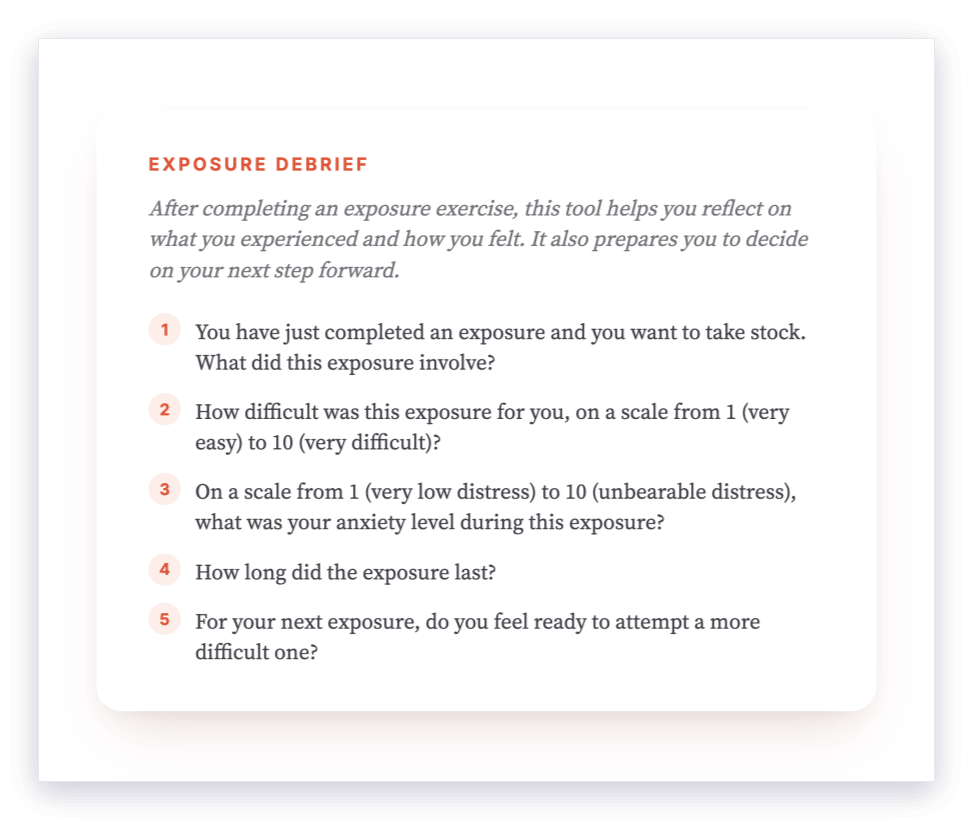
This five-question structured homework exercise guides the patient through a systematic debrief of a single completed exposure. The first question anchors the report concretely: the patient describes what the exposure consisted of, preventing vague or global accounts. Questions two and three collect two distinct ratings that clinicians in exposure work know carry different information: the perceived difficulty of the situation itself (1 to 10) and the anxiety level actually experienced during it (1 to 10). These are not the same measure, and having both in writing gives you material to work with. Question four records the duration of the exposure, a variable directly relevant to habituation and to tracking whether patients are cutting exposures short. The fifth question invites the patient to assess their own readiness to progress to a harder step, making the hierarchy feel self-directed rather than clinician-imposed.
The image above lists all five questions in order, with a brief introductory framing. This is a static preview only. The full guided exercise, with patient-facing instructions and space to write responses, is experienced by the patient on their own in the app, not in this image.
This exercise is available to patients through the mobile patient app of SessionFuel: once you assign it, your patient completes it directly on their phone, on their own, between consultations, and you receive their responses before the next session.
750+ clinical tools
A library built with and for clinicians, ready to use in session and extend between appointments.
Access all the toolsHow to integrate this as between-session work
Patient profile. This exercise suits any patient engaged in graded exposure therapy, whether for specific phobias, social anxiety, panic disorder, agoraphobia, health anxiety, or OCD. It works particularly well once the patient has a personal exposure list already built and has completed at least one autonomous attempt.
How to introduce it. Frame it simply: after each exposure the patient carries out on their own, they open the app and answer the five questions immediately, or as soon as practical. Emphasise that the goal is not a perfect account but an honest snapshot taken close to the moment. You can normalise that both ratings, difficulty and anxiety, may surprise them. For patients working on comfort and stretch zones, this exercise becomes a concrete measure of where each step actually sits.
What to do with what they bring back. When the patient's responses arrive, look first at the gap between difficulty and anxiety ratings: a step rated 8 in difficulty but only 5 in anxiety is evidence that the feared catastrophe did not materialise at the predicted intensity, a powerful cognitive lever. Duration data flags avoidance-via-brevity. The fifth question, about readiness to progress, often surfaces ambivalence worth exploring directly. You can also pair completed reports over time with the Anxiety Self-Monitoring exercise to build a visible trajectory of change, or use the debriefs alongside the Coping Strategy Effectiveness worksheet to examine which approaches the patient used during the exposure itself.
Key insight: The structured debriefing record transforms exposure from a vague experience into clinical data: two numeric ratings, a duration, and the patient's own readiness appraisal, all captured between sessions and ready to drive the next step.
Use it with your patients
Share this tool in the mobile app and follow the work between sessions.
Adaptations and articulations worth knowing
For patients with social anxiety safety behaviours, consider adding a brief verbal prompt at the session to explore whether any safety behaviours were used during the exposure, since the exercise as written captures intensity and duration but not behavioural strategy. For patients working through fear of body sensations or interoceptive exposures, the anxiety rating in question three takes on particular clinical weight and deserves close attention. For younger patients or those new to the exposure rationale, grounding the exercise in the Facing Fears in Children worksheet first can ease the transition to autonomous self-monitoring.
Your session continues in your patients' pocket
Use with a patientYour resources, available everywhere
The handouts, exercises, programs and audios above: you choose which ones to make available to your patients, in the mobile app dedicated to them.
And far more than a library
The app goes well beyond resources, to support your patients every day:
Related categories
Explore other clinical resources by category.

Anxiety
Clinical hub for anxiety disorders: CBT and ACT worksheets, psychoeducation sheets, and exercises for assessment and treatment across the anxiety spectrum.

Exposure
Exposure therapy clinical resources for practitioners: worksheets, hierarchies, and psychoeducation tools for anxiety, PTSD, OCD, and avoidance-based presentations.

CBT
CBT worksheets, cognitive restructuring exercises & behavioral tools for clinicians. Evidence-based resources for every phase of cognitive behavioral therapy.

Trauma
Clinical hub on trauma and PTSD: assessment, differential diagnosis, treatment phases, and printable resources for practitioners. 155 chars.

Mood
Evidence-based worksheets and clinical tools for mood disorders: CBT, ACT, and positive psychology resources for psychologists and therapists.

Identity
Clinical resources for self-identity work in therapy: CBT, ACT, schema tools for clinicians addressing self-concept, core beliefs, and identity disruption.