
Clinical picture. M., a woman in her late thirties, completed a course of CBT for panic disorder with agoraphobia; she had progressively restricted her travel radius over two years before presenting. In the final two sessions, the clinician introduced the Therapy Blueprint worksheet, guiding M. to document, in her own words, the maintaining loop she had identified (avoidance followed by short-term relief followed by a narrower comfort zone), the behavioural experiments that had shifted her most, and the early warning signs she had learned to recognise. M. engaged readily with the past and present sections but initially left the future section sparse, saying she preferred not to think about relapse. The clinician normalised this, framing the slip-versus-slide distinction not as anticipating failure but as extending the work she had already done. At a three-month follow-up, M. reported having re-read the blueprint once after a difficult week and described it as "recognising my own handwriting on the wall before it got worse."
Therapy Blueprint: PDF Worksheet, Tools and Exercises for Clinical Practice
A printable psychoeducation tool helping clinicians consolidate therapeutic gains, anchor relapse prevention, and give patients a durable written reference before or after termination.
Clinical vignettes
Blueprint as Discharge Anchor
Consolidating Gains After Social Anxiety Treatment
Clinical picture. T., a man in his mid-twenties, had attended twelve sessions targeting social anxiety, with particular focus on safety behaviours and belief testing around negative evaluation. As termination approached, the clinician offered the Therapy Blueprint worksheet as a structured way to capture what T. had found genuinely useful, rather than what sounded clinically correct. T. completed the beliefs-tested section in detail, noting that declining two social invitations in one week had not resulted in the feared rejection, and he recorded this outcome in his own phrasing alongside the coping phrases that had resonated with him during sessions. The process itself appeared to consolidate his gains; articulating the maintaining loop in writing prompted a short discussion about one pattern he had not previously named. The clinician kept a copy in the clinical record and T. retained his, with a shared agreement on the specific sign that would prompt him to make contact again.
Patients leave therapy with genuine insight and hard-won skills, then encounter a stressful month and quietly unlearn most of it. Not because the work was shallow, but because stress degrades access to declarative memory, and nothing was written down in their own voice, at their clearest. This Therapy Blueprint PDF addresses exactly that gap: a structured visual support you co-construct with the patient in session, so they leave with a portable, personal reference rather than a vague memory of what helped.
Use this resource with your patients
Handout, exercises and materials ready to use, right inside SessionFuel.
Why Gains Are So Hard to Hold Without a Written Anchor
The consolidation problem is well documented across CBT outcome research. Patients often show solid in-session recall of what shifted, yet real-world transfer is patchy, particularly under conditions of stress or physiological arousal. The therapeutic relationship itself can inadvertently become a safety behaviour: gains feel stable because the clinician is there, not because the patient has independently internalised them.
A verbal summary at the end of treatment rarely solves this. The cognitive load of termination, combined with the emotional weight of ending, means patients absorb a fraction of what you say. What holds is a document in their own voice, built while they were still thinking clearly, that they can reread on a bad evening without requiring a session.
What the Fiche Contains, and Why the Visual Structure Matters
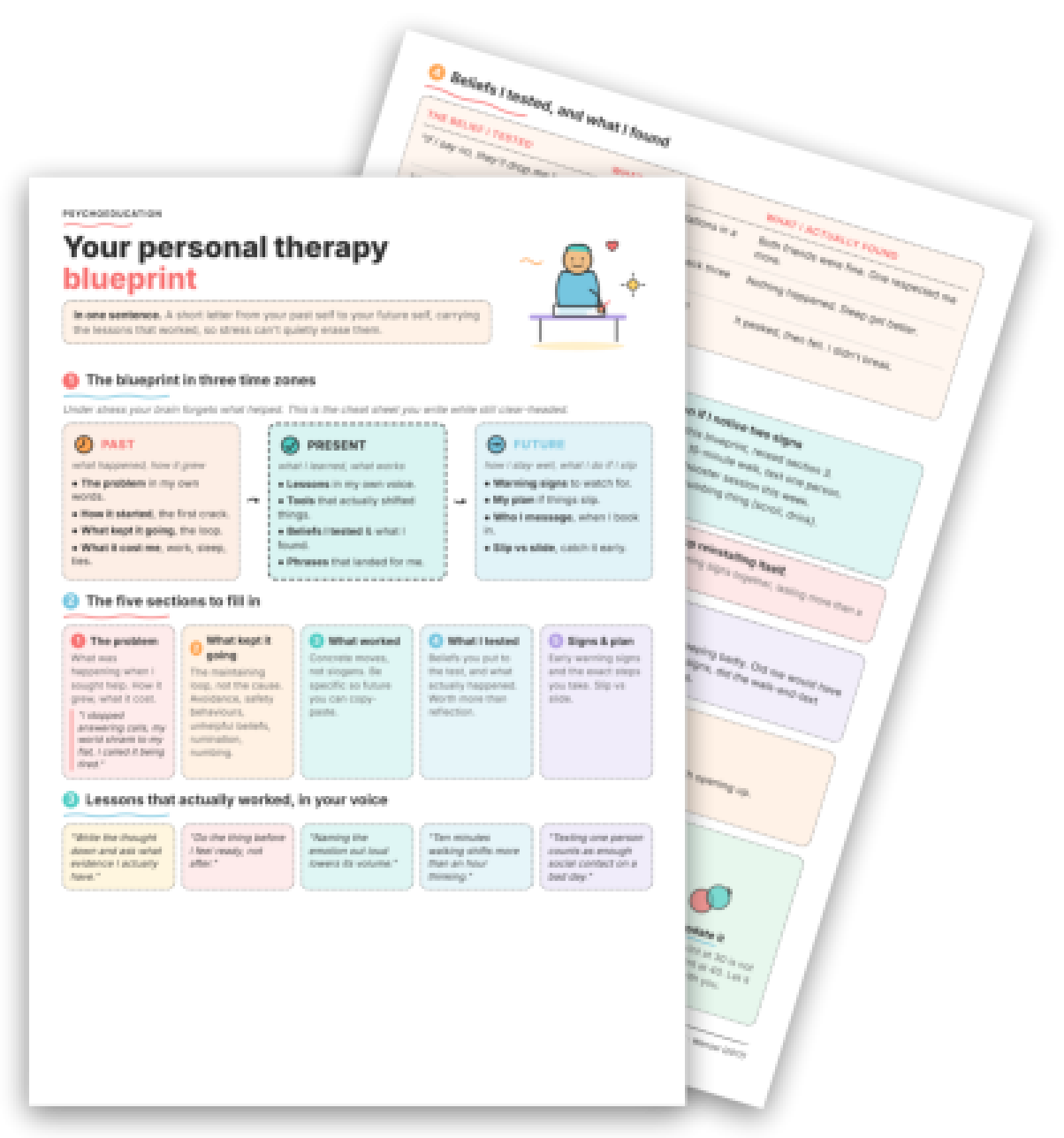
The Therapy Blueprint PDF is a structured visual support organised around three time zones: Past (what happened and how it grew), Present (what was learned and what concretely shifted), and Future (warning signs and a step-by-step plan). This three-column layout does something an oral summary cannot: it makes the temporal arc of the patient's work visible at a glance, and separates maintaining loops from causes, a distinction that is clinically important and frequently collapsed by patients when talking unassisted.
The fiche then scaffolds five sections for the patient to fill in: the problem in their own words, what kept it going, what worked, beliefs they tested and what they found, and early warning signs with an exact plan. The beliefs section takes the form of a visual table with three columns ("The belief I tested," "What I did," "What I actually found"), structured as behavioural experiments. Completed with the patient during session, this table is far more potent than a therapist's oral account of what shifted, because the evidence comes from the patient's own tested behaviour, not from your clinical formulation.
A short slip-versus-slide distinction is built into section 5: "A slip, one bad day or week. Normal. Expected. Doesn't mean therapy didn't work. A slide, the loop reinstalling itself." Having this written and visible interrupts catastrophic appraisal of relapse early, before it compounds.
> Key takeaway: The Therapy Blueprint is a visual support that facilitates psychoeducation in session, not an autonomous homework form. You build it with the patient while still working together, so the final document reflects their language, their examples, and their tested evidence.
750+ clinical tools
A library built with and for clinicians, ready to use in session and extend between appointments.
Access all the toolsWhen and How to Introduce It in Session
The optimal moment is two to four sessions before planned termination, when gains are consolidated enough to name concretely but the therapeutic relationship is still active enough to workshop the wording together. Introducing it too early produces generic answers; too late, and there is no time to revisit and sharpen it.
For patients who resist tracking their own progress, frame it plainly: "We're going to write you a cheat sheet, in your words, for the version of you who's having a rough week three months from now." This reframe sidesteps the self-monitoring anxiety some patients carry and positions the document as a practical tool rather than a test.
The fiche includes a "To discuss in session" block pointing to three clinical uses: co-sharpening the wording, working with avoidance of section 2 (maintaining loops), and scheduling rereading dates. Section 2 avoidance is worth naming explicitly; patients who skip what kept it going are often still running partial avoidance or safety behaviours, and that resistance is clinically useful data.
Condition-specific versions exist for OCD, panic disorder, and social anxiety, each with tailored maintaining-loop language. The universal version works across presentations and integrates naturally alongside longitudinal case formulation work or a life narrative exercise. For patients who benefit from a forward-projection component, pairing it with the Speaking to Your Future Self exercise deepens the temporal anchoring.
The fiche does not replace the formulation, the relational work, or the follow-up plan. It gives the patient something to hold when those are no longer available.
Use it with your patients
Share this tool in the mobile app and follow the work between sessions.
Sources
- Fennell, M. J. V. (1989). Depression. In K. Hawton, P. M. Salkovskis, J. Kirk, & D. M. Clark (Eds.), Cognitive Behaviour Therapy for Psychiatric Problems: A Practical Guide (pp. 169-234). Oxford University Press.
- Wells, A. (1997). Cognitive Therapy of Anxiety Disorders: A Practice Manual and Conceptual Guide. Wiley.
- Beck, J. S. (2020). Cognitive Behavior Therapy: Basics and Beyond (3rd ed.). Guilford Press.
Your session continues in your patients' pocket
Use with a patientYour resources, available everywhere
The handouts, exercises, programs and audios above: you choose which ones to make available to your patients, in the mobile app dedicated to them.
And far more than a library
The app goes well beyond resources, to support your patients every day:
Related categories
Explore other clinical resources by category.

Anxiety
Clinical hub for anxiety disorders: CBT and ACT worksheets, psychoeducation sheets, and exercises for assessment and treatment across the anxiety spectrum.

Mood
Evidence-based worksheets and clinical tools for mood disorders: CBT, ACT, and positive psychology resources for psychologists and therapists.

Cognition
Printable cognitive therapy worksheets and clinical tools for therapists: CBT, ACT, schema work, defusion, distortions, and belief restructuring.

Understand
Clinical hub for the therapeutic aim 'Understand': worksheets and tools to build patient insight across CBT, ACT, schema therapy and more.

Build awareness
Clinical worksheets and tools to build awareness in therapy: cognitive distortions, schemas, emotions, ACT and CBT resources for practitioners.

Prevent relapse
Prevention as a therapeutic aim: clinical framing, risk stratification, and printable resources for relapse prevention and early intervention in mental health.