
Clinical picture. M., a 34-year-old logistics worker, presented with intrusive images and hypervigilance eighteen months after a serious road accident; he had avoided driving since. He met criteria for single-incident PTSD and had no current dissociative symptoms or active suicidality, making him a suitable candidate for the Rewind technique. The clinician spent the first part of the session on grounding, then walked M. through the cinema metaphor step by step, pausing after each position to confirm he felt settled before proceeding. M. ran the memory forward and then rewound it rapidly four times; he reported the image feeling "further away, like something that happened to someone else." At two-week follow-up his PCL-5 score had dropped by eleven points, and he had driven short distances twice without a panic response.
Rewind Technique for PTSD: PDF Worksheet, Tools and Exercises
A printable psychoeducation fiche to explain the Rewind Technique in session, give patients a visual map of each step, and lay the groundwork for trauma processing.
Clinical vignettes
Road Accident Memory, Single Session
Childhood Incident, Avoidant Presentation
Clinical picture. T., a woman in her mid-forties, sought therapy for chronic sleep disruption and a persistent startle response tied to a single episode of witnessed violence in childhood; she had never discussed it in detail and was unwilling to engage in prolonged exposure. The clinician introduced the Rewind technique as a way to work with the memory without requiring a verbal narrative, framing it as creating distance rather than reliving. T. engaged tentatively, required two preparatory sessions to consolidate grounding skills, and on the third attempt completed the full rewind sequence. She noted the memory still existed but no longer "played on its own." Nighttime intrusions reduced in frequency over the following month, and she was able to tolerate brief, therapist-guided discussion of the event for the first time.
Explaining the Rewind Technique to a patient who has never encountered image-based trauma work can stall quickly: the procedure sounds unusual, the rationale for running a memory backwards feels counterintuitive, and a purely verbal walkthrough rarely conveys the structured distance the method is designed to create. This fiche PDF gives you a ready visual scaffold to present the technique clearly during the session itself, reducing confusion and securing informed consent before any trauma contact begins.
Use this resource with your patients
Handout, exercises and materials ready to use, right inside SessionFuel.
Why the Rewind Technique Resists Verbal Explanation Alone
The core clinical challenge is one of credibility and pacing. Patients who have been flooded by intrusive reexperiencing, as mapped in frameworks like the Ehlers & Clark PTSD model, often arrive with a binary expectation: either they must narrate everything in full, or they must stay completely away from the memory. The Rewind Technique sits precisely between those poles, and that "middle path" rationale is difficult to convey in abstract language.
The reconsolidation window is equally hard to explain without something the patient can look at. Saying "a briefly reactivated memory becomes temporarily editable" sounds speculative unless it is anchored to a concrete mechanism. Add to this the three-position cinema structure (audience seat, screen, projection booth), and you have a procedure that benefits enormously from a spatial visual. Without one, clinicians often spend the first part of the session managing confusion rather than building the alliance and grounding needed before any trauma-proximate work begins.
What the Fiche Contains: A Visual Support for In-Session Explanation
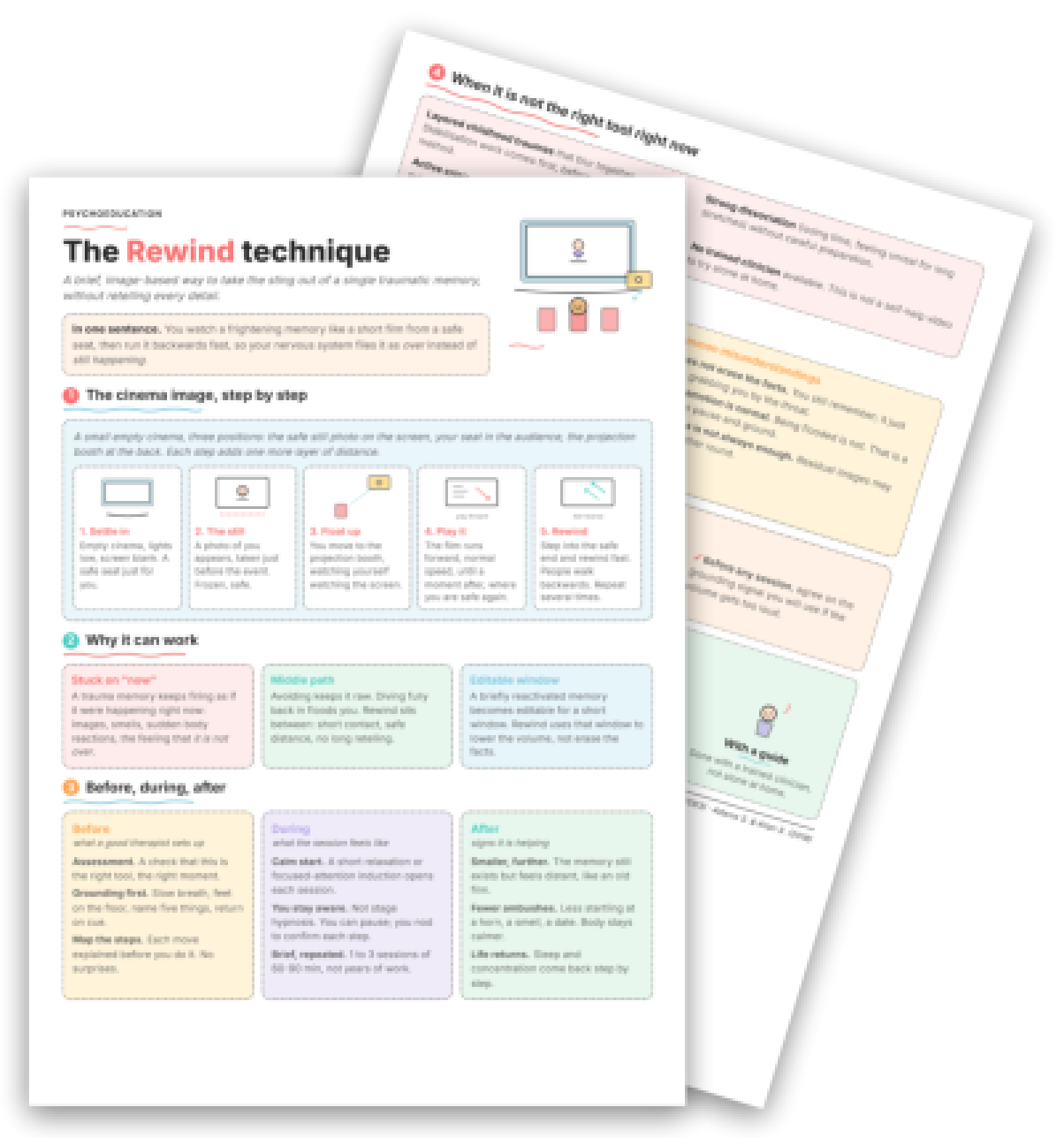
The fiche is organized into five numbered panels, each serving a distinct preparatory or psychoeducational function. Panel 1 presents the cinema metaphor step by step: "A small empty cinema, three positions: the safe still photo on the screen, your seat in the audience, the projection booth at the back." The five steps (Settle in, The still, Float up, Play it, Rewind) are laid out sequentially, with directional cues ("play forward," "fast reverse") that let the patient track exactly where they are in the procedure before it begins.
Panel 2 explains the mechanism in plain language: the "stuck on now" quality of trauma memory, why avoidance keeps the memory raw, and why brief reactivation followed by rapid reversal can lower its affective charge. This gives you language to normalize the approach without overloading the patient with neuroscience.
Panel 3 structures the before/during/after arc, which is clinically useful for setting realistic expectations around session length (60-90 minutes, one to three sessions) and what "it is helping" actually looks like: "Smaller, further. The memory still exists but feels distant, like an old film." Panels 4 and 5 address contraindications directly, list ready-to-hold phrases for patients to keep, and flag common misunderstandings ("It does not erase the facts"). The fiche closes with a short "To discuss in session" checklist the clinician and patient can review together.
As a support visuel, the fiche does what oral explanation cannot: it shows the spatial logic of the three-position cinema in a single glance, makes the sequencing of steps tangible, and lets the patient carry home a concrete reference rather than a set of verbal instructions they may misremember.
> Key point: The fiche is not a self-directed workbook. It is a psychoeducation support the clinician uses in session to make the Rewind procedure comprehensible before any trauma contact begins, then leaves with the patient as a reference between appointments.
750+ clinical tools
A library built with and for clinicians, ready to use in session and extend between appointments.
Access all the toolsWhen and How to Introduce the Fiche
This fiche fits naturally at the beginning of the first Rewind session, after thorough assessment has confirmed the technique is appropriate: a single-event memory, PTSD symptoms that include clear intrusive images, no current active crisis, and manageable dissociation. It is contraindicated, as the fiche itself states, where layered childhood traumas blur together or where strong dissociation is insufficiently stabilised. For complex presentations, Complex PTSD tools and stabilisation work take precedence.
Before distributing it, you might introduce it as: "I'd like to show you a diagram of how we'll approach this memory, so there are no surprises. We'll go through each step together before we do anything." That framing positions the fiche as a map, not an instruction sheet for solo use.
When debriefing, use Panels 3 and 5 to review the patient's experience: how "distant" the memory now feels, whether residual images warrant another round, and which phrases from the fiche they found most useful. Connecting this work to how trauma memories form and consolidate, or to the somatic dimension of threat responses, deepens the psychoeducation over successive sessions.
For the grounding preparation every Rewind session requires, grounding techniques make a practical companion resource. Where EMDR is already part of the care plan, the EMDR cognitions worksheet can complement the rewind by formalising the negative and positive cognitions tied to the target memory.
The fiche does not replace clinical judgment or the relational groundwork that makes any trauma procedure safe. It makes the explanation clearer and leaves the patient with a concrete reference, which is precisely where it earns its place in the session.
Use it with your patients
Share this tool in the mobile app and follow the work between sessions.
Sources
- Adams, S., Allan, S. (2020). Four practice-based preliminary studies on Human Givens Rewind treatment for posttraumatic stress in Great Britain. F1000Research.
- Bandler, R. (1985). Using Your Brain for a Change. Real People Press.
Your session continues in your patients' pocket
Use with a patientYour resources, available everywhere
The handouts, exercises, programs and audios above: you choose which ones to make available to your patients, in the mobile app dedicated to them.
And far more than a library
The app goes well beyond resources, to support your patients every day:
Related categories
Explore other clinical resources by category.
Trauma
Clinical hub on trauma and PTSD: assessment, differential diagnosis, treatment phases, and printable resources for practitioners. 155 chars.

Exposure
Exposure therapy clinical resources for practitioners: worksheets, hierarchies, and psychoeducation tools for anxiety, PTSD, OCD, and avoidance-based presentations.

Process trauma
Clinical resources to process trauma: worksheets, psychoeducation, and exercises for trauma-focused practitioners working with PTSD and complex presentations.

CBT
CBT worksheets, cognitive restructuring exercises & behavioral tools for clinicians. Evidence-based resources for every phase of cognitive behavioral therapy.

EMDR
Clinical hub for EMDR therapy resources: worksheets, stabilisation tools, and guided audio for all 8 phases of trauma reprocessing. For trained clinicians.

Anxiety
Clinical hub for anxiety disorders: CBT and ACT worksheets, psychoeducation sheets, and exercises for assessment and treatment across the anxiety spectrum.