
Clinical picture. A woman in her late thirties, referred to here as P., presents with recurrent intrusive images of being left alone as a young child while a parent was intoxicated. Standard cognitive work had reduced her avoidance somewhat, yet the images remained vivid and were accompanied by intense shame. The clinician introduced imagery rescripting as a structured way to revisit the scene without simply retelling it, explaining the three-phase model and the rationale that a new imagined ending leaves a real emotional trace. In the session, P. brought the scene to life in the present tense, locating herself in the original room and noticing the body sensations she carried as a seven-year-old. Her adult self then stepped into the image, removed the child from the situation, and spoke words the child had never received: "This is not yours to carry." At the following appointment, P. reported that the image still arose but felt less charged, and she had begun, cautiously, to question the shame-based meaning she had long attached to the memory.
Imagery Rescripting: PDF Worksheet, Tools and Exercises for Clinical Practice
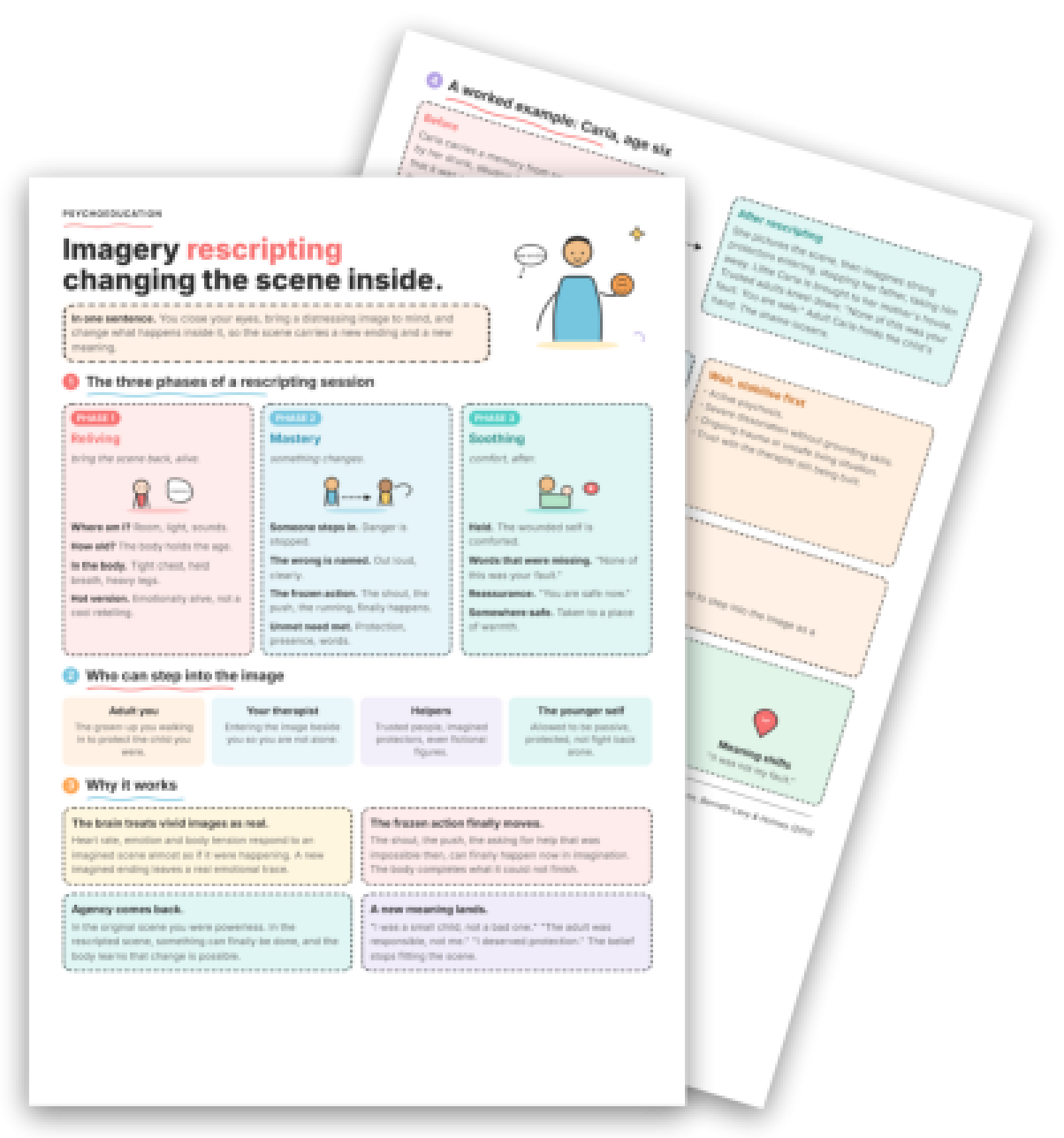
A visual psychoeducation worksheet clinicians can use in session to explain the three-phase rescripting structure, ground the procedure in mechanism, and prepare patients for imagery work.
Clinical vignettes
Rescripting a Childhood Scene of Neglect
Using a Therapist Figure in the Image
Clinical picture. M., a man in his mid-forties with a long history of complex trauma, found it difficult to generate any compassionate figure from his own life to enter a distressing scene involving early physical threat. The clinician normalized this, noting that the person stepping into the image can be the therapist, a trusted helper, or even a fictional protector. With agreement, M. invited an imagined version of the clinician into the scene: the figure stood between the child and the source of threat, named the wrong clearly, and offered physical and verbal reassurance the child had never received. M. described a noticeable shift in body tension during the rescripting and, afterward, articulated for the first time that the responsibility had belonged to the adult in the room, not to him. Progress remained gradual, though he engaged more consistently with subsequent sessions and reported fewer overnight intrusions over the following two weeks.
Explaining imagery rescripting verbally rarely lands on the first attempt: patients nod, leave with a vague sense of "changing a memory," and arrive at the next session having misunderstood the procedure entirely. This imagery rescripting PDF worksheet gives you a structured visual support to walk through the mechanics in session, establishing shared vocabulary and realistic expectations before any imagery work begins.
Use this resource with your patients
Handout, exercises and materials ready to use, right inside SessionFuel.
Why Imagery Rescripting Resists Verbal Explanation
The core difficulty is not unfamiliarity with the concept. It is the gap between what the patient imagines ("editing a memory like a film") and what the technique actually demands: deliberate re-entry into a hot, body-level representation, not a detached cognitive retelling. Patients who have only heard the procedure described tend to approach it observationally, staying cool precisely when the protocol requires affective presence, tight chest, held breath, heavy legs, as the fiche puts it.
A second obstacle is the shame-and-blame dimension. Work grounded in Arntz and Weertman (1999) consistently shows that patients presenting with childhood trauma or early maladaptive schemas, particularly defectiveness and shame patterns, carry the conviction that the original scene reflects something true about who they are. Explaining in words that "meaning can shift" rarely moves that belief. Showing a patient exactly where meaning change occurs within the three-phase structure is faster and more credible.
There is also the who-steps-in question. Without a visual anchor, the available protector figures get conflated, and patients default to whichever option feels least threatening rather than whichever is clinically indicated.
What the Fiche Contains: A Visual Map of Three Phases
The fiche is built around five numbered panels. The centrepiece maps Phase 1 (Reliving), Phase 2 (Mastery), and Phase 3 (Soothing) with concrete sensory and somatic anchors at each step. For Reliving: "Where am I? Room, light, sounds. How old? The body holds the age." For Soothing, the fiche names the specific words that were missing: "None of this was your fault" and "You are safe now." Seeing this sequence laid out visually, rather than hearing it as a verbal list, makes the phase boundaries legible and reduces the most common source of procedural confusion.
A second panel maps who can step into the image: adult self, the therapist entering in imagination, trusted helpers, and the explicit protection of the younger self. Shown as a visual set of options, this panel surfaces the who question early and economically, before it stalls the session.
The panel on why it works draws on Holmes and Mathews (2010): the brain responds to vivid imagery almost as if it were live, so a rescripted ending leaves a genuine emotional trace, the frozen action finally completes, and agency returns. Patients who understand this mechanism engage the procedure as clinically grounded rather than arbitrary.
A clinical indicators panel covers relevant presentations: PTSD with a clear hotspot, complex trauma and childhood abuse, intrusive images and recurring nightmares, social anxiety structured around a vivid scene of being judged, depression with intrusive memories, and eating distress with strong imagery components. The wait / stabilise first column, active psychosis, severe dissociation, unsafe living situation, alliance still forming, is equally explicit.
> Key point: The fiche is a visual psychoeducation support you work through with the patient in session, not a self-report tool completed alone. Its layout externalises the three-phase structure so the patient can hold it as a reference while you introduce the procedure, a genuine clinical time-saver.
750+ clinical tools
A library built with and for clinicians, ready to use in session and extend between appointments.
Access all the toolsWhen and How to Propose It
The fiche fits naturally in the psychoeducation phase, once a working alliance is established and the formulation points toward schema-level or trauma work. For patients presenting with PTSD, introduce it after stabilisation, after grounding skills are in place and trauma memory properties have been explained, and before the imagery protocol itself. For clinicians working with EMDR (EMDR negative and positive cognitions), the mastery phase maps cleanly onto positive cognition installation; the parallel is worth naming explicitly.
A clean framing: "Before we do this together, I want to show you exactly what we'll be doing and why. There's a sheet that maps it out in stages." After reviewing the fiche, ask specifically about the who-steps-in panel. Patients who hesitate over the protector figure often carry mistrust schemas or an abandonment-related core belief that needs attention before imagery work proceeds safely. The fiche makes that clinical information surface earlier, in a low-stakes moment.
For patients simultaneously engaged in schema cognitive restructuring, you can draw an explicit link between the soothing phase and the healthy adult mode, using the fiche as a bridge between cognitive and experiential interventions rather than treating them as separate tracks.
The fiche does not replace a formal case formulation or supervision. It renders one technically demanding intervention legible and negotiable before the patient ever closes their eyes.
Use it with your patients
Share this tool in the mobile app and follow the work between sessions.
Sources
- Smucker, M. R., Dancu, C. V. (1999). Cognitive-Behavioral Treatment for Adult Survivors of Childhood Trauma: Imagery Rescripting and Reprocessing. Jason Aronson.
- Hackmann, A., Bennett-Levy, J., Holmes, E. A. (2011). Oxford Guide to Imagery in Cognitive Therapy. Oxford University Press.
Your session continues in your patients' pocket
Use with a patientYour resources, available everywhere
The handouts, exercises, programs and audios above: you choose which ones to make available to your patients, in the mobile app dedicated to them.
And far more than a library
The app goes well beyond resources, to support your patients every day:
Related categories
Explore other clinical resources by category.

Anxiety
Clinical hub for anxiety disorders: CBT and ACT worksheets, psychoeducation sheets, and exercises for assessment and treatment across the anxiety spectrum.

Trauma
Clinical hub on trauma and PTSD: assessment, differential diagnosis, treatment phases, and printable resources for practitioners. 155 chars.

Mood
Evidence-based worksheets and clinical tools for mood disorders: CBT, ACT, and positive psychology resources for psychologists and therapists.

Understand
Clinical hub for the therapeutic aim 'Understand': worksheets and tools to build patient insight across CBT, ACT, schema therapy and more.

Process trauma
Clinical resources to process trauma: worksheets, psychoeducation, and exercises for trauma-focused practitioners working with PTSD and complex presentations.

CBT
CBT worksheets, cognitive restructuring exercises & behavioral tools for clinicians. Evidence-based resources for every phase of cognitive behavioral therapy.