
Clinical picture. A father in his early forties presented with concerns about his seven-year-old son's chronic morning irritability; the child had no formal diagnosis, but transitions were consistently dysregulated and the father reported feeling helpless. During a parent guidance session, the clinician introduced the Family Mindfulness Schedule and worked with him to identify the car ride as an already-existing anchor moment. Rather than teaching the child directly, the father was asked to begin the I Spy colour-scanning exercise himself, narrating aloud without any expectation of participation. By the third session the son was initiating the game unprompted, and the father noted that mornings felt less adversarial, though overall dysregulation remained a work in progress.
Family Mindfulness Schedule: PDF Worksheet, Tools and Exercises
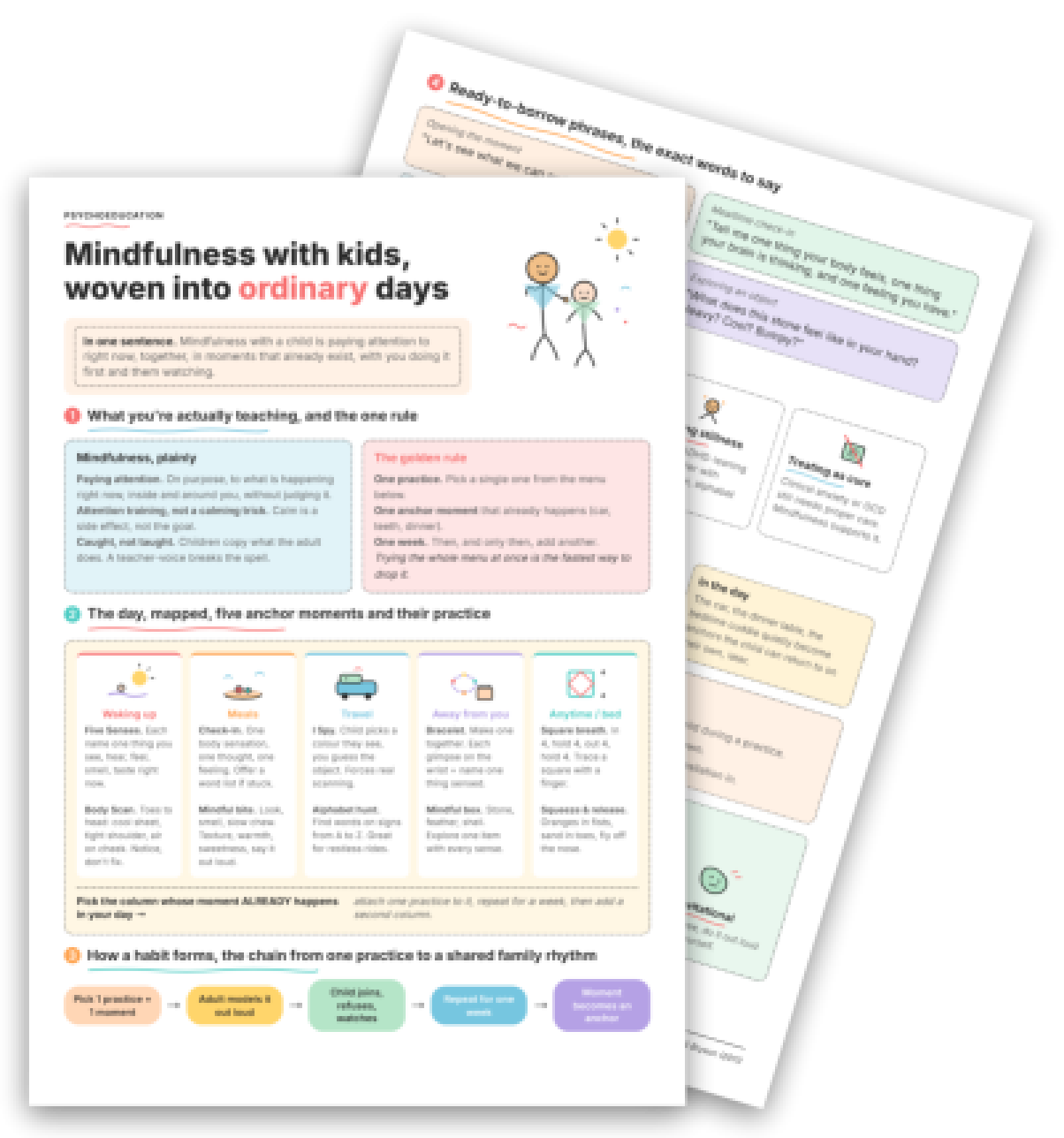
A visual fiche to help clinicians explain how mindfulness fits into ordinary family life, with anchor moments, ready phrases, and habit-formation steps.
Clinical vignettes
Anchoring Practice to the School Run
One Practice, One Week
Clinical picture. A mother of two children aged nine and eleven sought support following a period of family stress; she arrived at session having already downloaded several mindfulness apps and attempted daily formal meditation with the children, which had collapsed within days. The clinician used the Family Mindfulness Schedule to reframe the goal: not a new routine, but one practice attached to dinner, which already happened. She chose the Check-In sequence, offering a printed word list for body sensations and feelings. At follow-up she reported that one child engaged inconsistently while the other adopted it readily; the clinician normalised the asymmetry and held the single-practice boundary for a further week before any expansion was considered.
When parents arrive having "tried mindfulness with the kids" and abandoned it within a week, the problem is rarely motivation. It is almost always that they received a concept, not a structure. This fiche PDF gives you a concrete visual scaffold to use in session so parents leave with a working plan, not just an idea.
Use this resource with your patients
Handout, exercises and materials ready to use, right inside SessionFuel.
Why Family Mindfulness Resists Verbal Explanation in Session
Mindfulness is genuinely difficult to convey to parents in a consulting room. The word itself carries weight, and most parents hear it as either a quasi-spiritual practice or a calming technique reserved for meltdowns. Both framings lead to the same dead end: the parent tries it once under stress, it fails, and the whole experiment is dropped.
The deeper clinical obstacle is that parents underestimate how much modelling drives the process. When you explain at the oral level that children copy co-regulation, it makes intellectual sense. What parents cannot see from a verbal explanation is exactly when in their day to practice, which specific micro-practice fits that moment, and what to say to open it without triggering a protest. Those three gaps, moment, practice, and phrasing, are precisely where consistency collapses.
Working with children's anxiety programs or parenting fundamentals curricula, you have likely noticed that parents need their psychoeducation broken into steps small enough to execute without thinking. That is what this fiche does for family mindfulness practice.
750+ clinical tools
A library built with and for clinicians, ready to use in session and extend between appointments.
Access all the toolsWhat the Fiche Contains: A Visual Map of Five Anchor Moments
The Family Mindfulness Schedule is structured around the core pedagogical problem: mindfulness does not need a new time slot, it needs to attach to moments that already exist. The fiche makes this visible across five daily anchors, waking up, meals, travel, time away from the parent, and bedtime, each paired with two concrete practices.
For waking up, the fiche proposes Five Senses ("each name one thing you see, hear, feel, smell, taste right now") and a light body scan from toes to head. For the car or public transit, it offers I Spy and an alphabet hunt, both of which redirect a restless child's attention outward without announcing a mindfulness session. For separation moments, there is the bracelet anchor: make one together, and each glimpse on the wrist becomes a cue to name one sensed thing. For bedtime, square breathing ("in 4, hold 4, out 4, hold 4, trace a square with a finger") and a squeeze-and-release body exercise round out the menu.
The visual layout, five columns the parent can literally point to and pick from, does what oral explanation cannot: it shows that one practice attached to one existing moment is enough to start. The fiche also maps the habit-formation chain explicitly: pick one practice, adult models it out loud, child joins or watches, repeat for one week, moment becomes an anchor. Parents can follow this chain on paper, which reduces the cognitive load in those first days.
A dedicated panel on common traps flags four failure modes with direct, non-euphemistic language: slipping into a teacher voice, reaching for the practice only at meltdown, expecting stillness, and treating mindfulness as a clinical intervention for anxiety or OCD. That last point matters for your work with children presenting with obsessive or anxious profiles, where the fiche explicitly directs parents to maintain proper clinical care alongside the schedule.
The fiche closes with a "To discuss in session" section, giving you three ready-made debriefing prompts to use at the next appointment.
> Key point: The fiche is a visual support that facilitates the explanation of family mindfulness in session. It is not a questionnaire for the parent to fill in alone at home. You use it together, pointing to the five anchor columns, selecting one practice, and walking through the habit chain before the parent leaves. The fiche then goes home as a reference, not a task.
Use it with your patients
Share this tool in the mobile app and follow the work between sessions.
When and How to Introduce the Fiche
This fiche fits best at the transition point between psychoeducation and implementation, typically the session after you have established why mindfulness with children works (modelling, co-regulation, attentional training). At that point you can say simply: "I have a one-pager that maps your day and shows you exactly where one practice fits. Let's look at it together and pick one column."
It is particularly well-suited for parents of children with ADHD profiles, where the movement-compatible practices (bracelet, box, alphabet hunt) work better than stillness-based ones. It is also useful alongside parent-child communication programs and belly breathing exercises for kids when you want to build a coherent between-session skill set.
One productive debrief question, drawn directly from the fiche's own "To discuss in session" section: "Did you notice yourself slipping into a teacher voice? What was happening in the room when that happened?" That question often opens a productive conversation about the parent's own arousal regulation, which is, as the fiche notes, "half of co-regulation, before a single word is spoken."
Avoid proposing this fiche when the presenting child has active clinical anxiety or OCD that is not yet stabilized under treatment. The fiche itself flags this clearly: mindfulness supports clinical care, it does not replace it. In those cases, the building secure attachment and emotion regulation frameworks may carry more clinical weight first. The fiche does not replace the therapeutic frame; it makes one specific piece of psychoeducation concrete enough to actually land.
Your session continues in your patients' pocket
Use with a patientYour resources, available everywhere
The handouts, exercises, programs and audios above: you choose which ones to make available to your patients, in the mobile app dedicated to them.
And far more than a library
The app goes well beyond resources, to support your patients every day:
Related categories
Explore other clinical resources by category.
Anxiety
Clinical hub for anxiety disorders: CBT and ACT worksheets, psychoeducation sheets, and exercises for assessment and treatment across the anxiety spectrum.

Emotions
Clinical resources on emotion regulation: worksheets, coping tools, CBT, REBT, and ACT exercises for therapists working across diagnoses and age groups.

Relationships
Clinical worksheets and tools on relational functioning: attachment, schemas, assertiveness, and communication skills for therapists. Printable PDF resources.

Neurodevelopment
Clinical hub for neurodevelopmental disorders: psychoeducation, worksheets and intervention tools for ADHD, ASD, learning disorders and related conditions.

Build awareness
Clinical worksheets and tools to build awareness in therapy: cognitive distortions, schemas, emotions, ACT and CBT resources for practitioners.

Regulate
Clinical resources for emotion regulation: worksheets, ACT exercises, and psychoeducation tools for affect regulation across diagnoses. For clinicians.