
Clinical picture. M., a 38-year-old engineer referred for chronic tension headaches and low mood, describes himself as "not really an emotional person" and notes that colleagues find him difficult to read. In the first two sessions he answers questions about feeling states with brief, rationalised summaries, going visibly blank when pressed for anything more specific. The clinician introduces the informational sheet on emotional inhibition, framing it as a map of a learned pattern rather than a character trait. M. pauses at the sign "body carries it" and reports, unprompted, that his jaw is clenched most of the day and that he is exhausted after any team meeting. This recognition opens a working thread around the somatic cost of sustained suppression, which M. is willing to explore where direct affect work had felt premature.
Emotional Inhibition Schema: PDF Worksheet, Tools and Exercises
A printable PDF worksheet with clinical tools and exercises to explain the emotional inhibition schema in session, support schema identification, and introduce graded emotional expression.
Clinical vignettes
Flat Affect, Somatic Load
Warmth Avoidance in Couples Context
Clinical picture. D., a 45-year-old woman seen in individual therapy alongside couples work, reports that her partner describes her as cold and says she deflects every compliment with a joke or a subject change. She grew up in a household where visible distress was met with the instruction to "be reasonable," and she learned early that composure was the safest presentation. The clinician shares the psychoeducation sheet on emotional inhibition during a session focused on the couples feedback, pointing specifically to the section on caregivers who were shut down themselves. D. identifies the "rehearses, then flattens" pattern immediately, noting that she had planned to tell her partner she was grateful but said something neutral instead. Over the following weeks she begins to name this moment in session when it occurs, which gives the couples work a more concrete and less blame-laden vocabulary.
In schema therapy, emotional inhibition is one of the patterns that most reliably conceals itself inside the consulting room. Patients who habitually suppress warmth, anger, and vulnerability present as cooperative and composed, exactly the presentation that can delay recognition of the schema. This fiche PDF gives you a concrete visual support to name and explain the pattern directly in session, without waiting for an affective rupture to make it visible.
Use this resource with your patients
Handout, exercises and materials ready to use, right inside SessionFuel.
Why Emotional Inhibition Resists Oral Explanation
The early maladaptive schemas framework (Young, 2003) places emotional inhibition in the Overvigilance and Inhibition domain: the patient has learned that showing feelings is dangerous, humiliating, or simply not permitted. The clinical difficulty is that this schema is structurally self-concealing. The same patient who shuts down warmth at the door of your office also shuts down the distress that would otherwise prompt you to probe. They describe significant relational isolation or social anxiety in a measured, dry tone, and you register only a vague sense of absence in the room.
Naming it verbally rarely lands. Without an external reference, patients reframe inhibition as temperament ("I'm just an introvert"), character strength ("I don't let things get to me"), or even approval-seeking behavior repackaged as composure. A structured visual support shifts the frame from self-attribution to learned pattern, which is a far more workable starting point for schema-focused work.
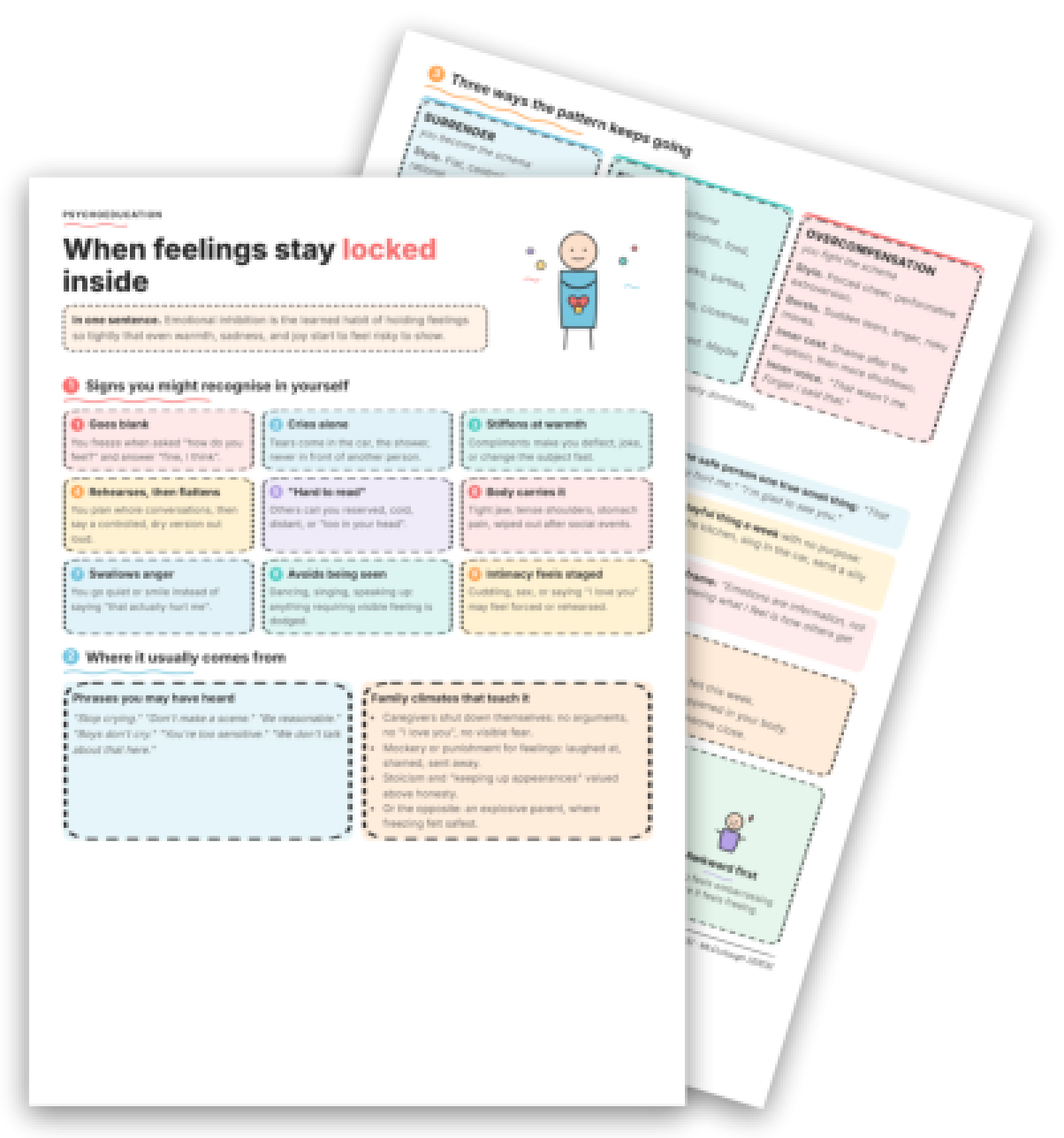
What the Fiche Contains: A Visual Map of the Schema
The fiche opens with a one-sentence formulation: "Emotional inhibition is the learned habit of holding feelings so tightly that even warmth, sadness, and joy start to feel risky to show." That framing, non-pathologizing and behaviorally grounded, is worth reading aloud before moving further.
The nine recognition signs panel is the first clinically productive section. Items range from "goes blank when asked how you feel" and "cries alone, never in front of another person" to "stiffens at compliments" and "body carries it" (tight jaw, held breath, exhaustion after social events). Laid out visually, these signs help patients recognize a systemic pattern rather than isolated quirks. Many identify five or six items without prompting, producing the schema recognition moment that oral description almost never achieves.
The origins panel pairs phrases patients may have heard ("Be reasonable," "Stop crying," "Boys don't cry") with five family climates, including the emotionally shut-down caregiver and, crucially, the explosive parent for whom freezing felt like the child's safest adaptation.
The structural center of the fiche is the three coping mode layout: surrender (hyper-rational, flat style with growing inner emptiness), avoidance (numbing through work, alcohol, or scrolling), and overcompensation (forced cheer, followed by shame after an emotional outburst). Each column names the behavioral style, the inner cost, and a representative inner voice. This three-column visual does what a verbal explanation cannot: it shows the patient that apparently opposite behaviors all serve the same inhibiting schema. Pair it with the coping styles in schema therapy worksheet for a fuller mode-based conceptualization, or with the 12 ACT schemas and modes reference for ACT-inflected work.
Six behavioral experiments follow, graded from minimal exposure ("Name one feeling out loud daily, even to yourself") toward relational disclosure ("Tell one safe person one true small thing"). The closing section, "To discuss in session," gives three concrete prompts, including "When the fear of losing control stopped you from saying something true to someone close."
> Key point: This fiche is a visual support that facilitates in-session explanation, not a self-administered questionnaire. You work through it with the patient; they take it home as a concrete reference, not as a task to complete alone.
750+ clinical tools
A library built with and for clinicians, ready to use in session and extend between appointments.
Access all the toolsWhen and How to Propose It
The fiche fits naturally into the schema identification phase, typically around the second or third session, once initial history-taking is complete. It also slots into standard CBT when core beliefs about self and others are clinically central, or when assertiveness work keeps stalling because the patient cannot access what they actually feel. It complements work with patients whose communication style is notably flat, or whose intimacy difficulties trace to affective unavailability rather than abandonment fear.
Target profiles: patients described by others as "hard to read," those presenting with somatic complaints (jaw tension, chronic fatigue) without clear organic etiology, and those with defectiveness or shame schemas carrying a strong affect-suppression component. If emotional vocabulary is limited, the 114-emotion wheel is a useful companion before starting section one.
Introduce it simply: "I'd like to show you a framework that many people find useful for understanding a pattern I'm noticing in what you've described. Let's go through it together." Avoid leading with the schema label until after the recognition signs section; letting the patient self-identify accelerates buy-in considerably. Debrief by asking which coping mode feels most dominant, and which of the six experiments feels minimally threatening enough to try before the next session. The fiche does not replace the therapeutic relationship; it makes the schema concrete enough to work with.
Use it with your patients
Share this tool in the mobile app and follow the work between sessions.
Sources
- Young, J. E., Klosko, J. S., Weishaar, M. E. (2003). Schema Therapy: A Practitioner's Guide. Guilford Press.
- Young, J. E., Klosko, J. S. (1994). Reinventing Your Life: The Breakthrough Program to End Negative Behavior and Feel Great Again. Plume / Penguin Books.
- Abdelrazek, M. N., El-Ashry, A. M., Abdelaal, H. M. (2024). The relationship between emotional inhibition, emotional deprivation, failure, vulnerability to harm schema, and severity of symptoms among patients with obsessive-compulsive disorder. BMC Psychiatry.
Your session continues in your patients' pocket
Use with a patientYour resources, available everywhere
The handouts, exercises, programs and audios above: you choose which ones to make available to your patients, in the mobile app dedicated to them.
And far more than a library
The app goes well beyond resources, to support your patients every day:
Related categories
Explore other clinical resources by category.

Identity
Clinical resources for self-identity work in therapy: CBT, ACT, schema tools for clinicians addressing self-concept, core beliefs, and identity disruption.

Emotions
Clinical resources on emotion regulation: worksheets, coping tools, CBT, REBT, and ACT exercises for therapists working across diagnoses and age groups.
Relationships
Clinical worksheets and tools on relational functioning: attachment, schemas, assertiveness, and communication skills for therapists. Printable PDF resources.

Understand
Clinical hub for the therapeutic aim 'Understand': worksheets and tools to build patient insight across CBT, ACT, schema therapy and more.

Build awareness
Clinical worksheets and tools to build awareness in therapy: cognitive distortions, schemas, emotions, ACT and CBT resources for practitioners.
CBT
CBT worksheets, cognitive restructuring exercises & behavioral tools for clinicians. Evidence-based resources for every phase of cognitive behavioral therapy.