
Clinical picture. A., a woman in her late thirties, presented with chronic work-related exhaustion and recurrent difficulty refusing requests from colleagues. She described feeling "pulled in all directions" and could not identify why she kept agreeing to tasks she resented. During a session focused on a recent episode, the clinician introduced the informational sheet on the twelve modes and invited her to read through the list slowly. A. stopped at mode six, "Please Others," and said quietly, "That's exactly it, that's what happens every time." The clinician did not move immediately to intervention; instead, both spent time practising the labelling sentence aloud: "The Please-Others mode is running." At the following session A. reported that naming the mode twice during the week had created, in her words, "a half-second where I could actually think" before responding to a colleague's request.
12 ACT Schemas and Modes: PDF Worksheet, Tools and Exercises
A visual PDF worksheet with tools and exercises to help clinicians teach patients to name and defuse from their most entrenched cognitive-emotional modes in session.
Clinical vignettes
Naming the Mode Mid-Session
Psychoeducation Reduces Self-Blame
Clinical picture. T., a man in his mid-fifties referred for low mood and procrastination, described a long-standing pattern of avoiding administrative tasks until they became crises, then berating himself as "weak" and "incompetent." When the clinician introduced the sheet as a reading exercise between sessions, T. returned the following week having annotated it; he had circled mode five ("Incapacity") and mode eleven ("No Willpower") and written "both" beside them. Reframing his avoidance as two recognisable modes rather than a character flaw visibly reduced the contemptuous quality of his self-talk within the session. The clinician noted this shift was modest and context-specific, and that deeper work on the underlying schemas would follow, but the labelling practice gave T. a manageable entry point he had not had before.
Explaining cognitive defusion to a patient who has never heard of ACT is one thing. Helping them catch a mode as it fires, in real time, with enough distance to choose differently, that is another problem entirely. This PDF worksheet gives you a visual scaffold for exactly that work, presenting 12 named modes as a shared clinical vocabulary you and the patient can use from the very next session.
Use this resource with your patients
Handout, exercises and materials ready to use, right inside SessionFuel.
Why modes are so hard to explain without a visual anchor
The obstacle is not the concept itself. Most patients grasp, intellectually, that thoughts are not facts. The problem is fusion: when the Inadequacy mode fires, the patient does not experience a thought about inadequacy, they are inadequate, at that moment, in their body. Pointing to ACT cognitive defusion techniques is correct, but the technique has to attach to something concrete before it sticks.
What patients miss when you explain this verbally is the packaged nature of a mode. As the fiche puts it, a mode fires as one, beliefs, memories, body sensations, emotional tone, and behavioural urges activate together. Without a diagram or a named list in front of them, patients tend to focus on one strand (usually the emotion or the thought) and miss the rest. That selective attention is precisely what maintains fusion. A visual layout that shows all six components converging into a single activation changes what patients see, and that perceptual shift is what this support visuel is designed to produce in session.
What the worksheet actually contains
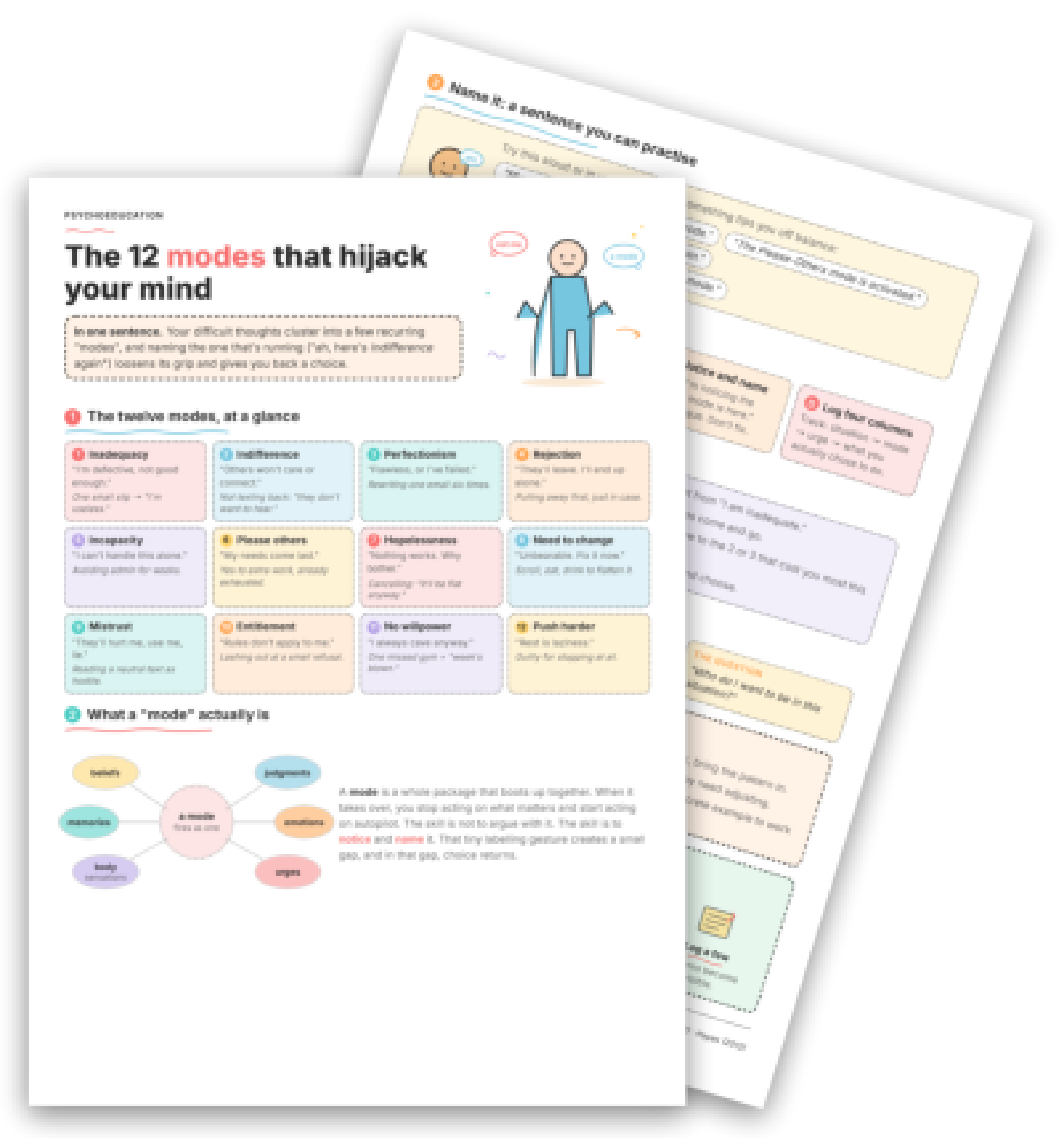
The fiche is structured across six panels, all of which you can walk through directly with the patient or assign selectively.
Panel 1 presents the 12 modes at a glance: Inadequacy, Indifference, Perfectionism, Rejection, Incapacity, Please Others, Hopelessness, Need to Change, Mistrust, Entitlement, No Willpower, and Push Harder. Each entry pairs a core belief with a brief behavioural snapshot, for instance, "Rewriting one email six times" for the Perfectionism mode, or "Pulling away first, just in case" for the Rejection mode. That concreteness is what makes the list clinically useful rather than encyclopedic.
Panel 2 shows the mode-as-package diagram: a circle where beliefs, judgments, memories, emotions, body sensations, and urges converge. No verbal explanation achieves what this diagram does in ten seconds.
Panel 3 gives ready-made labelling sentences the patient can try aloud: "My mind has gone into Indifference mode" or "This urge is part of the Need-to-change mode." These are not metaphors; they are the precise defusion micro-move, modelled in plain language.
Panel 4 outlines a four-step daily practice: mark the top three modes, anchor each to a recent episode, notice and name without arguing, and log a four-column journal (situation, mode, urge, chosen action). This dovetails naturally with values-aligned action work and fits inside the broader ACT Hexaflex framework you may already be using.
Panel 5 addresses common confusions, notably that naming a mode is not agreeing with its content, and that a mode returning is a cue, not a relapse. Panel 6 makes the core ACT pivot explicit: from "I AM anxious / useless" to "I'm NOTICING the mode right now", closing with the values question: "Who do I want to be in this situation?", a direct entry point into the Choice Point and psychological flexibility work.
> To keep in mind: this worksheet is a visual support designed to facilitate the explanation of modes in session, not a self-help checklist the patient fills in alone. Its clinical value is in what it makes visible together, and in the common vocabulary it leaves the patient with between appointments.
750+ clinical tools
A library built with and for clinicians, ready to use in session and extend between appointments.
Access all the toolsWhen and how to introduce the fiche
This worksheet fits best after initial assessment, once you have a working formulation and at least a provisional sense of which schemas or core beliefs are organising the presentation. It is especially useful with patients who are stuck in fusion despite having been introduced to cognitive restructuring, those for whom automatic thought restructuring techniques feel intellectual but do not shift in-the-moment experience.
You can introduce it with a simple frame: "I'd like to show you something that might give us a shared language for what happens when you get pulled into that state." Hand the fiche over and go to Panel 1 together. Ask the patient to mark two or three modes that feel recognisable, do not rush this step.
For patients with prominent perfectionist patterns or abandonment schemas, you will likely identify their top modes within minutes. The four-column log in Panel 4 can then become a structured between-session task, feeding directly back into your next debrief. Patients presenting with more diffuse or ego-syntonic patterns may need the inner speech psychoeducation curriculum alongside it before the labelling practice lands.
One practical limit: with patients in acute crisis or with severe dissociative presentations, the naming exercise can sometimes intensify distress rather than create distance. Raise that risk explicitly in session and check the patient's response before assigning autonomous practice.
The fiche does not replace schema mapping, core belief exploration, or the ACT for Depression program, it compresses the first step of defusion into a format that is fast, concrete, and something the patient can take away and return to on their own.
Use it with your patients
Share this tool in the mobile app and follow the work between sessions.
Sources
- Young, J. E., Klosko, J. S., & Weishaar, M. E. (2003). Schema Therapy: A Practitioner's Guide. Guilford Press.
- Lobbestael, J., van Vreeswijk, M., & Arntz, A. (2007). Shedding light on schema modes: a clarification of the mode concept and its current research status. Netherlands Journal of Psychology.
- Lobbestael, J., van Vreeswijk, M., Spinhoven, P., Schouten, E., & Arntz, A. (2010). Reliability and validity of the short Schema Mode Inventory (SMI). Behavioural and Cognitive Psychotherapy.
- Hayes, S. C., Strosahl, K. D., & Wilson, K. G. (2012). Acceptance and Commitment Therapy: The Process and Practice of Mindful Change (2nd ed.). Guilford Press.
- Levin, M. E., Hildebrandt, M. J., Lillis, J., & Hayes, S. C. (2017). Cognitive Defusion in Acceptance and Commitment Therapy: What Are the Basic Processes of Change?. The Psychological Record.
Your session continues in your patients' pocket
Use with a patientYour resources, available everywhere
The handouts, exercises, programs and audios above: you choose which ones to make available to your patients, in the mobile app dedicated to them.
And far more than a library
The app goes well beyond resources, to support your patients every day:
Related categories
Explore other clinical resources by category.

Identity
Clinical resources for self-identity work in therapy: CBT, ACT, schema tools for clinicians addressing self-concept, core beliefs, and identity disruption.

Emotions
Clinical resources on emotion regulation: worksheets, coping tools, CBT, REBT, and ACT exercises for therapists working across diagnoses and age groups.

Behaviours
Clinical hub for behaviors in therapy: worksheets and tools for coping, eating disorders, CBT formulation, and maladaptive behavioral patterns.

Cognition
Printable cognitive therapy worksheets and clinical tools for therapists: CBT, ACT, schema work, defusion, distortions, and belief restructuring.

Understand
Clinical hub for the therapeutic aim 'Understand': worksheets and tools to build patient insight across CBT, ACT, schema therapy and more.

Build awareness
Clinical worksheets and tools to build awareness in therapy: cognitive distortions, schemas, emotions, ACT and CBT resources for practitioners.