
Clinical picture. R., a woman in her late thirties, presented with chronic relationship instability and a pattern of abruptly ending friendships after perceived slights. She described herself as "a realist about people" and initially resisted framing her vigilance as a problem. The clinician introduced the Mistrust/Abuse Schema handout midway through the assessment phase, reading the self-confirming loop aloud together rather than assigning it as homework. R. paused at the "guard behaviour" step and said, unprompted, that she recognised her habit of sending provocative messages to "see if they would leave." By the following session she had annotated the sheet with two specific childhood incidents, which gave the formulation work a concrete anchor it had previously lacked.
Mistrust/Abuse Schema: PDF Worksheet, Tools and Exercises
A visual PDF worksheet to explain the mistrust/abuse schema in session, map the self-confirming loop, and give patients a concrete reference to carry between appointments.
Clinical vignettes
Handout Sparks Schema Recognition
Handout Limits With a Guarded Patient
Clinical picture. T., a man in his mid-forties with a history of workplace conflict and a documented pattern of premature therapy dropout, was referred for schema-focused work following a disciplinary review. The clinician introduced the Mistrust/Abuse Schema handout in session three, framing it as descriptive rather than prescriptive. T. read it carefully and acknowledged that the "inner voice" section was accurate, yet stated flatly that the loop existed because people genuinely were untrustworthy. Engagement with the material remained intellectualised over the following weeks, and the handout served primarily as a shared reference point for naming the dynamic rather than as a catalyst for change. This was noted in the formulation as consistent with a highly consolidated schema requiring a longer period of relationship-building before deeper processing could begin.
The mistrust/abuse schema is one of the most treatment-resistant patterns in schema therapy: patients with this history rarely extend trust to the therapeutic relationship itself, and verbal psychoeducation can easily be read as yet another attempt to gain access before causing harm. This PDF worksheet gives you a structured visual support to introduce the schema in session, name the loop precisely, and build a shared clinical language, without triggering the very defensiveness you are trying to address.
Use this resource with your patients
Handout, exercises and materials ready to use, right inside SessionFuel.
Why the Mistrust/Abuse Schema Resists Verbal Explanation
The core difficulty is not complexity; it is circularity. Patients operating inside this schema typically read explanatory conversations as potentially manipulative. When you describe the pattern verbally, you are using the very medium, trusted speech from an authority figure, that the schema treats as inherently unreliable. The result is often surface agreement with minimal internal shift.
A second obstacle is the schema's ego-syntonic quality. The hypervigilance feels like realism, not pathology. Patients arrive with core beliefs about others being fundamentally dangerous that present as facts rather than distortions. They have accumulated years of confirming evidence through the self-reinforcing loop described in Young (2003): guard behaviour generates relational friction, which generates the very responses that "confirm" the belief. Breaking that cycle through verbal explanation alone rarely lands.
Early maladaptive schemas formed around chronic unsafe attachment also interact closely with abandonment fear, emotional deprivation, and defectiveness/shame, all of which the fiche explicitly flags as frequent co-travellers. A visual support externalises the structure so the patient can observe it alongside you, rather than feel implicated by it.
What the Fiche Contains: A Structured Visual Map of the Loop
The fiche opens with a one-line anchor that is worth reading aloud before handing the page over: "an alarm that once kept a child safe and now quietly runs your adult relationships." That reframe, adaptive origin, problematic persistence, is the therapeutic hinge.
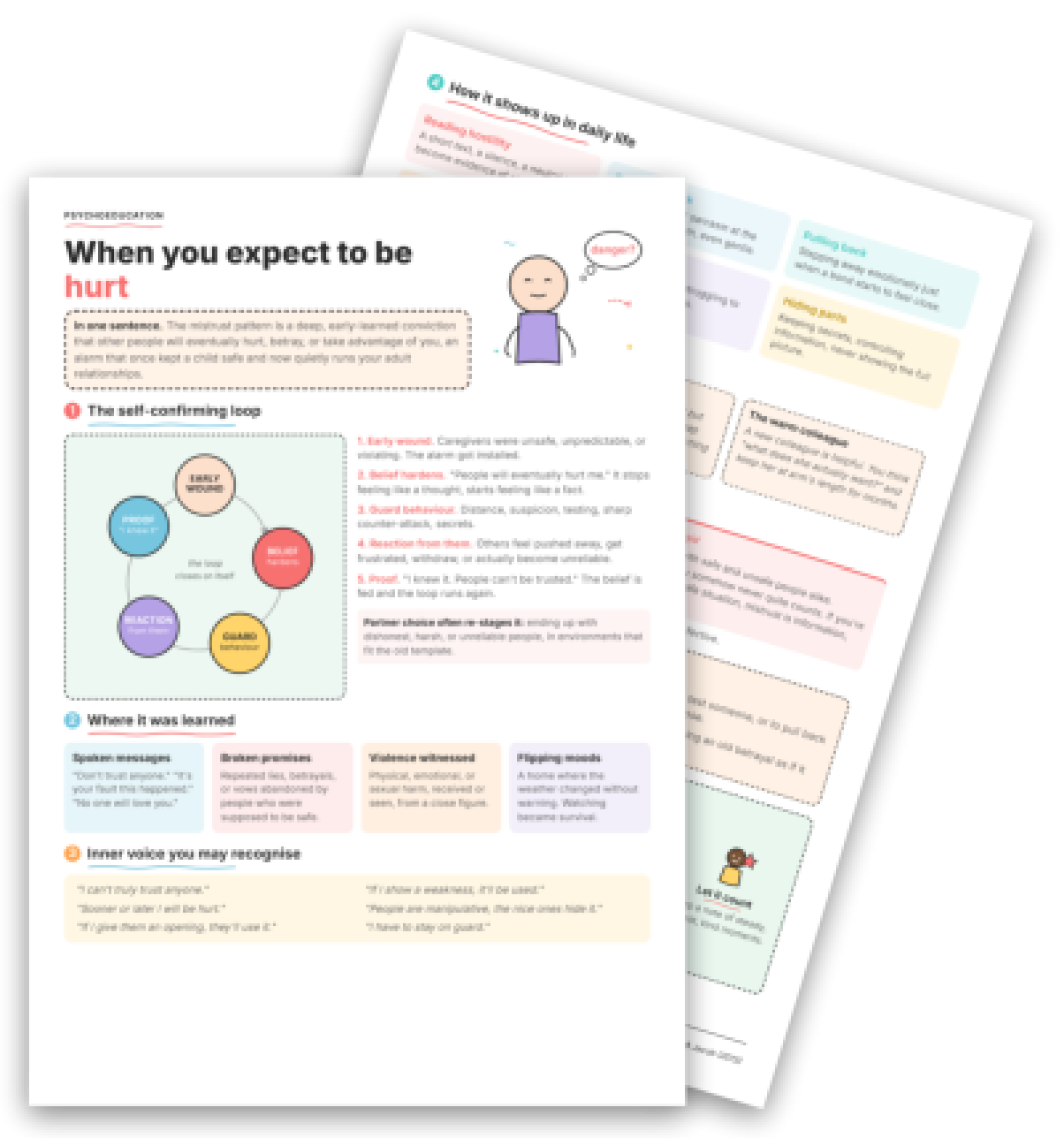
The visual centrepiece is Panel 1: the self-confirming loop, a five-step cycle running from early wound to hardened belief, to guard behaviour, to the reaction it provokes in others, to the "proof" that closes the loop. Having this printed means you can trace a patient's recent relational episode around the diagram in real time, rather than reconstructing the sequence mid-air.
Panel 2 maps the four learning contexts (spoken messages, broken promises, witnessed violence, unpredictable moods), giving patients a vocabulary for how their past shapes present relational behaviour without requiring them to narrate trauma in detail. Panel 3 lists six inner-voice statements, including "If I show a weakness, it'll be used," which patients can scan silently, reducing the interpretive labour of the session. Panel 4 names six behavioural manifestations: reading hostility into neutral cues, counter-attack, emotional withdrawal, testing, holding grudges, and compartmentalising information, all of which map directly onto attachment-related patterns you are likely already tracking.
Panel 6 provides a clinically important distinction between the schema (the alarm fires equally with safe and unsafe people) and healthy caution (evidence of safety registers and counts). This is valuable with patients who resist the schema label because their history was genuinely dangerous. The fiche explicitly acknowledges: "If you're currently in an unsafe situation, mistrust is information, not a pattern." That caveat prevents the psychoeducation from feeling invalidating.
The closing section proposes five between-session practices: naming the alarm, slowing the interpretive flash, tracking triggers, practising small disclosures, and logging steady and kind moments from others, each framed as a concrete, low-threshold behavioural experiment.
> Key takeaway: the fiche is a visual support that facilitates the explanation of the mistrust/abuse schema in session; it externalises the self-confirming loop so patient and clinician can examine it together, and it leaves a concrete reference the patient can return to between appointments, not a questionnaire to fill in alone.
750+ clinical tools
A library built with and for clinicians, ready to use in session and extend between appointments.
Access all the toolsWhen and How to Introduce the Fiche in Session
This worksheet belongs in the schema identification and psychoeducation phase, once the alliance is solid enough to tolerate naming the pattern without it reading as an accusation. For most patients with prominent mistrust features, that rules out the first session. The practical signal is a spontaneously reported relational incident that fits the loop. At that point, you might say: "There's a diagram I'd like to show you. It describes something I think we've been circling around. I'm curious what resonates and what doesn't."
The frame of curiosity matters. Patients with this schema are sensitive to being categorised. Inviting them to identify which items ring true, and which do not apply, engages their schema coping style in an observational rather than defensive register.
For patients with comorbid trauma, pair the fiche with broader trauma psychoeducation and defer detailed exploration of Panel 2 until stabilisation work is established. For couples presentations, the Panel 6 distinction between the pattern and realistic caution is the most productive entry point, and you can follow it with trust-focused psychoeducation. The Defectiveness/Shame Schema worksheet and the Emotional Deprivation Schema worksheet are natural next steps when the broader schema network needs mapping, as is the Mistrust/Abuse Schema worksheet for a complementary angle on the same terrain.
Debriefing is straightforward: ask which behavioural manifestation the patient recognised most readily, then use the self-confirming loop as a shared reference whenever they bring in a relational incident. The fiche's closing line, "My vigilance kept a child alive. It is no longer the job description," often becomes one of those phrases patients quote back months later.
The fiche does not replace formulation; it makes the schema legible enough that formulation work can actually begin.
Use it with your patients
Share this tool in the mobile app and follow the work between sessions.
Sources
- Young, J. E., Klosko, J. S., & Weishaar, M. E. (2003). Schema Therapy: A Practitioner's Guide. Guilford Press.
- Young, J. E., & Klosko, J. S. (1993). Reinventing Your Life: The Breakthrough Program to End Negative Behavior and Feel Great Again. Plume.
Your session continues in your patients' pocket
Use with a patientYour resources, available everywhere
The handouts, exercises, programs and audios above: you choose which ones to make available to your patients, in the mobile app dedicated to them.
And far more than a library
The app goes well beyond resources, to support your patients every day:
Related categories
Explore other clinical resources by category.

Trauma
Clinical hub on trauma and PTSD: assessment, differential diagnosis, treatment phases, and printable resources for practitioners. 155 chars.

Identity
Clinical resources for self-identity work in therapy: CBT, ACT, schema tools for clinicians addressing self-concept, core beliefs, and identity disruption.

Relationships
Clinical worksheets and tools on relational functioning: attachment, schemas, assertiveness, and communication skills for therapists. Printable PDF resources.

Understand
Clinical hub for the therapeutic aim 'Understand': worksheets and tools to build patient insight across CBT, ACT, schema therapy and more.

Build awareness
Clinical worksheets and tools to build awareness in therapy: cognitive distortions, schemas, emotions, ACT and CBT resources for practitioners.

CBT
CBT worksheets, cognitive restructuring exercises & behavioral tools for clinicians. Evidence-based resources for every phase of cognitive behavioral therapy.