
Clinical picture. M., a 34-year-old project manager, presented with chronic low mood and recurrent episodes of intense self-criticism following minor professional mistakes. He described spending entire evenings mentally replaying a brief lapse in a team meeting, cataloguing every detail as evidence of fundamental incompetence. The clinician introduced the punitiveness schema using the informational sheet, inviting M. to locate the three courtroom voices in his own internal experience; he quickly recognised the prosecutor function, noting that his apology to a colleague had not, in his mind, closed the file. Over subsequent sessions, naming the judge and prosecutor as learned parts rather than objective verdicts created a modest but consistent reduction in the duration of self-attack episodes, though the underlying rigidity remained a focus of ongoing schema work.
The Punitiveness Schema: PDF Worksheet, Tools and Exercises
A printable psychoeducation sheet with visual tools and exercises to help clinicians explain the punitiveness schema clearly and efficiently during session.
Clinical vignettes
Self-Attack After a Minor Workplace Error
Punitive Withdrawal Toward a Partner
Clinical picture. T., a woman in her late forties referred for couples difficulties, described an automatic pattern of cold withdrawal lasting several days whenever her partner made a careless remark. She framed this as a moral response: people must experience consequences. During an individual session, the clinician used the punitiveness schema sheet to map the origins of this stance; T. recalled caregivers who withheld warmth after minor infractions and whose forgiveness was rarely explicit or complete. She began to distinguish the schema-driven verdict from her actual relational needs, which she had not previously articulated. The withdrawal episodes did not stop immediately, but T. became able to flag them in session as the courtroom activating, which shifted the tone of couples work toward repair rather than score-keeping.
The punitiveness schema is one of the harder early maladaptive schemas to bring into the patient's awareness, precisely because it presents itself as morality. Patients rarely say "I punish myself excessively." They say "I'm just being honest about what I did." This fiche PDF gives you a concrete visual support to draw that distinction in session, quickly and without a lengthy verbal explanation.
Use this resource with your patients
Handout, exercises and materials ready to use, right inside SessionFuel.
Why Punitiveness Resists Explanation in Session
When you name the schema verbally, the most common response is partial agreement: the patient acknowledges harsh self-talk but frames it as deserved. The schema is ego-syntonic in a very specific way; it recruits the patient's sense of fairness. That makes purely conversational psychoeducation slow. You end up debating whether the self-criticism is proportionate rather than examining the mechanism itself.
The problem compounds in patients where punitiveness co-occurs with the defectiveness/shame schema or the failure schema: suffering does not feel like pathology, it feels like evidence of moral seriousness. Naming the schema without a shared vocabulary that externalises the process often produces defensiveness rather than curiosity.
A visual support shifts the frame. Instead of "your self-criticism is excessive," you can point to a diagram and say, "Here's the mechanism. Does this map onto what you described?"
What the Fiche Contains: A Visual Guide to the Inner Courtroom
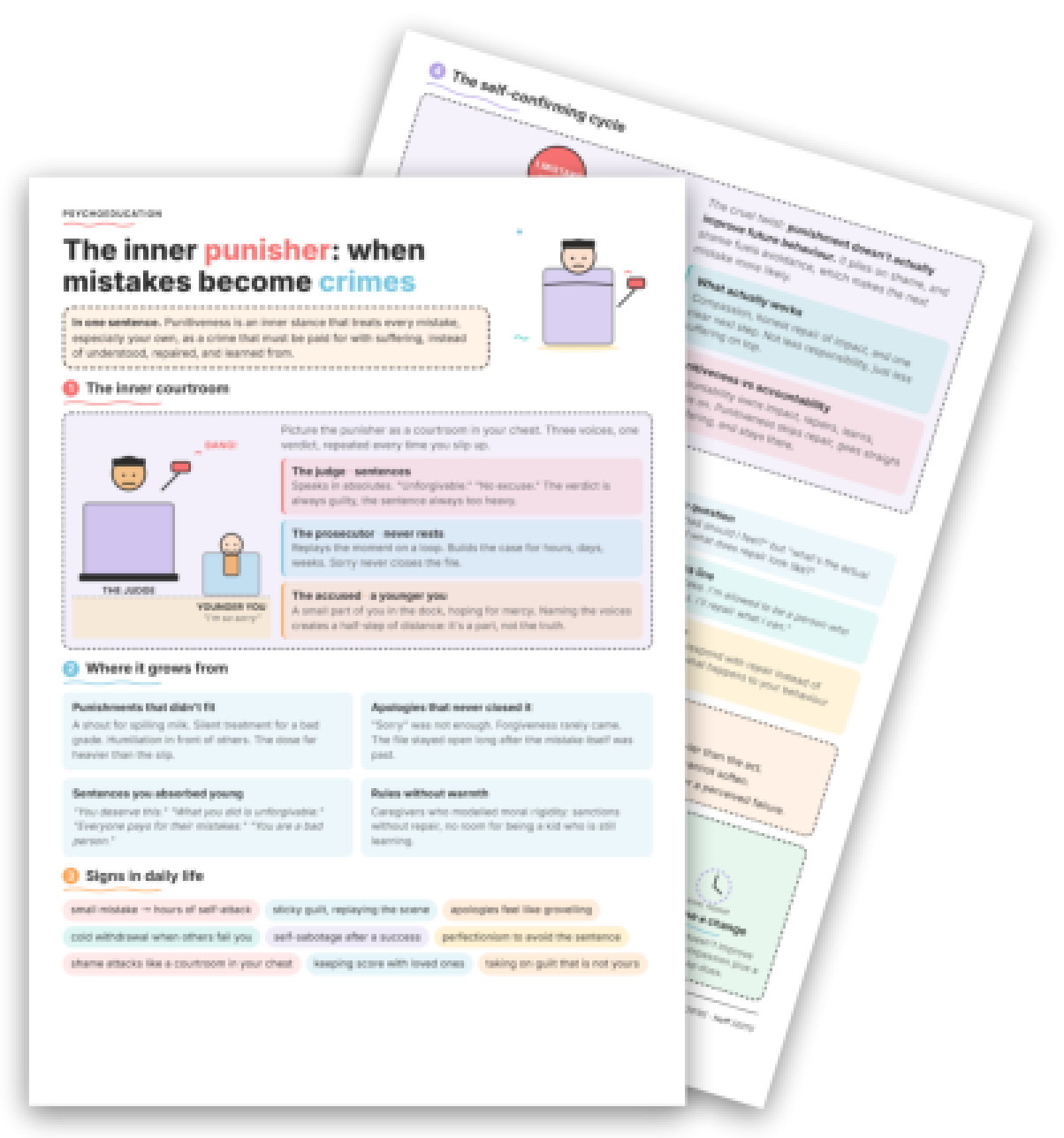
The fiche opens with a psychoeducation panel framing punitiveness as "an inner stance that treats every mistake, especially your own, as a crime that must be paid for with suffering, instead of understood, repaired, and learned from." From there, the layout is built for in-session use.
Panel 1 introduces the inner courtroom metaphor: three named voices (the Judge who sentences in absolutes, the Prosecutor who replays the moment on a loop, and the Accused, a younger version of the patient hoping for mercy). Naming the parts connects naturally to schema mode work and also to IFS-informed approaches. Crucially, seeing the three roles laid out simultaneously makes the architecture of the schema visible in a way that oral description rarely achieves.
Panel 2 maps the developmental origins: disproportionate punishments, apologies that never closed the file, absorbed sentences ("You deserve this," "What you did is unforgivable"), and caregivers who modelled rules without warmth. This panel grounds the schema in the patient's history without requiring a full anamnèse rerun.
Panel 3 lists nine behavioural signs in daily life, from sticky guilt and replaying the scene to self-sabotage after a success and keeping score with loved ones. You can use this list as a rapid recognition tool, particularly useful when early maladaptive schemas are still being mapped in the early phase of schema therapy.
Panel 4 shows the self-confirming cycle as a five-step loop: Mistake → Verdict → Attack or Withdraw → Shame → Tension. The diagram makes explicit what many patients have never seen articulated: punishment doesn't actually improve future behaviour. It piles on shame, and shame fuels avoidance, which increases the probability of the next mistake. This is the key cognitive reframe that unlocks work on schema maintenance cycles.
Panel 5 offers six concrete softening steps, from catching and labelling the voice to the friend test ("Speak to yourself like you'd speak to a friend who made the same slip"). The fiche also closes with a "To discuss in session" section offering three specific prompts for follow-up, and a Remember block reinforcing the core distinctions: repair, not pay, and shame ≠ change.
> Key takeaway: The fiche is a visual support that facilitates the in-session explanation of punitiveness; it is not a self-report questionnaire the patient completes alone, but a shared reference point you work through together to build a common vocabulary and leave a concrete anchor.
750+ clinical tools
A library built with and for clinicians, ready to use in session and extend between appointments.
Access all the toolsWhen and How to Introduce the Fiche
This fiche fits most naturally once the punitiveness schema has been tentatively identified but before the patient fully owns the concept. Typically from the third or fourth session onward, after the initial case formulation and when the therapeutic alliance is solid enough to name self-directed processes without triggering withdrawal.
Profiles where it is particularly useful:
- Perfectionism presentations, especially where clinical perfectionism is driven by pre-emptive self-punishment rather than genuine standards
- Chronic guilt without clear interpersonal repair, where the feeling-guilty exercise could run in parallel
- Depressive presentations in which activation is blocked by a sense that enjoyment must be "earned" by first suffering enough
- Relational patterns involving cold withdrawal after a partner apologises, a presentation where beliefs that damage relationships are also prominent
To introduce it, you might say: "I want to show you something that maps out a pattern I'm noticing. Have a look at the diagram and tell me if any part of it feels familiar." That framing invites observation rather than self-labelling, which is important given how ego-syntonic the schema can be.
When debriefing, focus the first pass on Panel 4: ask the patient to identify where in the cycle they most recognise themselves. The friend test in Panel 5 often generates productive affect in session and connects directly to self-compassion work and self-forgiveness exercises you may already be running between sessions.
One contraindication worth noting: with patients in an acute crisis of shame, presenting the full courtroom metaphor in a first psychoeducation pass can feel overwhelming. In those cases, start with Panel 4 alone (the cycle) and return to the inner-courtroom imagery when there is more affective distance.
The fiche does not replace the relational work; it makes the conceptual scaffolding clear enough that the relational work can proceed more efficiently.
Use it with your patients
Share this tool in the mobile app and follow the work between sessions.
Sources
- Young, J. E., Klosko, J. S., Weishaar, M. E. (2003). Schema Therapy: A Practitioner's Guide. Guilford Press.
- Young, J. E., Klosko, J. S. (1994). Reinventing Your Life: The Breakthrough Program to End Negative Behavior and Feel Great Again. Plume/Penguin.
- Tan, Y. M., Lee, C. W., Averbeck, L. E., Brand-de Wilde, O., Farrell, J., Fassbinder, E., Jacob, G. A., Martius, D., Wastiaux, S., Zarbock, G., Arntz, A. (2018). Schema Therapy for Borderline Personality Disorder: A Qualitative Study of Patients' Perceptions. PLOS ONE.
Your session continues in your patients' pocket
Use with a patientYour resources, available everywhere
The handouts, exercises, programs and audios above: you choose which ones to make available to your patients, in the mobile app dedicated to them.
And far more than a library
The app goes well beyond resources, to support your patients every day:
Related categories
Explore other clinical resources by category.

Identity
Clinical resources for self-identity work in therapy: CBT, ACT, schema tools for clinicians addressing self-concept, core beliefs, and identity disruption.

Understand
Clinical hub for the therapeutic aim 'Understand': worksheets and tools to build patient insight across CBT, ACT, schema therapy and more.

Build awareness
Clinical worksheets and tools to build awareness in therapy: cognitive distortions, schemas, emotions, ACT and CBT resources for practitioners.

CBT
CBT worksheets, cognitive restructuring exercises & behavioral tools for clinicians. Evidence-based resources for every phase of cognitive behavioral therapy.

Integrative
Integrative therapy clinical resources: worksheets, psychoeducation programs, and exercises for eclectic, multimodal practice across orientations.

Schema therapy
Schema therapy clinical resources for practitioners: worksheets, exercises, and programs targeting early maladaptive schemas, core beliefs, and schema modes.