
Clinical picture. M., a woman in her late thirties, presented with chronic low mood and a pattern of staying in relationships well past the point of distress, describing this as simply "how things are." The clinician introduced the informational sheet listing Young's 18 schemas and invited her to rate each statement from 0 to 10 before the next session. M. returned having marked Abandonment at 9, Emotional Deprivation at 8, and Self-Sacrifice at 7, noting with some surprise that she had never seen those three patterns as connected. This gave the clinician a structured entry point into childhood attachment history that felt less threatening to M. than open-ended inquiry had previously been. The schema map did not shift her presentation immediately, but it gave shared language that made subsequent sessions more focused.
Young's 18 Early Maladaptive Schemas: PDF Worksheet, Tools and Exercises
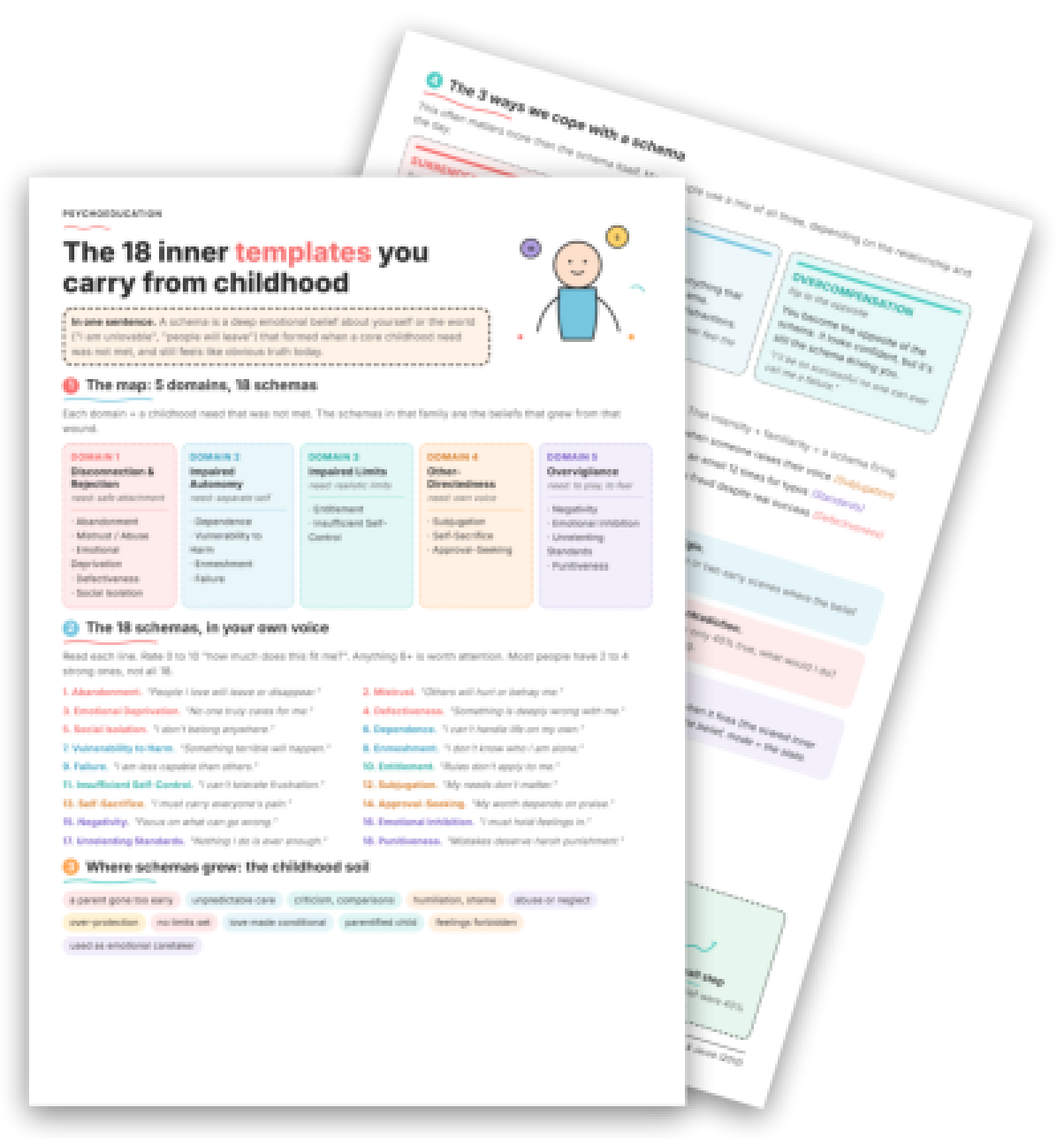
A visual reference covering all 5 domains, the three coping styles, and first softening steps, a practical psychoeducation tool for schema therapy work.
Clinical vignettes
Rating Schemas Opens a New Conversation
Unrelenting Standards Schema in a High-Functioning Patient
Clinical picture. T., a man in his mid-forties referred for burnout, minimised his distress by pointing to his professional output as evidence that nothing was seriously wrong. The clinician used the psychoeducation sheet to walk through Domain 5 (Overvigilance), reading the Unrelenting Standards statement aloud: "I must perform at the highest level or it is not acceptable." T. rated it 10 without hesitation, then paused and said it was the first time a clinical concept had felt immediately accurate rather than approximate. Introducing the developmental framing, that the schema formed when a childhood need to simply play and rest went unmet, shifted his self-narrative from personal weakness to learned adaptation. He remained sceptical of the broader schema model, but agreed to track situations in which the standard he applied to himself clearly exceeded what he would ask of anyone else.
Explaining the logic of early maladaptive schemas verbally rarely lands on the first try. Patients grasp that something repetitive is happening, but the map connecting childhood unmet needs, eighteen distinct belief structures, and three automatic coping patterns is simply too dense to hold in working memory during a fifty-minute session. This fiche PDF gives that map a visual form, so the explanation happens once, clearly, and the patient leaves with a reference they can return to between appointments.
Use this resource with your patients
Handout, exercises and materials ready to use, right inside SessionFuel.
Why early maladaptive schemas resist oral explanation
The core difficulty is structural. Young's model is simultaneously a taxonomy (eighteen schemas grouped into five domains) and a developmental hypothesis (each domain maps to a childhood need that went unmet) and a functional theory (the same schema can generate surrender, avoidance, or overcompensation depending on context). That is three conceptual layers in one, and patients regularly conflate them.
A second sticking point is the coping style. In clinical experience, patients identify more readily with a coping pattern than with the underlying schema itself. Someone presenting with self-sacrifice patterns may have no conscious access to the Subjugation schema driving the behaviour. Without a visual that shows the relationship between the belief and the coping response, the psychoeducation stays abstract.
Understanding what schemas are is one thing; seeing the full architecture laid out spatially is another. The fiche bridges that gap.
What the fiche contains, a visual support for in-session explanation
The PDF worksheet is structured into six panels, each doing a specific clinical job.
-
Panel 1, the domain map: the five domains (Disconnection and Rejection, Impaired Autonomy, Impaired Limits, Other-Directedness, Overvigilance) are listed alongside the childhood need each represents and the schemas within each family. Seeing all eighteen schemas positioned within their domain immediately shows a patient that their fear of abandonment and their emotional deprivation beliefs belong to the same relational wound, without needing to say that twice.
-
Panel 2, the 18 schemas in first-person voice: each schema is rendered as a belief statement ("People I love will leave or disappear", "My needs don't matter") with a 0-to-10 self-rating prompt. The instruction is direct: anything rated 6 or above warrants attention, and most people carry two to four strong schemas, not all eighteen. This immediately calibrates expectations and prevents the patient from catastrophising the full list.
-
Panel 3, the childhood soil: a concrete list of formative conditions (unpredictable care, conditional love, emotional parentification, shame) that contextualises schema formation without requiring a lengthy developmental history in session.
-
Panel 4, the three coping styles: surrender, avoidance, and overcompensation are defined with brief clinical examples. The panel makes explicit what the coping styles in schema therapy literature describes: overcompensation in particular is the most frequently missed, because it looks adaptive on the surface.
-
Panel 5, schemas firing in everyday life: recognisable micro-scenarios ("re-reading an email twelve times for typos", "saying yes, then collapsing, resentful") ground the abstract concepts in somatic and behavioural language.
-
Panel 6, first softening steps: a four-step sequence (name the schema, trace its origin, label it out loud, try one small contradiction) that gives the patient a concrete take-home exercise without requiring a formal homework protocol.
> Key point: this fiche is a visual support that facilitates the explanation of early maladaptive schemas in session, it is not a self-administered questionnaire. The clinician works through it alongside the patient, using the panels as shared reference points. The patient leaves with a physical anchor for concepts that would otherwise dissolve between appointments.
750+ clinical tools
A library built with and for clinicians, ready to use in session and extend between appointments.
Access all the toolsWhen and how to introduce it in session
The fiche fits naturally after the initial anamnesis, once a repeating relational or cognitive pattern has been identified but before schema-specific work begins. It is particularly useful when opening schema therapy formally, when introducing ACT-informed schema work, or when a patient raised in a context of unmet emotional needs needs a framework to make sense of chronic self-critical loops.
For patients with shame-based defectiveness beliefs, take a moment before handing over the sheet: frame the exercise explicitly as mapping adaptations, not pathologies. The "Remember" box on the fiche makes this straightforward, "You adapted to what you were given" is already printed there.
To introduce it, something like: "I'd like to show you a map we use to understand these recurring patterns. We'll look at it together and you can note which ones feel most relevant to you" keeps the register collaborative and prevents the patient from reading it as a diagnostic checklist.
Debrief by asking which schemas were rated highest, then moving directly to panel 4 to identify the dominant coping style. That sequence connects belief to behaviour in a single session and sets up the formulation work to come. Pair it with schema maintenance cycle work or how past experiences shape present reactions as the next step.
The fiche does not replace case formulation or the therapeutic relationship. It makes the first explanation of a complex model precise, efficient, and memorable for the patient.
Use it with your patients
Share this tool in the mobile app and follow the work between sessions.
Sources
- Young, J. E., Klosko, J. S., Weishaar, M. E. (2003). Schema Therapy: A Practitioner's Guide. Guilford Press.
- Young, J. E., Klosko, J. S. (1993). Reinventing Your Life: The Breakthrough Program to End Negative Behavior and Feel Great Again. Dutton.
- Young, J. E. (1990). Cognitive Therapy for Personality Disorders: A Schema-Focused Approach. Professional Resource Exchange.
Your session continues in your patients' pocket
Use with a patientYour resources, available everywhere
The handouts, exercises, programs and audios above: you choose which ones to make available to your patients, in the mobile app dedicated to them.
And far more than a library
The app goes well beyond resources, to support your patients every day:
Related categories
Explore other clinical resources by category.

Identity
Clinical resources for self-identity work in therapy: CBT, ACT, schema tools for clinicians addressing self-concept, core beliefs, and identity disruption.

Cognition
Printable cognitive therapy worksheets and clinical tools for therapists: CBT, ACT, schema work, defusion, distortions, and belief restructuring.

Understand
Clinical hub for the therapeutic aim 'Understand': worksheets and tools to build patient insight across CBT, ACT, schema therapy and more.

Build awareness
Clinical worksheets and tools to build awareness in therapy: cognitive distortions, schemas, emotions, ACT and CBT resources for practitioners.

CBT
CBT worksheets, cognitive restructuring exercises & behavioral tools for clinicians. Evidence-based resources for every phase of cognitive behavioral therapy.

Schema therapy
Schema therapy clinical resources for practitioners: worksheets, exercises, and programs targeting early maladaptive schemas, core beliefs, and schema modes.