
Clinical picture. M., a woman in her late thirties, presented after a third relationship breakdown in five years, describing each partner as "eventually cold and unavailable." She met the psychoeducational sheet on schema therapy with initial scepticism, saying she had already tried CBT twice without lasting change. The clinician used the chain diagram to walk through a recent argument, tracing the late-reply trigger through her Vulnerable Child panic, the Detached Protector shutdown, and the subsequent Angry Child message she sent. M. paused at the mode map and said, quietly, that she had never seen the sequence laid out as a system rather than as character flaws. She agreed to continue with schema-focused work, with the explicit goal of identifying her Abandonment schema before addressing relationship behaviour.
Schema Therapy: PDF Worksheet, Tools and Exercises for Clinical Practice
A visual psychoeducation fiche clinicians can use in session to explain schema formation, mode activation, and therapeutic mechanisms, clearly and efficiently.
Clinical vignettes
Naming the Pattern Behind Repeated Ruptures
Reframing Chronic Self-Criticism in a Male Patient
Clinical picture. R., a man in his mid-forties referred for persistent low mood unresponsive to two antidepressant trials, described a lifelong internal voice he called "the coach," which narrated his daily failures in detail. During a session introducing schema therapy concepts, the clinician pointed to the Punitive Inner Critic mode on the informational sheet and asked R. to consider what unmet need that voice might originally have been managing. R. connected it, with some effort, to childhood criticism from a high-achieving parent and to an early-formed Defectiveness schema. He did not find the framework immediately convincing, though he noted it was the first explanation that accounted for why the self-criticism persisted even in weeks when his functioning was objectively adequate. A further session was scheduled to map his specific schemas before agreeing on treatment goals.
Introducing schema therapy to a patient verbally tends to produce polite nodding and very little retention. The model spans childhood unmet needs, deep belief structures, somatic charge, mode-flipping, and a reparative therapeutic relationship, all at once. This fiche PDF gives you a structured visual scaffold to carry that explanation in session without losing the patient at step two.
Use this resource with your patients
Handout, exercises and materials ready to use, right inside SessionFuel.
Why Schema Therapy Resists an Oral Explanation
The core difficulty is layering. A patient who has already done standard CBT understands automatic thoughts well enough, but schema therapy asks them to hold something more complex: that the thought is not the root, that the root is a need that went unmet, that the unmet need hardened into a schema, and that what feels like "just how I react" is actually a mode taking over. Presented orally, this chain collapses quickly. Patients either hear it as abstract theory or, more clinically problematic, hear it as a new vocabulary for self-blame.
The same difficulty surfaces when explaining coping styles. Surrender, avoidance, and overcompensation sound intuitive until a patient tries to locate themselves, and realises they use all three depending on the day. Without a visual structure, the distinctions blur. The Coping Styles in Schema Therapy fiche addresses this specifically, but you need a prior shared frame for it to land.
What the Fiche Contains: A Visual Map of the Full Model
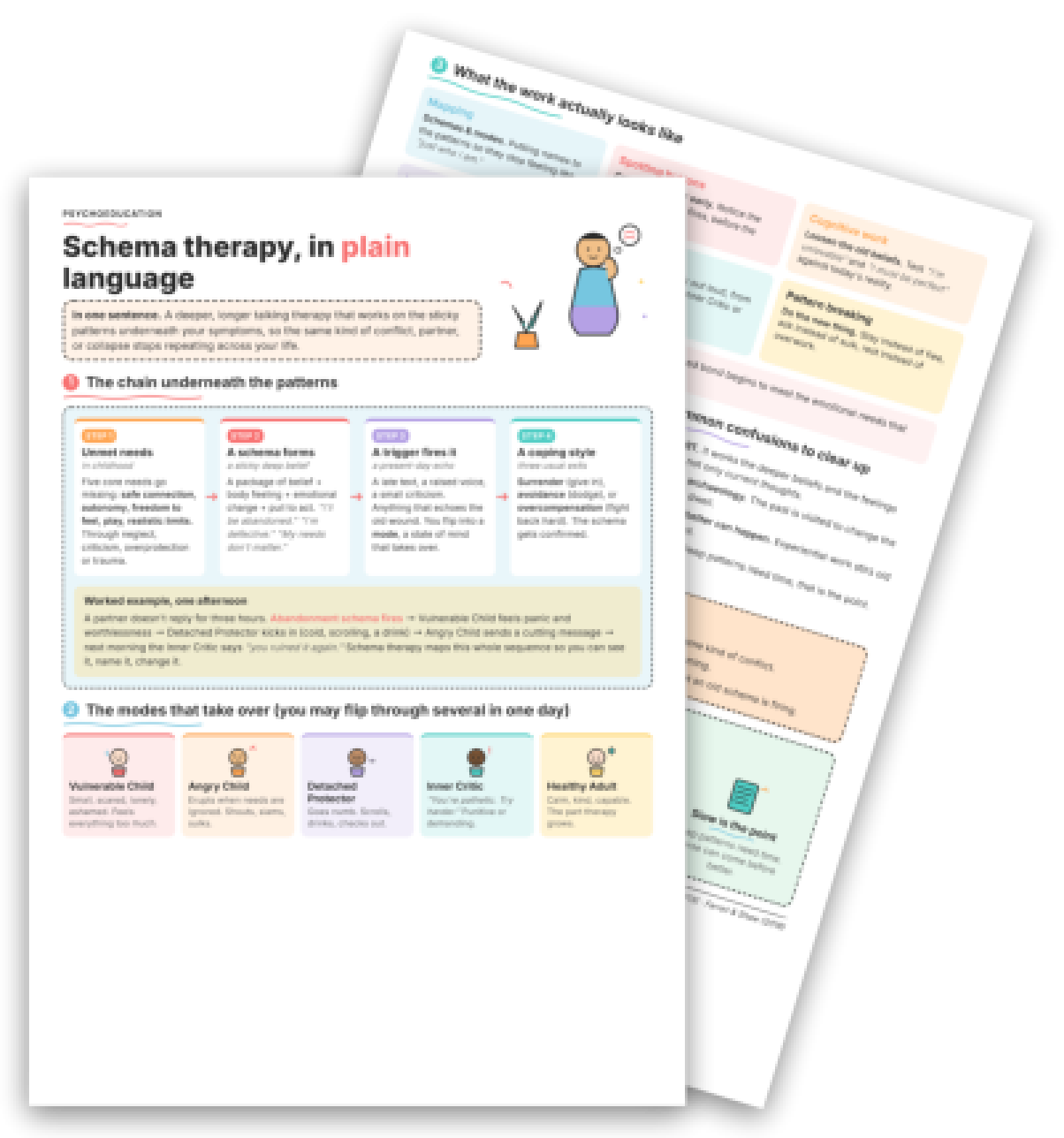
The fiche is organised into five numbered panels, each targeting a distinct layer of the model.
Panel 1 traces the four-step chain: unmet core needs in childhood (safe connection, autonomy, freedom to feel, play, realistic limits) produce a schema, a schema is fired by a present-day trigger, and a coping style (surrender, avoidance, overcompensation) locks the loop. A worked example runs a single afternoon through all four steps, a partner's silence triggering an abandonment schema, cycling through Vulnerable Child panic, Detached Protector numbing, Angry Child eruption, then Inner Critic recrimination. Patients can follow that sequence on the page even when they cannot yet name it in their own experience.
Panel 2 maps the five modes: Vulnerable Child, Angry Child, Detached Protector, Inner Critic, and Healthy Adult. Each is described in one or two words ("Small, scared, lonely, ashamed" for Vulnerable Child; "Goes numb. Scrolls, drinks, checks out" for Detached Protector). The brevity is deliberate and clinically useful: patients recognise the phenomenology immediately, which opens the mode-labelling work far faster than a definition would.
Panel 3 lists the six therapeutic mechanisms: mapping, spotting buttons, cognitive work, imagery rescripting, chairwork, and pattern breaking, each named and described in one sentence. For patients wondering what schema work will actually ask of them, this panel does the orientation. It pairs naturally with the Imagery Rescripting fiche for the sessions when you move into that technique directly.
Panels 4 and 5 cover what to expect from a schema therapist and five common confusions ("Not just CBT", "Not endless archaeology", "Worse before better can happen"). The closing "Remember" block distils four takeaways: "Patterns, not flaws", "Name to tame", "Bond as medicine", "Slow is the point".
> Key takeaway: This fiche is a visual support for explaining schema therapy in session, not a self-directed questionnaire. You use it to guide the patient through the model, pause at each panel, and let the diagram do the heavy lifting that verbal explanation alone cannot.
750+ clinical tools
A library built with and for clinicians, ready to use in session and extend between appointments.
Access all the toolsWhen and How to Introduce It
Timing. The fiche fits best in the second or third session, once you have a working formulation hypothesis and the alliance is stable enough to introduce developmental material. Avoid session one: the model needs an anamnesis to anchor it. Avoid also the sessions when early maladaptive schemas are actively distressing, those are treatment sessions, not orientation sessions.
For which patients. The fiche is particularly useful for patients with chronic relational patterns, repeated therapy dropout, or histories where short-term CBT helped symptoms without touching the underlying loop. Patients tracking an abandonment schema, shame and defectiveness, or chronic emotional self-suppression (see Emotional Deprivation Schema) benefit especially because the fiche normalises their intensity without minimising it.
Introducing it. A neutral framing works well: "I want to show you a map of how the kind of patterns you're describing tend to form and sustain themselves. It might help us both name what we're looking at." Avoid positioning it as a diagnosis of their coping. The fiche's own language, "schemas are old learning, not who you are", does that reframe for you.
Debrief. After walking through the panels, ask the patient which mode they most readily recognise in themselves, and which feels furthest away. That answer often locates the schema maintenance cycle you will spend the next phase of therapy disrupting. The Schema Model: Here and Now fiche bridges neatly from this psychoeducation into present-focused schema work.
One limit worth naming: for patients with active dissociation or complex trauma, the mode panel can activate rather than orient. Introduce the fiche more slowly with those presentations, and consider pairing it with somatic grounding before and after.
The fiche does not replace the formulation conversation; it makes that conversation more efficient and leaves the patient with a concrete reference between sessions.
Use it with your patients
Share this tool in the mobile app and follow the work between sessions.
Sources
- Young, J. E., Klosko, J. S., Weishaar, M. E. (2003). Schema Therapy: A Practitioner's Guide. Guilford Press.
- Young, J. E., Klosko, J. S. (1993). Reinventing Your Life: The Breakthrough Program to End Negative Behavior and Feel Great Again. Plume/Penguin.
- Young, J. E. (1990). Cognitive Therapy for Personality Disorders: A Schema-Focused Approach. Professional Resource Press.
- Arntz, A., van Genderen, H. (2021). Schema Therapy for Borderline Personality Disorder (2nd ed.). Wiley-Blackwell.
Your session continues in your patients' pocket
Use with a patientYour resources, available everywhere
The handouts, exercises, programs and audios above: you choose which ones to make available to your patients, in the mobile app dedicated to them.
And far more than a library
The app goes well beyond resources, to support your patients every day:
Related categories
Explore other clinical resources by category.

Identity
Clinical resources for self-identity work in therapy: CBT, ACT, schema tools for clinicians addressing self-concept, core beliefs, and identity disruption.

Cognition
Printable cognitive therapy worksheets and clinical tools for therapists: CBT, ACT, schema work, defusion, distortions, and belief restructuring.

Understand
Clinical hub for the therapeutic aim 'Understand': worksheets and tools to build patient insight across CBT, ACT, schema therapy and more.
CBT
CBT worksheets, cognitive restructuring exercises & behavioral tools for clinicians. Evidence-based resources for every phase of cognitive behavioral therapy.

Emotion-focused
Emotion-focused therapy clinical resources: worksheets, exercises & programs for EFT practitioners working with individuals and couples.

Schema therapy
Schema therapy clinical resources for practitioners: worksheets, exercises, and programs targeting early maladaptive schemas, core beliefs, and schema modes.