
Clinical picture. T., a man in his late 30s, presents with recurrent occupational difficulties linked to anger dysregulation; he reports several incidents in which he abruptly left team meetings after feeling criticised by his manager. In session, the clinician introduces the signal-urge-choice framework using the worksheet, asking T. to map what he noticed in his body during the last incident, what the anger was pulling him toward, and what actually followed from leaving. T. identifies the urge to escape as a combination of anger and shame, a pairing he had not previously separated. Over the following two weeks he practises naming the urge aloud to himself before responding; he reports staying in one meeting he would previously have walked out of, describing the outcome as tolerable rather than resolved.
Emotions Motivate Actions: PDF Worksheet, Tools and Exercises
A visual PDF worksheet, clinical tools and exercises to help patients slow the automatic leap from emotion to behavior and make a conscious choice about what to do next.
Clinical vignettes
Naming the Urge Before Acting
Sadness Urge and Behavioural Withdrawal
Clinical picture. M., a woman in her mid-20s, is seen six weeks after a relationship ending; she describes spending most evenings in bed replaying conversations and declining invitations from friends, which she frames as needing rest. The clinician uses the informational sheet to draw her attention to the sadness-to-withdrawal pairing, and asks her to consider what the withdrawal had produced so far in terms of mood trajectory. M. notes, with some reluctance, that the low mood had deepened rather than lifted. They agree on a limited behavioural experiment: accepting one social invitation that week while observing the urge to cancel without automatically following it. At the next session M. reports that the urge was present but that going out had not made things worse, which she found unexpectedly useful information.
Most patients can name what they felt. What they cannot do, at least not quickly, is see the gap between the emotion and the behavior it produced. This PDF worksheet exists precisely to make that gap visible in session, giving you a concrete visual to work from rather than a concept to argue for.
Use this resource with your patients
Handout, exercises and materials ready to use, right inside SessionFuel.
What makes the emotion-action link hard to convey verbally
The theoretical point is simple enough: emotions generate action urges, and those urges are not commands. But patients routinely collapse the two. "I felt angry, so I had to yell." "I was terrified, so of course I avoided it." When you challenge this in session, the pushback is rarely intellectual, it is experiential. The fusion between feeling and behavior feels total, automatic, and self-evidently justified.
Oral explanation alone rarely dislodges it. A verbal account of action urges stays abstract; patients nod without the concept actually sticking to a real behavioral sequence they recognise. The problem is partly attentional, the moment passes too fast in vivo, and partly linguistic, patients have no ready vocabulary for the specific pull each emotion generates. Paired with work on basic emotion recognition, adaptive versus maladaptive coping, and behavioral avoidance cycles, the fiche gives you a shared reference point the patient can actually hold in mind between sessions.
What the fiche contains: a visual map from signal to choice
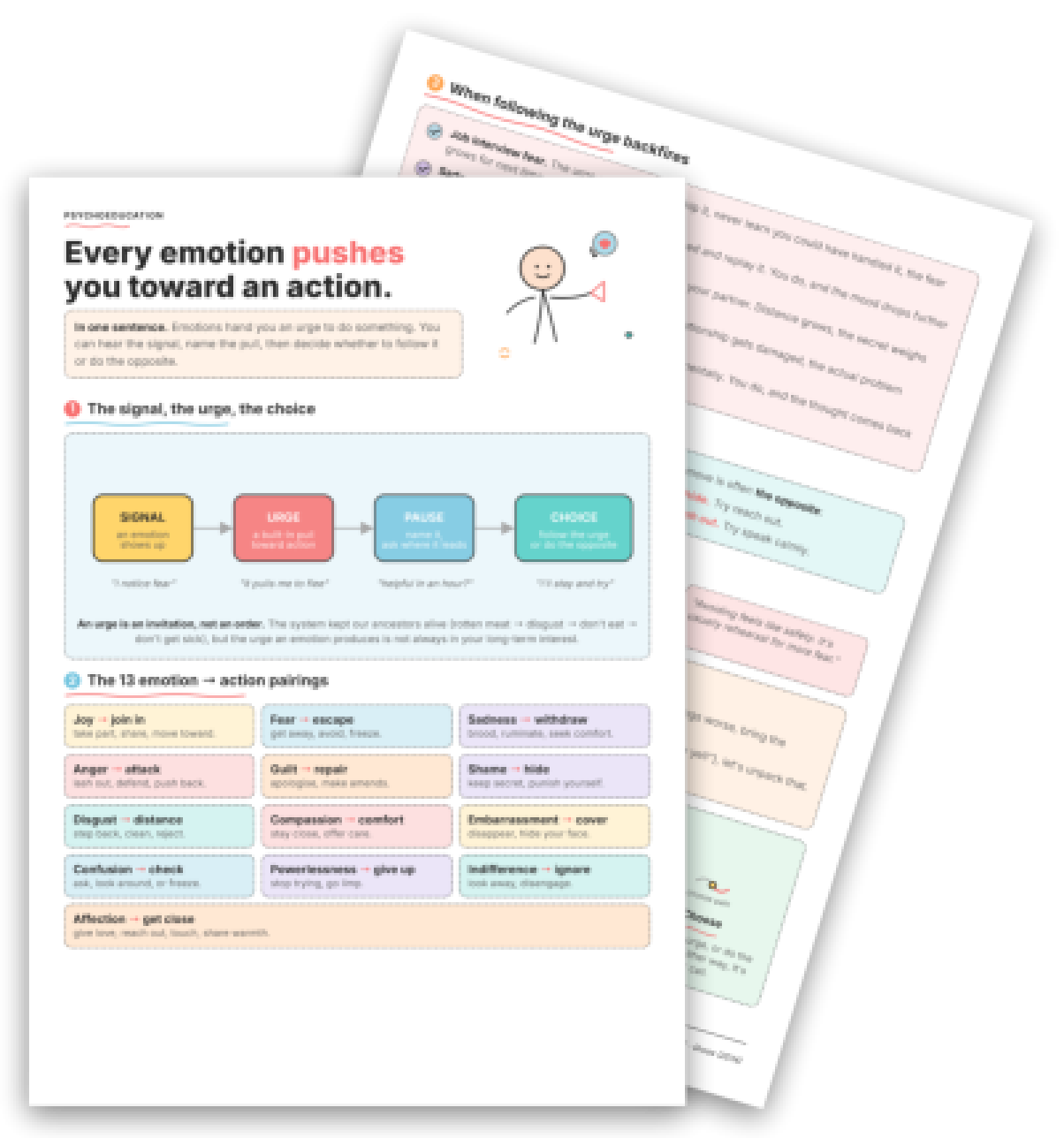
The fiche PDF is built around four sequential panels: Signal, Urge, Pause, Choice. Each panel is labeled and illustrated with a concrete example ("I notice fear" → "it pulls me to flee" → "helpful in an hour?" → "I'll stay and try"). What a schema like this does that speech cannot is freeze the sequence. Patients see the four steps as discrete, ordered, and interruptible, which is exactly the therapeutic message.
The second panel is clinically dense: 13 emotion-to-action pairings laid out in a scannable grid. Joy pushes toward joining; shame pushes toward hiding; guilt pulls toward repair; powerlessness pulls toward giving up. For patients who have spent years believing their behavior was just "how they are," seeing their pattern named and normalized inside a list of thirteen is often immediately relieving. You can use this grid to target a specific pairing the patient has described and mark it together during session.
Panel three, "When following the urge backfires," gives five concrete scenarios: the job interview avoided because fear said "don't go," the intrusive thought that grew louder when the patient tried to neutralise it mentally, the shame-driven secret that compounded the shame. These examples map cleanly onto the avoidance-anxiety maintenance cycle and onto DBT emotion regulation work, so the fiche integrates with frameworks you are likely already using.
Panel four names the opposite action per emotion (fear says flee, try approach; shame says hide, try reach out), which connects directly to ACT committed action and the Choice Point model. The fiche also includes three reframes worth reading aloud with the patient: "The urge to withdraw is loudest exactly when connection would help most."
> To retain: This fiche is a visual support that facilitates the explanation of the emotion-action link in session. It is not a self-administered questionnaire; it is a psychoeducation tool the clinician uses to make an otherwise abstract concept concrete, shared, and debriefable.
The closing section, "To discuss in session," lists three structured prompts the patient brings back next appointment, including a recent moment where obeying an urge made things worse, and any moment where they confused the emotion with the urge itself.
750+ clinical tools
A library built with and for clinicians, ready to use in session and extend between appointments.
Access all the toolsWhen and how to introduce the fiche
The fiche is best placed after the initial anamnesis phase, once you have identified at least one behavioral pattern worth targeting. It works across a wide range of presentations: anxiety-driven avoidance, anger dysregulation, shame-related withdrawal, or OCD-linked neutralisation. It is also a strong early-session tool for patients who intellectualise emotions but struggle to connect affect to their own behavior, including those with shame and defectiveness dynamics or persistent confrontation of avoidance patterns.
A low-friction introduction: "I want to show you something that maps a process that seems to be running the decisions you've been describing. Let's look at it together and see where it fits your situation." Avoid labelling the patient as reactive or impulsive before they have had a chance to see themselves in the framework.
In the debrief, two things are worth tracking: whether the patient distinguishes the urge from the emotion cleanly, and whether the opposite action feels possible or blocked. If it feels impossible, that block is the next clinical target and connects to upstream work on cognitive defusion, behavioral experiments, or deeper emotion regulation skills. The fiche does not replace that work; it makes it easier to point to what exactly needs doing.
Use it with your patients
Share this tool in the mobile app and follow the work between sessions.
Sources
- Frijda, N. H. (1986). The Emotions. Cambridge University Press.
- Linehan, M. M. (2015). DBT Skills Training Manual, Second Edition. Guilford Press.
- Dunkley, C. (2020). Regulating Emotion the DBT Way: A Therapist's Guide to Opposite Action. Routledge.
Your session continues in your patients' pocket
Use with a patientYour resources, available everywhere
The handouts, exercises, programs and audios above: you choose which ones to make available to your patients, in the mobile app dedicated to them.
And far more than a library
The app goes well beyond resources, to support your patients every day:
Related categories
Explore other clinical resources by category.

Anxiety
Clinical hub for anxiety disorders: CBT and ACT worksheets, psychoeducation sheets, and exercises for assessment and treatment across the anxiety spectrum.

Mood
Evidence-based worksheets and clinical tools for mood disorders: CBT, ACT, and positive psychology resources for psychologists and therapists.

Identity
Clinical resources for self-identity work in therapy: CBT, ACT, schema tools for clinicians addressing self-concept, core beliefs, and identity disruption.

Emotions
Clinical resources on emotion regulation: worksheets, coping tools, CBT, REBT, and ACT exercises for therapists working across diagnoses and age groups.

Understand
Clinical hub for the therapeutic aim 'Understand': worksheets and tools to build patient insight across CBT, ACT, schema therapy and more.

Build awareness
Clinical worksheets and tools to build awareness in therapy: cognitive distortions, schemas, emotions, ACT and CBT resources for practitioners.