
Clinical picture. M., a 34-year-old man referred after a recent ADHD diagnosis, arrived skeptical and visibly uncomfortable, describing himself as someone who had "never lived up to his potential" despite above-average intelligence. His psychiatrist introduced the informational sheet during the second session, walking through the inattention symptom list together. M. paused at the line distinguishing effortful avoidance from indifference, and said quietly that he had never considered the two might be different things. By the end of the session he could articulate, in his own words, why the framework of brain-based dysregulation fit his history more accurately than the moral one he had carried for decades. No dramatic shift occurred, but he returned the following week having shared the sheet with his partner, which opened a conversation they described as long overdue.
What Is ADHD? PDF Worksheet, Tools and Exercises for Clinical Practice
A printable PDF fiche and clinical tools for explaining ADHD's brain-based mechanisms, symptom clusters, and treatment pathways during psychoeducation sessions.
Clinical vignettes
Reframing a Lifelong 'Laziness' Label
Psychoeducation With a Parent in the Room
Clinical picture. K., a 12-year-old girl recently assessed for combined-presentation ADHD, attended a feedback session with her mother, who remained unconvinced that the diagnosis was not simply a product of "too much screen time." The clinician used the informational sheet to review the heritability data and the distinction between environmental factors that shape expression versus those that cause the condition. The mother recognized several items from the hyperactive-impulsive column as matching her own daily experience, which shifted the conversation toward the possibility of her own undiagnosed ADHD. K. engaged most with the symptom reframes, reading the "doesn't care versus I care and I also forgot" line aloud twice. The session ended without full parental buy-in, though the mother agreed to read the sheet before the next appointment, which represented a meaningful step in the alliance.
The single biggest obstacle in early ADHD psychoeducation is not the symptom list, it is the moral narrative the patient carries into the room. Decades of being labelled lazy, careless, or unmotivated have calcified into a self-schema that an oral explanation alone rarely dislodges. This ADHD PDF fiche gives you a visual support to anchor the psychoeducation, shift the explanatory frame, and leave the patient with something concrete to return to between sessions.
Use this resource with your patients
Handout, exercises and materials ready to use, right inside SessionFuel.
Why ADHD Resists Explanation in Session
When you describe ADHD verbally, most patients track the words and nod. What they do not readily update is the attributional layer: the long-standing belief that their difficulties reflect a character flaw rather than a neurobiological difference. Barkley's work on inhibitory control and Faraone's heritability data are well established, but telling a patient "the science shows strong genetic heritability" lands differently than showing them how structural and functional brain differences map onto the exact struggles they have named in the room.
The moral reframe is where sessions stall. A patient simultaneously understanding the concept and disbelieving its application to themselves is the norm, not the exception. This is compounded when the presentation is predominantly inattentive: many adults, particularly women, were never identified in childhood and have spent years accumulating a low self-esteem pattern grounded precisely in the shame of underperformance. A visual support that externalises the mechanism, putting brain, not blame on the page, changes the conversational register in a way that spoken explanation cannot replicate.
What the Fiche Contains: a Visual Anchor for ADHD Psychoeducation
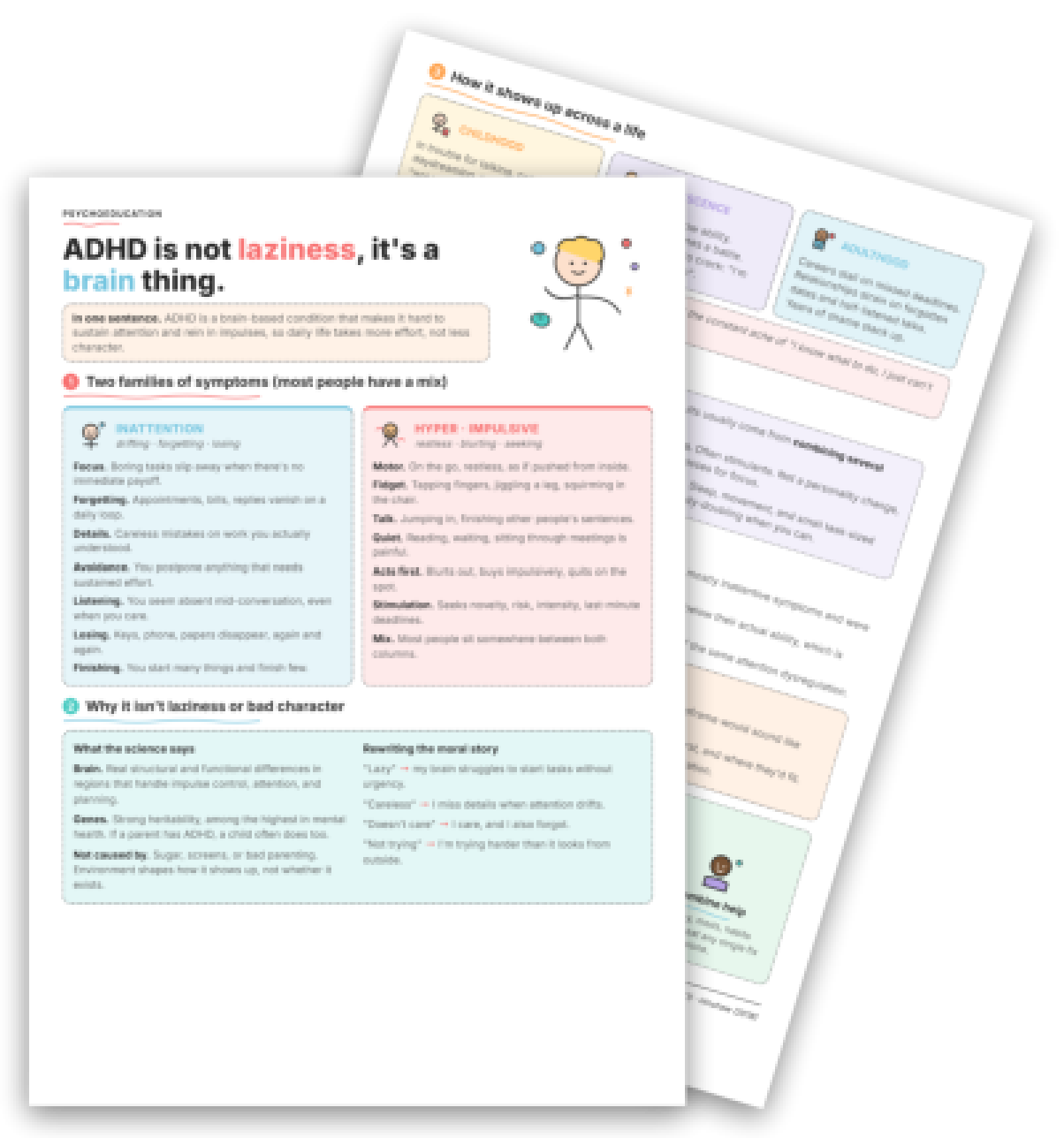
The fiche is organised across five clearly labelled panels, each targeting a different layer of the psychoeducation.
- Panel 1: two symptom columns. Inattention (drifting, forgetting, losing) and hyper/impulsive (restless, blurting, seeking) are laid out side by side, with a reminder that "most people sit somewhere between both columns." This dissolves the stereotype of the hyperactive child before the patient has time to reject the diagnosis as not applicable.
- Panel 2: the moral reframe. Four direct substitutions are printed verbatim: "Lazy" → my brain struggles to start tasks without urgency. Seeing the exact words they use about themselves matched to a neurobiological explanation has a defusion quality that mirrors cognitive restructuring work.
- Panel 3: a lifespan view. Childhood, adolescence, and adulthood are mapped in sequence, naming the accumulating shame and the inner experience of "I know what to do, I just can't make myself do it."
- Panel 4: what actually helps. Therapy and coaching, medication framed as "glasses for focus", external structure, and body basics are presented as a combined approach, not a hierarchy.
- Panel 5: myth-busting. Three common misconceptions are addressed directly, including hyperfocus as part of the same attention dysregulation, which surprises many patients with anxiety symptoms they have attributed to something else entirely.
At the bottom, three "To discuss in session" prompts guide you straight into clinical territory: the "lazy" self-label, practical support preferences, and any avoidance around the medication conversation.
> Key point: This fiche is not a self-administered questionnaire. It is a visual support that facilitates the explanation of ADHD in session, giving you a shared reference point, a common vocabulary, and a printable the patient takes home as a continuing anchor.
750+ clinical tools
A library built with and for clinicians, ready to use in session and extend between appointments.
Access all the toolsWhen and How to Introduce the Fiche
The optimal window is the second or third appointment, once the anamnèse is complete and the working alliance is established, but before the patient's self-critical framework has had time to consolidate further. It works well alongside managing ADHD skills tools and can be introduced with a simple frame: "I'd like to show you something that maps out what we've been discussing, so you have it in front of us both."
For adults with a long history of procrastination patterns or occupational difficulties, focus the debrief on Panel 2 first, letting the moral reframe do its work before moving to treatment options. For patients who are parents of a child with the same diagnosis, combine this sheet with the ADHD parenting strategies resource in a subsequent session. For adolescents, the children's ADHD tools and study tips for ADHD extend the work naturally.
Watch for the patient who engages intellectually with the fiche but continues using self-blaming language in the same session. That gap, between cognitive acceptance and affective integration, is your clinical target, and the shame/defectiveness schema work or cognitive distortion tools are the natural next layer. When depression or dysthymia is in the picture, the depression worksheet and ADHD management tips become relevant complements, since the two presentations reinforce each other in ways patients rarely anticipate.
The fiche does not replace formulation or therapeutic work on time management deficits. It establishes the conceptual and emotional ground on which that work can actually take root.
Use it with your patients
Share this tool in the mobile app and follow the work between sessions.
Sources
- Barkley, R. A., & Benton, C. M. (2021). Taking Charge of Adult ADHD (2nd ed.). Guilford Press.
- National Institute of Mental Health (NIMH) (2024). Attention-Deficit/Hyperactivity Disorder: What You Need to Know.
- National Institute of Mental Health (NIMH). ADHD in Adults: 4 Things to Know.
- American Psychiatric Association (2022). Diagnostic and Statistical Manual of Mental Disorders (5th ed., text revision; DSM-5-TR). American Psychiatric Association Publishing.
Your session continues in your patients' pocket
Use with a patientYour resources, available everywhere
The handouts, exercises, programs and audios above: you choose which ones to make available to your patients, in the mobile app dedicated to them.
And far more than a library
The app goes well beyond resources, to support your patients every day:
Related categories
Explore other clinical resources by category.

Neurodevelopment
Clinical hub for neurodevelopmental disorders: psychoeducation, worksheets and intervention tools for ADHD, ASD, learning disorders and related conditions.

Understand
Clinical hub for the therapeutic aim 'Understand': worksheets and tools to build patient insight across CBT, ACT, schema therapy and more.

CBT
CBT worksheets, cognitive restructuring exercises & behavioral tools for clinicians. Evidence-based resources for every phase of cognitive behavioral therapy.

Anxiety
Clinical hub for anxiety disorders: CBT and ACT worksheets, psychoeducation sheets, and exercises for assessment and treatment across the anxiety spectrum.

Trauma
Clinical hub on trauma and PTSD: assessment, differential diagnosis, treatment phases, and printable resources for practitioners. 155 chars.

Mood
Evidence-based worksheets and clinical tools for mood disorders: CBT, ACT, and positive psychology resources for psychologists and therapists.