
Clinical picture. M., a man in his late thirties, was referred following a manic episode that ended in significant financial loss and a marital separation. Three weeks into mood-stabiliser treatment, he remained ambivalent about his diagnosis, describing his elevated periods as "the only time I feel like myself." The clinician introduced the Bipolar Disorder Info Sheet, focusing on the section describing mania as an internal motor rather than a pleasurable state, and invited M. to read it aloud and pause wherever something resonated or felt wrong. He stopped at the line about damage appearing after the motor cuts off, sat quietly, and said this matched what his wife had been trying to tell him for years. This small shift in framing did not resolve his ambivalence, but it opened a more honest conversation about what treatment was actually protecting him from.
Bipolar Disorder: PDF Worksheet, Tools and Exercises for Clinical Practice
A structured psychoeducation PDF worksheet with clinical tools and exercises to help patients understand bipolar disorder, its two poles, and the pillars of treatment.
Clinical vignettes
Mania Reframed During Stabilisation
Addressing the 'Feeling Well' Discontinuation Risk
Clinical picture. T., a woman in her mid-forties with a confirmed bipolar I diagnosis, attended a routine session reporting that she had been stable for eight months and was seriously considering stopping her lithium. She attributed her current wellbeing to lifestyle changes and felt the medication was no longer necessary. The clinician used the Bipolar Disorder Info Sheet to review the misconception section together, particularly the point that feeling well is typically the moment to maintain treatment rather than withdraw it. T. acknowledged she had heard this before but had not connected it to her own reasoning until seeing it placed alongside the description of what the depressive and manic poles actually involve. She agreed to delay any medication decision and to bring her prescribing psychiatrist into the discussion at the next appointment.
Explaining bipolar disorder verbally in session is reliably harder than it looks. Patients nod, then return the next week describing a "bipolar moment" because they felt irritable after lunch. This fiche PDF exists to solve exactly that problem: it gives you a concrete visual support to anchor the psychoeducation, replace the word salad, and leave the patient with something they can re-read between sessions.
Use this resource with your patients
Handout, exercises and materials ready to use, right inside SessionFuel.
Why Bipolar Disorder Resists Explanation in Session
The core difficulty is conceptual compression. When you describe depression and mania in sequence, the patient is processing one pole while you are already explaining the other. The two-pole structure gets flattened into a vague "ups and downs" narrative that maps poorly onto the patient's lived experience, especially around mania.
Mania is where most misunderstanding lives. Patients, and often their families, arrive with a "happy high" model. The clinical reality is far more disruptive: driven, irritable, sleep-compressed, consequence-blind. Without a side-by-side comparison, the gap between "I was feeling great" and "I spent €4,000 in a weekend" stays psychologically unaccounted for.
Medication adherence is the second structural problem. The "I feel well, so I can stop" reasoning is one of the most consistent relapse drivers in bipolar care, and it is very hard to counter with words alone during a 45-minute session. A patient staring at a printed list that reads "Feeling well is usually the moment to keep treatment steady, not stop it" registers differently than hearing it once.
What the Fiche Contains: A Visual Support for Both Poles
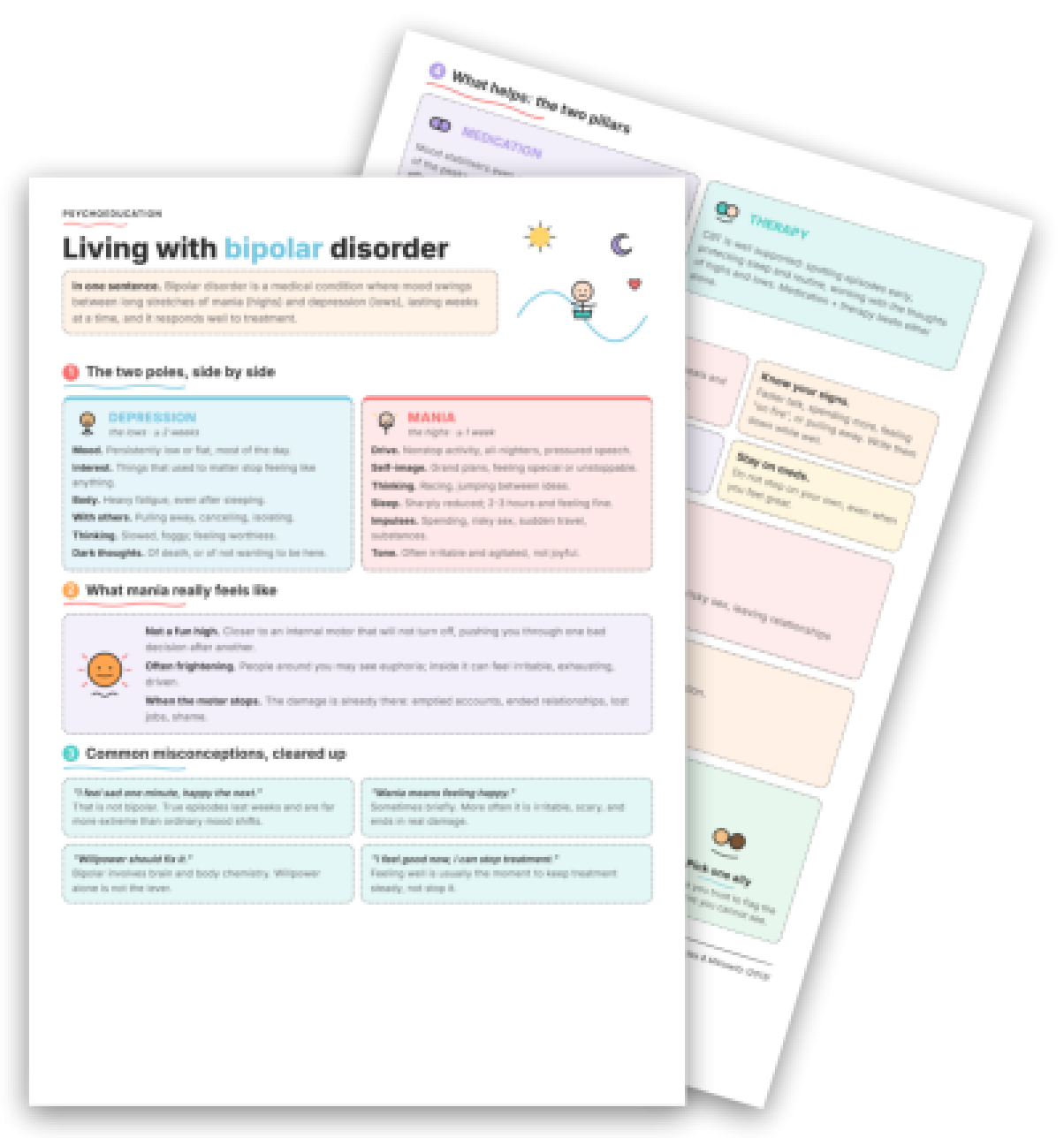
The fiche opens with a single plain-language definition of the disorder, then immediately moves into its most clinically useful panel: a side-by-side comparison of depression and mania, each with its own symptom list across mood, cognition, behavior, sleep, and social functioning. Seeing the two columns in parallel, rather than hearing them in sequence, is what the visual format makes possible. A patient can point to items and say "yes, that was me" across both columns, which is often the first moment genuine recognition lands.
Section 2 addresses what mania actually feels like from the inside: "closer to an internal motor that will not turn off, pushing you through one bad decision after another." This reframing is precisely what many patients need before they can stop glorifying past episodes.
Section 3 targets the four most treatment-interfering misconceptions directly: the "mood shift" confusion, the "happy high" myth, the willpower belief, and the "I'm better, I'll stop" trap. Each is answered with a single clear clinical correction. You can use this panel to anchor a shared vocabulary without lecturing.
The fiche then presents the two pillars (mood stabilisers and CBT), a short skills list covering sleep tracking, routine maintenance, early warning sign identification, and substance limitation, and a "To discuss in session" prompt block to structure what comes next therapeutically. For monitoring work between appointments, you can pair this with behavioral activation exercises for depression or a structured weekly activity planning tool.
> Key point: This fiche is a visual support that facilitates the explanation in session, not a self-administered checklist. You work through it with the patient, section by section, and they leave with a printed reference anchored in your shared clinical language.
750+ clinical tools
A library built with and for clinicians, ready to use in session and extend between appointments.
Access all the toolsWhen and How to Introduce It
The optimal window is after diagnostic disclosure and before the first deep psychoeducation session, typically sessions two or three. The fiche is most useful when the patient is euthymic enough to process information, and before a relapse has already been attributed to character or willpower.
For patients who arrive having already received a diagnosis elsewhere, the misconceptions panel (section 3) is your entry point. You might introduce it as: "Here is a sheet that directly addresses some of the things patients often tell me when they've just received this diagnosis. I'd like us to go through a few of these together." That framing avoids the didactic register and positions the fiche as a collaborative tool.
Profiles who benefit most:
- Patients in the post-manic phase, where shame and confusion are both high and insight is fragile
- Patients presenting with depressive symptoms who have not yet connected them to a bipolar framework
- Relatives attending a session, who need the two-pole structure explained without clinical jargon
- Patients where psychosis screening is also in play and you need a clear differential anchor
Debrief by returning to the "To discuss in session" block at the bottom of the fiche: sleep shifts, medication thoughts, and early warning sign identification. These three items map directly onto the emotion regulation work and rumination monitoring you may already be doing, and can structure the next several sessions without forcing a separate agenda.
The fiche does not replace the therapeutic alliance or the formulation. It makes the explanation cleaner, the vocabulary shared, and the patient less alone with information they would otherwise misremember.
Use it with your patients
Share this tool in the mobile app and follow the work between sessions.
Sources
- American Psychiatric Association (APA) (2022). Diagnostic and Statistical Manual of Mental Disorders, Fifth Edition, Text Revision (DSM-5-TR): Bipolar I and Bipolar II Disorders. American Psychiatric Association.
- National Institute for Health and Care Excellence (NICE) (2014). Bipolar Disorder: Assessment and Management (Clinical Guideline CG185). NICE.
- Colom, F., Vieta, E. (2006). Psychoeducation Manual for Bipolar Disorder. Cambridge University Press.
- Lam, D. H., Jones, S. H., Hayward, P. (2010). Cognitive Therapy for Bipolar Disorder: A Therapist's Guide to Concepts, Methods and Practice (2nd ed.). Wiley.
- Clery-Melin, M. L., Papeta, N., Lebon, F., Fal, M., Polosan, M. (2023). Current Practices of Psychoeducation Interventions with Persons with Bipolar Disorders: A Literature Review. Frontiers in Psychiatry.
Your session continues in your patients' pocket
Use with a patientYour resources, available everywhere
The handouts, exercises, programs and audios above: you choose which ones to make available to your patients, in the mobile app dedicated to them.
And far more than a library
The app goes well beyond resources, to support your patients every day:
Related categories
Explore other clinical resources by category.

Mood
Evidence-based worksheets and clinical tools for mood disorders: CBT, ACT, and positive psychology resources for psychologists and therapists.

Understand
Clinical hub for the therapeutic aim 'Understand': worksheets and tools to build patient insight across CBT, ACT, schema therapy and more.

CBT
CBT worksheets, cognitive restructuring exercises & behavioral tools for clinicians. Evidence-based resources for every phase of cognitive behavioral therapy.
Anxiety
Clinical hub for anxiety disorders: CBT and ACT worksheets, psychoeducation sheets, and exercises for assessment and treatment across the anxiety spectrum.

Trauma
Clinical hub on trauma and PTSD: assessment, differential diagnosis, treatment phases, and printable resources for practitioners. 155 chars.

Identity
Clinical resources for self-identity work in therapy: CBT, ACT, schema tools for clinicians addressing self-concept, core beliefs, and identity disruption.