
Clinical picture. M., a woman in her mid-forties, presented twenty-six months after the death of her husband, reporting that she felt she "should be over it" but had recently begun setting two coffee cups out each morning without noticing. In session, the clinician introduced the tasks-of-mourning worksheet as a psychoeducational reference, naming what M. was experiencing as Task 1 work resurfacing, not regression. Using the sheet's framing, they discussed how the body and the daily routine often lag behind cognitive acceptance by months or years. M. expressed visible relief at the idea that no deadline applied and that revisiting a task carried no clinical significance of failure. She left with the worksheet and agreed to notice, without judgment, which task felt most alive on any given day.
Tasks of Mourning: PDF Worksheet, Tools and Exercises for Clinical Practice
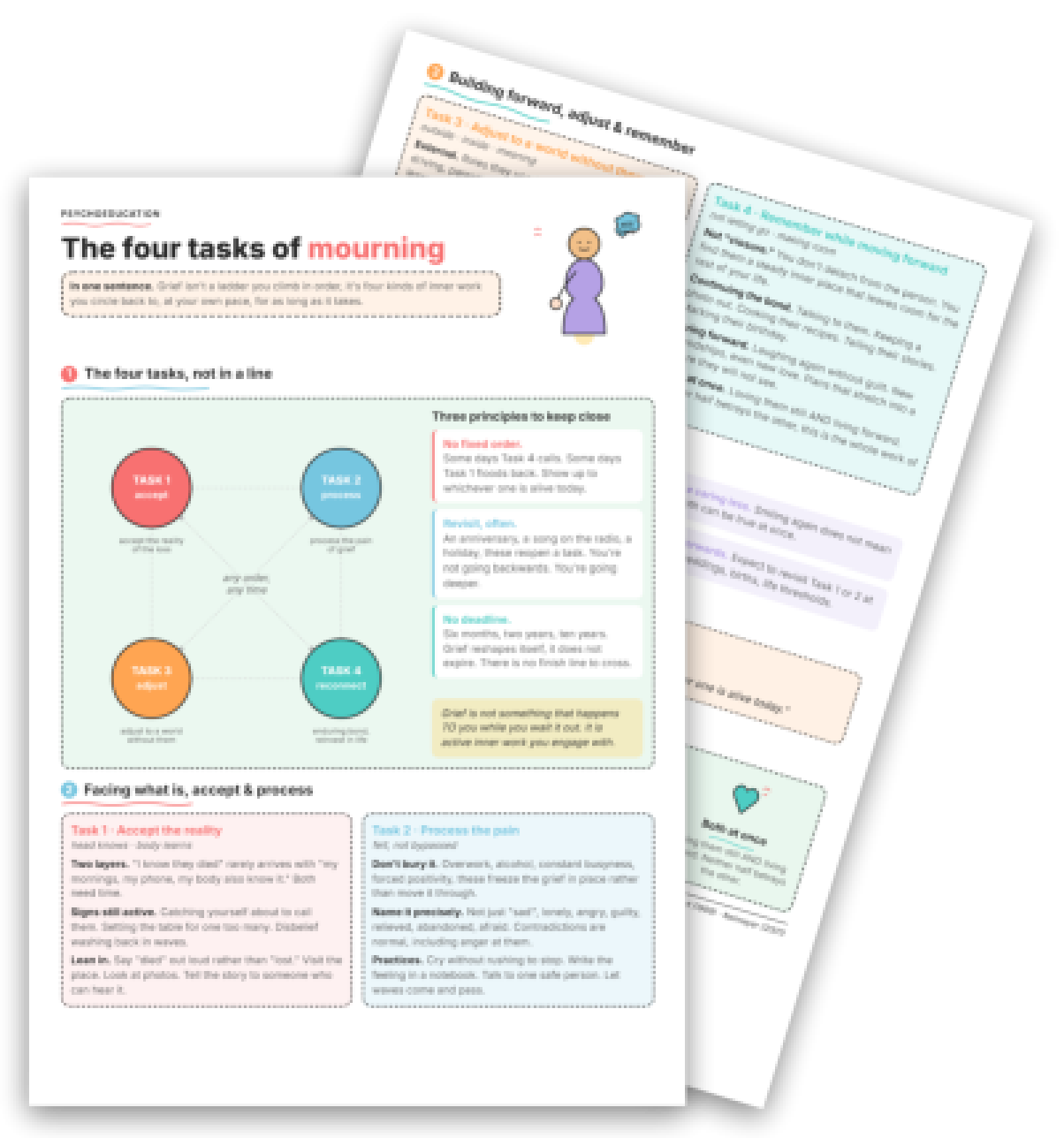
A visual quick-reference fiche to explain Worden's four tasks of mourning in session, build a shared vocabulary with grieving patients, and normalise the non-linear work of grief.
Clinical vignettes
Task 1 Flooding Back at Year Two
Naming Contradictory Affect in Bereavement
Clinical picture. R., a man in his early thirties, was seen eight months after losing his father to a prolonged illness; he described feeling "nothing but guilt" because alongside grief he noticed relief, and he assumed this disqualified his mourning as genuine. The clinician used the quick-reference sheet to anchor a brief psychoeducation segment on Task 2, pointing specifically to the note that contradictory affects, including relief and anger directed at the deceased, are within normal range. R. had been managing the discomfort through sustained overwork, which the sheet named explicitly as a pattern that freezes rather than moves grief. Over the following two sessions, R. began experimenting with brief written reflection after work, a low-demand practice consistent with the worksheet's suggestions, and reported that naming "relieved" alongside "bereft" reduced rather than amplified his shame.
Explaining Worden's task model to a grieving patient in session is genuinely harder than it looks. The concept is clinically precise, but patients arrive with Kübler-Ross in their heads, and the gap between "stages you pass through" and "work you engage with, in any order, for as long as it takes" is not one that resolves with a verbal explanation alone. This fiche PDF gives you a visual support to close that gap in real time.
Use this resource with your patients
Handout, exercises and materials ready to use, right inside SessionFuel.
Why the task model resists oral explanation
The core difficulty is not complexity; it is the patient's prior mental model. Most people who enter grief work have already absorbed the five-stage framework from popular culture, and that model carries two assumptions the task approach directly contradicts: that grief has a fixed sequence, and that it has a finish line. When you explain Worden's framework verbally, patients frequently hear it through the stage lens and assimilate it into something it is not.
There is a second resistance point. Grieving patients are often already harsh judges of their own progress. The moment Task 1 ("accept the reality of the loss") floods back on an anniversary or during a routine commute, many interpret that as regression. Communicating that "revisiting a task isn't failure; it's depth" in spoken words during a distressed session rarely lands with enough authority to override the patient's shame about "going backwards." A concrete printed reference does more than repetition.
The third layer is identity disruption, especially around Task 3. The shift from "I am a wife" to "I am a widow" the fiche names explicitly rarely gets articulated in session without a prompt. The visual triggers it.
750+ clinical tools
A library built with and for clinicians, ready to use in session and extend between appointments.
Access all the toolsWhat the fiche contains, and what the visual layout adds
The fiche is structured across six panels. The first presents the four tasks at a glance: accept, process, adjust, reconnect, laid out with the explicit note "any order, any time". That single visual fact, rendered as a design choice rather than a spoken caveat, communicates non-linearity more effectively than any amount of explanation.
Three anchor principles follow: no fixed order, revisit often, no deadline. Then the fiche moves into paired deep-dives: Tasks 1 and 2 together under "Facing what is", and Tasks 3 and 4 under "Building forward". Each task is broken down into clinical sub-layers. Task 1 distinguishes between the cognitive layer ("I know they died") and the somatic layer ("my body also knows it"), with behavioural signs still active listed for recognition. Task 2 names specific affective labels beyond "sad": "lonely, angry, guilty, relieved, abandoned, afraid", and identifies maladaptive avoidance patterns (overwork, forced positivity) that freeze rather than move grief through.
Task 4 addresses the most clinically delicate point: the difference between detachment and continuing the bond. The phrase "Both at once. Loving them still AND living forward. Neither half betrays the other" gives patients language for something that often sits as an unspoken fear.
A "Common confusions" panel directly corrects the stages conflation and addresses the "crying less equals caring less" misread. The closing panel offers three short phrases patients can keep close.
> Key clinical point: this fiche is not a questionnaire patients complete at home. It is a visual support you use during the session itself to explain a nuanced framework, reduce shame, and leave the patient with a concrete printed reference they can return to between appointments.
Use it with your patients
Share this tool in the mobile app and follow the work between sessions.
How and when to introduce it
The fiche fits naturally from the second or third session onward, once the initial anamnèse is complete and alliance thérapeutique is established enough to introduce psychoeducation without it feeling premature. It is particularly useful when a patient describes guilt about "not grieving correctly," when avoidance patterns (for instance, the kind addressed in resources on adaptive versus maladaptive coping strategies) are visible, or when the therapeutic work with prolonged grief disorder requires you to distinguish normal task-cycling from pathological avoidance.
A low-threshold introduction: "I want to show you a framework that a lot of people find helpful for understanding what grief actually asks of us. It's different from the stages model you may have heard of." From there, you walk through the fiche together rather than handing it over cold.
Debrief by asking which task feels most alive right now, and which feels most resisted. That question often opens directly into the session's clinical work. With patients presenting death anxiety alongside bereavement, Task 1's somatic layer deserves specific attention. For patients where radical acceptance is already a working concept from DBT, the "no deadline" principle maps cleanly onto existing vocabulary.
Pair the fiche with grief psychoeducation resources, grief myths, or the worksheet on maintaining the bond differently for patients working on Task 4 specifically. For the affective processing dimension of Task 2, the sadness psychoeducation program provides structured follow-up between sessions. Patients with comorbid trauma reactions may need the bereavement work sequenced carefully alongside trauma-focused interventions before the task model can be fully engaged.
One practical limit: the fiche works for adults navigating uncomplicated or complicated bereavement. With acute crisis presentations, or when prolonged grief disorder is the primary formulation, psychoeducation alone is insufficient and the fiche should be embedded within a more structured intervention framework.
The fiche does not replace the therapeutic container. It makes one genuinely difficult concept visible, names it precisely, and sends the patient away with something tangible to hold.
Your session continues in your patients' pocket
Use with a patientYour resources, available everywhere
The handouts, exercises, programs and audios above: you choose which ones to make available to your patients, in the mobile app dedicated to them.
And far more than a library
The app goes well beyond resources, to support your patients every day:
Related categories
Explore other clinical resources by category.

Mood
Evidence-based worksheets and clinical tools for mood disorders: CBT, ACT, and positive psychology resources for psychologists and therapists.

Understand
Clinical hub for the therapeutic aim 'Understand': worksheets and tools to build patient insight across CBT, ACT, schema therapy and more.

Repair & soothe
Clinical resources for the repair and soothe therapeutic aim: worksheets, exercises and tools to build self-compassion, reduce shame and restore emotional safety.

Humanistic
Printable clinical resources for humanistic therapy: worksheets, exercises, and psychoeducation programs for practitioners using person-centered and experiential approaches.

Integrative
Integrative therapy clinical resources: worksheets, psychoeducation programs, and exercises for eclectic, multimodal practice across orientations.

Anxiety
Clinical hub for anxiety disorders: CBT and ACT worksheets, psychoeducation sheets, and exercises for assessment and treatment across the anxiety spectrum.