
Clinical picture. M., a woman in her mid-forties, presented with persistent low mood and sleep disruption three years after a serious boundary violation by a former employer. Her GP had suggested she "try to forgive and move on," and she arrived describing herself as a failure for not having done so. The clinician introduced the informational sheet on forgiveness in session, working through the distinction between forgiveness and condoning, and between forgiveness and reconciliation. M. noted visible relief when reading that forgiveness is a slow, non-linear process rather than a single decision. By the following session she reported less self-criticism, though the resentment itself remained present and was acknowledged as appropriate material for continued work.
How to Forgive: PDF Worksheet, Tools and Exercises for Clinical Practice
A structured PDF worksheet with psychoeducation tools and exercises to help clinicians explain, normalize, and pace forgiveness work in individual and couples therapy.
Clinical vignettes
Psychoeducation Before Premature Closure
Somatic Carrying and Readiness Assessment
Clinical picture. T., a man in his early thirties, disclosed longstanding anger toward a parent who had been intermittently abusive during his adolescence. He described a recurring tightness in his chest whenever he heard his father's name, consistent with the somatic markers outlined in the sheet's second section. The clinician used the worksheet to map T.'s current position on the readiness continuum, identifying that family pressure to reconcile was actively interfering with any organic movement toward release. Rather than framing forgiveness as a treatment goal, the clinician and T. agreed to focus first on affect regulation and grief work, with forgiveness left as a possibility rather than an expectation. T. reported feeling less trapped by the framing once the distinction between forgiving and absolving had been made explicit.
Explaining forgiveness in session is rarely straightforward. Patients collapse it with condoning, reconciling, or forgetting, and that semantic confusion stops the work before it starts. This PDF worksheet gives you a shared visual map to work from, so the psychoeducation lands precisely instead of landing in a fog.
Use this resource with your patients
Handout, exercises and materials ready to use, right inside SessionFuel.
Why Forgiveness Resists Explanation in Session
The core difficulty is definitional overload. When a patient hears "forgiveness," they simultaneously hear "what they did was acceptable," "I have to let them back in," and "I'm supposed to feel okay now." All three are clinically inaccurate, and correcting them orally, one by one, takes session time and rarely sticks.
A second obstacle is the non-linear phenomenology of the process itself. Patients who feel they have made progress on forgiveness and then experience a renewed surge of anger conclude they have failed. That false conclusion is a clinical setback you end up managing reactively. The same patients who read the research on rumination and emotional cost in another context still need the specific frame that anger returning is built into the forgiveness process, not evidence that it collapsed.
A third challenge: pressure to forgive from family, religious community, or couples dynamics creates an ambivalent alliance to the concept. The patient who feels coerced will dismiss any oral explanation as more pressure. You need a neutral third object to point at.
What the Worksheet Contains
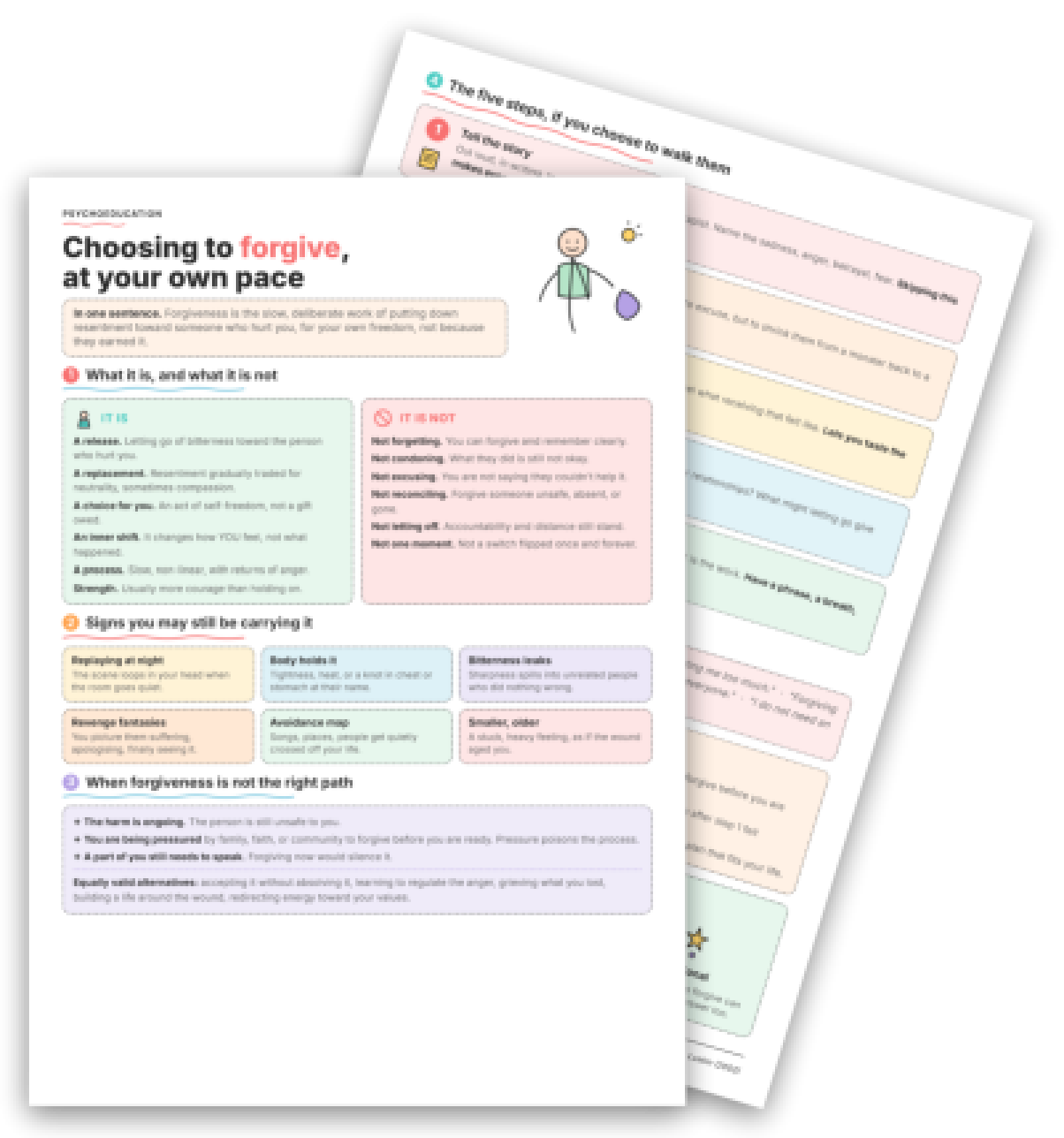
The fiche opens with a single definitional sentence that immediately corrects the most common distortion: "Forgiveness is the slow, deliberate work of putting down resentment toward someone who hurt you, for your own freedom, not because they earned it." That sentence alone redirects the frame from the perpetrator to the patient. Reading it together in session typically generates a pause you can use.
The visual layout then works in five structured panels:
- What it is, and what it is not: a side-by-side contrast (six items each) separating forgiveness from forgetting, condoning, excusing, reconciling, and letting accountability drop. This is the section that does the most definitional work visually. The symmetry on the page makes the distinctions tangible in a way that oral enumeration does not.
- Signs you may still be carrying it: six somatic and behavioral markers (nocturnal replay, bodily tension, bitterness leaking into unrelated relationships, revenge fantasies, avoidance mapping, a sense of shrinking). Useful for patients who intellectually claim they have moved on but continue to present with the phenomenology of unresolved anger.
- When forgiveness is not the right path: three clear contraindications, including ongoing harm, external pressure, and a part still needing to speak. The fiche explicitly names "equally valid alternatives" including accepting without absolving, grieving what was lost, and redirecting energy toward values. This panel is clinically important for patients in high-pressure relational or spiritual contexts.
- The five steps: a sequenced process from naming the story and affect (step 1) through maintaining the choice under returning anger (step 5). Step 2, "see a flawed human," is flagged as the hardest for most patients. This sequence maps naturally onto your formulation and gives you a shared language for tracking where the patient is stalled.
- Inner phrases to borrow: short self-talk phrases ("I do not need an apology to be free") the patient can carry between sessions.
> Key takeaway: the worksheet is a visual support that facilitates the explanation in session, not a self-help checklist the patient fills out alone. The side-by-side "is / is not" layout, the somatic sign inventory, and the sequenced steps make a complex, emotionally charged concept readable at a glance, giving the therapeutic conversation a shared object to work from.
The fiche also includes three specific "To discuss in session" prompts, grounding the handout firmly in the clinical relationship rather than autonomous use.
750+ clinical tools
A library built with and for clinicians, ready to use in session and extend between appointments.
Access all the toolsWhen and How to Introduce the Worksheet
The worksheet fits best after a solid alliance is established and the patient has already named the relational wound, typically from session three onward when guilt and shame are part of the clinical picture, or when trust rupture in a couple has been named as the presenting concern. It is equally indicated when grief and unresolved resentment are entangled, or when a patient shows the somatic and rumination markers described in the fiche without having named forgiveness as a goal.
For patients who feel pressured to forgive, introduce it with a framing like: "I want to show you something that starts from the premise that forgiveness is optional, and that it's something you'd do for yourself, not for them. Let's look at it together." That framing disarms the coercive associations before the patient reads a single word.
For patients using avoidance as a primary coping mode, the "avoidance map" marker in section two often opens productive dialogue. For those processing relational trauma, the explicit contraindication panel coordinates well with common trauma reactions already on your formulation.
Debrief by asking which item in the "It is NOT" panel surprised them most. That answer typically tells you exactly where the psychoeducation needs to go next. The worksheet does not replace the clinical frame; it makes the explanation precise enough to work from.
Use it with your patients
Share this tool in the mobile app and follow the work between sessions.
Sources
- Enright, R. D., & Fitzgibbons, R. P. (2015). Forgiveness Therapy: An Empirical Guide for Resolving Anger and Restoring Hope. American Psychological Association.
- Luskin, F. (2002). Forgive for Good: A Proven Prescription for Health and Happiness. HarperOne.
- Worthington, E. L., Jr.. REACH Forgiveness: The Model and Free Workbooks.
- Enright, R. D. (2001). Forgiveness Is a Choice: A Step-by-Step Process for Resolving Anger and Restoring Hope. American Psychological Association.
Your session continues in your patients' pocket
Use with a patientYour resources, available everywhere
The handouts, exercises, programs and audios above: you choose which ones to make available to your patients, in the mobile app dedicated to them.
And far more than a library
The app goes well beyond resources, to support your patients every day:
Related categories
Explore other clinical resources by category.

Trauma
Clinical hub on trauma and PTSD: assessment, differential diagnosis, treatment phases, and printable resources for practitioners. 155 chars.

Mood
Evidence-based worksheets and clinical tools for mood disorders: CBT, ACT, and positive psychology resources for psychologists and therapists.

Emotions
Clinical resources on emotion regulation: worksheets, coping tools, CBT, REBT, and ACT exercises for therapists working across diagnoses and age groups.

Relationships
Clinical worksheets and tools on relational functioning: attachment, schemas, assertiveness, and communication skills for therapists. Printable PDF resources.

Understand
Clinical hub for the therapeutic aim 'Understand': worksheets and tools to build patient insight across CBT, ACT, schema therapy and more.

Regulate
Clinical resources for emotion regulation: worksheets, ACT exercises, and psychoeducation tools for affect regulation across diagnoses. For clinicians.