
Clinical picture. A., a woman in her late forties, presented with persistent low mood and rumination following a serious betrayal by a close family member, with whom she had severed contact two years prior. She reported feeling unable to "move forward" because, in her words, she was not ready to let the person back into her life and therefore believed forgiveness was impossible for her. The clinician introduced the informational sheet during session, focusing specifically on the forgiveness-reconciliation split: that an inner release of resentment neither requires resumed contact nor signals that the original harm was acceptable. A. read the side-by-side table aloud and paused at "An inner shift you do alone. No contact required." Over the following two sessions she began to distinguish her self-protective boundary from a block on her own psychological process, which allowed grief work to resume.
What Forgiveness Is Not: PDF Worksheet, Tools and Exercises
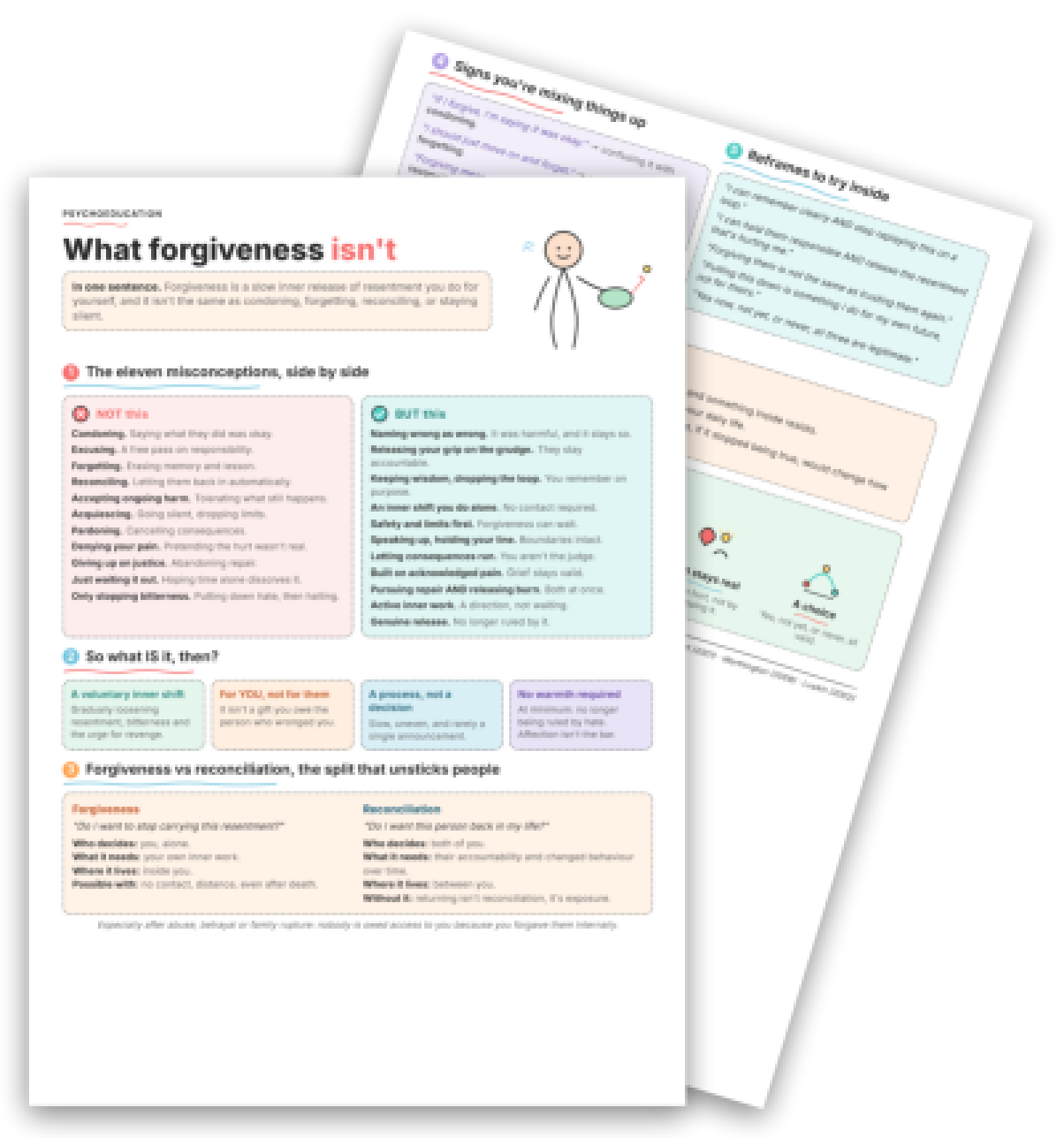
A visual psychoeducation worksheet helping clinicians clarify the eleven most common forgiveness misconceptions and separate forgiveness from reconciliation in session.
Clinical vignettes
Stalled by the Reconciliation Equation
Forgiveness Mistaken for Erasure
Clinical picture. T., a man in his mid-thirties, was working through the aftermath of childhood neglect in a trauma-focused therapy. He resisted any discussion of forgiveness, stating that forgiving his parent would mean "pretending it never happened" and would invalidate years of pain. The clinician used the informational sheet to name this as the forgetting misconception, contrasting it with the formulation "Keeping wisdom, dropping the loop: you remember on purpose." T. found the phrase "built on acknowledged pain; grief stays valid" particularly useful, as it made explicit that releasing resentment does not require minimising the original injury. He did not arrive at forgiveness within that session, but reported that the reframe reduced his sense that engaging with the concept was a betrayal of his own history.
Forgiveness is one of those concepts patients arrive with already half-formed. They conflate it with condoning, with forgetting, with granting relational access, and that conflation stalls the work before it starts. This fiche PDF gives you a concrete visual support to dismantle those misconceptions directly in session, before a faulty equation derails the therapeutic process.
Use this resource with your patients
Handout, exercises and materials ready to use, right inside SessionFuel.
Why forgiveness misconceptions block clinical progress
The difficulty isn't explaining what forgiveness is. It's correcting what patients already believe it to be. Most arrive having internalised at least one of the common equations: forgiveness equals excusing, reconciliation is its automatic consequence, anger must be fully gone before "real" forgiveness is possible. Correcting these one by one at the oral level costs session time and rarely lands cleanly; the patient nods, but the schema is still intact.
This is compounded by external pressure: family expectations, religious frameworks, cultural scripts. As the fiche states plainly, "forgiveness under pressure is compliance, and it rarely takes." That distinction between genuine inner release and performed capitulation is clinically decisive, particularly in trauma work and post-abuse processing. Patients mapping their experience with the mistrust/abuse schema or processing material tied to the cycle of abuse often resist the word "forgiveness" entirely because they read it as a demand to minimise what happened. A precise vocabulary for what forgiveness is not frequently removes that resistance faster than any reframe you could offer verbally.
The same block appears in complicated grief contexts, where patients confuse releasing resentment with betraying their own loss. Naming the confusion out loud, with the patient looking at a structured visual, changes the register of the conversation.
What the fiche contains: a map of eleven misconceptions
The fiche is organised into five panels, and each does work that oral explanation alone cannot replicate.
The centrepiece is a side-by-side table of eleven misconceptions: left column, the distorted version ("Condoning. Saying what they did was okay."); right column, the corrected version ("Naming wrong as wrong. It was harmful, and it stays so."). Seeing both columns simultaneously makes the contrast visible and locatable. Patients can point to the specific row blocking them, which is much harder to do when the distinctions live only in spoken language.
Panel 3 separates forgiveness from reconciliation in a two-column visual split covering who decides, what it requires, where it lives, and whether contact is necessary at all. This is the distinction, the fiche notes, that "unsticks people", especially after abuse, betrayal, or family rupture. The explicit statement that nobody is owed access because you forgave them internally is worth lingering on with patients who conflate boundary-setting with unforgiveness. You can pair this panel with resources on boundary types when relational re-entry is an active question.
Panel 4 lists five "mixing things up" signs, each as a faulty belief followed by its named confusion (for instance, "I should just move on and forget" flagged as "confusing it with forgetting"). The format makes self-identification quick and non-shaming. Panel 5 offers five reframes grounded in ACT-adjacent language, "I can hold them responsible AND release the resentment that's hurting me", that the patient can carry between sessions. The "To discuss in session" prompts close the sheet by handing the dialogue back to you: "Which of these misconceptions has been blocking you, and which one, if it stopped being true, would change how you feel?"
> To remember: this fiche is a visual support that facilitates the explanation of forgiveness in session, not a questionnaire the patient fills out alone. You walk through it together, and they leave with a concrete reference they can return to.
750+ clinical tools
A library built with and for clinicians, ready to use in session and extend between appointments.
Access all the toolsWhen and how to introduce it in session
The fiche earns its place once a patient has named forgiveness as a goal, a sticking point, or a source of ambivalence, typically from mid-therapy onward, after the alliance is solid and the injury has been adequately mapped. Introducing it before the patient has processed the hurt risks it being read as pressure.
A low-friction opener: "There's a lot of confusion around what forgiveness actually means. Let me show you something that might help us find the right words together." From there, work through the misconception table collaboratively, asking which row the patient recognises in themselves. The forgiveness-versus-reconciliation panel deserves its own pause, particularly in partner betrayal presentations or estranged family situations where internal forgiveness and physical proximity are being dangerously conflated.
For patients with strong self-blame patterns, sequence this sheet before the self-forgiveness worksheet in a subsequent session. The closing note, "Yes, not yet, or never, all three are legitimate", is worth reading aloud: it removes the implicit demand that forgiveness must happen, which is often the weight making the topic feel dangerous in the first place.
Build a complete psychoeducation arc by pairing this fiche with Forgiveness in Therapy, How to Forgive, Unforgiveness: The Hook, and How to Apologize as the work progresses. The fiche does not replace clinical processing of the injury; it clears the conceptual ground so that processing can actually begin.
Use it with your patients
Share this tool in the mobile app and follow the work between sessions.
Sources
- Enright, R. D., Fitzgibbons, R. P. (2015). Forgiveness Therapy: An Empirical Guide for Resolving Anger and Restoring Hope. American Psychological Association.
- Enright, R. D. (2001). Forgiveness Is a Choice: A Step-by-Step Process for Resolving Anger and Restoring Hope. APA Books.
- Luskin, F. (2002). Forgive for Good: A Proven Prescription for Health and Happiness. HarperCollins.
- Worthington, E. L., Jr. (2003). Forgiving and Reconciling: Bridges to Wholeness and Hope. InterVarsity Press.
- Worthington, E. L., Jr. (2006). Forgiveness and Reconciliation: Theory and Application. Routledge.
Your session continues in your patients' pocket
Use with a patientYour resources, available everywhere
The handouts, exercises, programs and audios above: you choose which ones to make available to your patients, in the mobile app dedicated to them.
And far more than a library
The app goes well beyond resources, to support your patients every day:
Related categories
Explore other clinical resources by category.

Trauma
Clinical hub on trauma and PTSD: assessment, differential diagnosis, treatment phases, and printable resources for practitioners. 155 chars.

Mood
Evidence-based worksheets and clinical tools for mood disorders: CBT, ACT, and positive psychology resources for psychologists and therapists.

Emotions
Clinical resources on emotion regulation: worksheets, coping tools, CBT, REBT, and ACT exercises for therapists working across diagnoses and age groups.

Relationships
Clinical worksheets and tools on relational functioning: attachment, schemas, assertiveness, and communication skills for therapists. Printable PDF resources.

Understand
Clinical hub for the therapeutic aim 'Understand': worksheets and tools to build patient insight across CBT, ACT, schema therapy and more.

Repair & soothe
Clinical resources for the repair and soothe therapeutic aim: worksheets, exercises and tools to build self-compassion, reduce shame and restore emotional safety.