
Clinical picture. M., a woman in her early forties, presented with persistent rumination and sleep difficulties following the discovery that her partner had concealed significant financial debt over several years. She described oscillating between rage and self-doubt, and reported that couple conversations consistently escalated before any issue could be examined calmly. The clinician introduced the guided reflection exercise as between-session homework, framing it as a structured way to slow down her thinking rather than a decision-making tool. Working through the questions across the following week, M. rated the severity of the concealment at 8 out of 10 and noted that transparency was a core personal value, which helped her articulate why the breach felt disproportionate to what her partner minimised as "a practical problem." At the next session she reported that question three, on imagining forgiveness, had surprised her: she had not anticipated feeling relief rather than weakness, and this shifted the focus of therapy toward clarifying what conditions, if any, she would need before trust could be rebuilt.
Loss of Trust in a Partner: A Guided Reflection Exercise
A structured homework exercise helping patients examine what broke their trust, weigh emotional interference, and explore the possibility of forgiveness.
Clinical vignettes
Weighing Betrayal After Repeated Lies
Distinguishing Mistrust from Prior Attachment Wounds
Clinical picture. T., a man in his mid-thirties with a history of anxious attachment, sought consultation after becoming convinced his partner was emotionally withdrawing from the relationship, despite an absence of concrete incidents he could name. He acknowledged that previous relationships had ended with abandonment and that his monitoring behaviour was creating friction. The clinician offered the exercise to help T. separate what he could observe from what he was anticipating, specifically drawing his attention to question two regarding the role of emotion and ego in appraisal. T. returned having scored the perceived offences at 3 out of 10, and written that he struggled to list specific triggering events beyond "a feeling." This distinction, made visible through his own written responses, gave the clinician concrete material to begin differentiating relational mistrust from anticipatory anxiety rooted in earlier experience.
When trust breaks: what makes this so hard to work with clinically
Loss of trust in a partner sits at one of the most charged intersections in couples work. Patients typically arrive with a mixture of raw indignation, grief, self-protective certainty, and real confusion about what they actually feel beneath it all. The difficulty is not that they cannot speak about what happened. They can, often at length. The difficulty is that verbal recounting in session rarely produces the calm analytical distance required to begin moving. Emotion and ego fold into each other, and the patient finds themselves either rehearsing grievances or defending themselves against their own doubts.
What is also hard to convey through conversation alone is the values dimension: not just "was this wrong?" but "how deeply does this contradict what genuinely matters to me?" That question requires time and solitude to answer honestly. A short guided homework exercise is often better placed than the session itself to create that space.
The Trust in Relationships: A 4-Lesson Psychoeducation Program can provide useful psychoeducational scaffolding around this work, and the Mistrust/Abuse Schema worksheet is worth considering when loss of trust activates older relational injuries.
Use this resource with your patients
Handout, exercises and materials ready to use, right inside SessionFuel.
What the exercise contains
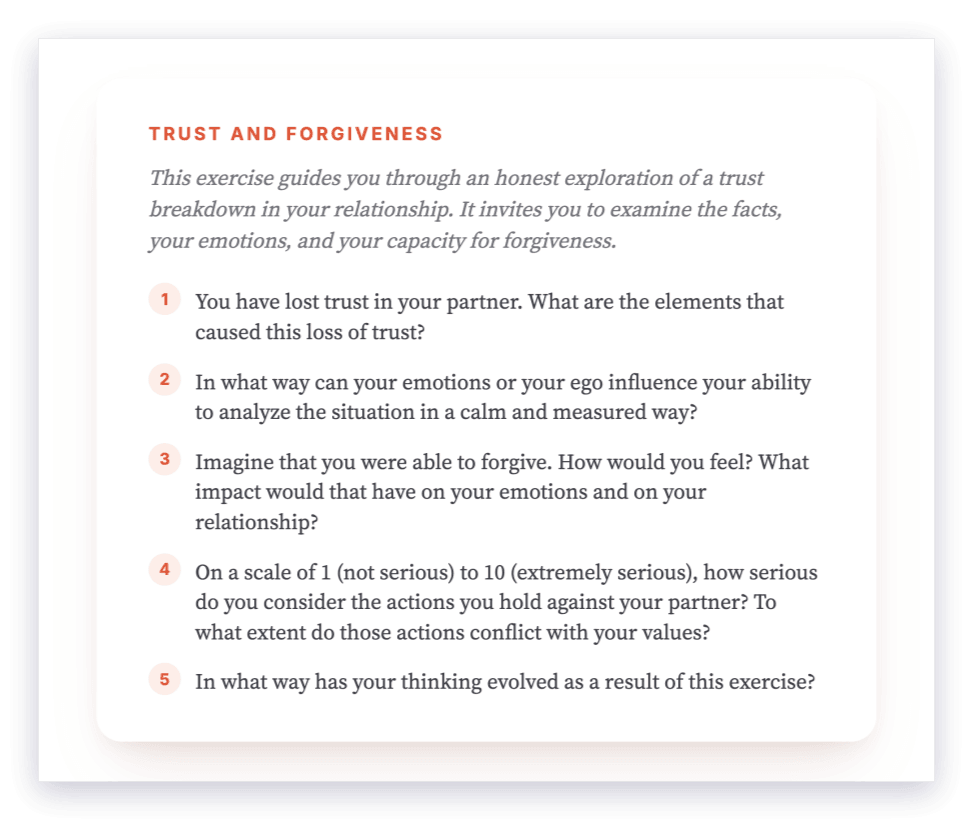
The exercise is built around five sequential questions that move the patient from factual grounding toward genuine self-examination.
The first question asks the patient to name the concrete events that produced the loss of trust, making explicit what is often kept implicit. The second immediately introduces friction: it invites the patient to consider how their emotions and ego might be distorting a calm reading of the situation. This is the exercise's most clinically significant move, because it does what a clinician's direct challenge sometimes cannot, it asks the patient to voice the interference themselves.
The third question uses a conditional imagining of forgiveness: how would the patient feel, and what would change in the relationship, if they were able to forgive? This is not a push toward reconciliation. It is a way of making the emotional cost of not forgiving legible. For patients working alongside resources like How to Forgive or the Forgiveness in Therapy fiche, this question provides a lived complement to the conceptual content.
The fourth question asks the patient to rate the gravity of the facts on a 1 to 10 scale and to reflect on the degree to which those facts conflict with their personal values. This dual prompt creates useful separation between emotional intensity and actual moral weight, a distinction that is easy to name clinically but hard for patients to feel on their own. The Relationship Values worksheet and resources on core values clarification pair naturally here.
The fifth question asks the patient to notice how their thinking has shifted through the exercise itself, turning the process into an object of reflection.
The image above lists the five questions in order with a short introductory framing. It is a static preview only: the complete guided exercise, with patient-facing instructions and space to write responses, is delivered through the app interface the patient uses on their own, not through this image.
This exercise is available to patients through the mobile application that is the dedicated patient-side interface of SessionFuel: the clinician assigns it directly from their SessionFuel account, and the patient then completes it autonomously on their phone, between appointments, at their own pace.
750+ clinical tools
A library built with and for clinicians, ready to use in session and extend between appointments.
Access all the toolsUse it with your patients
Share this tool in the mobile app and follow the work between sessions.
Integrating this as between-session homework
This exercise suits patients who are past the acute crisis phase of a trust breach and have enough stabilisation to engage reflectively rather than reactively. It is appropriate in individual therapy with a patient navigating whether to repair or exit a relationship, and in couples work where one partner needs to process their experience privately before any joint conversation.
To introduce it, a brief frame works well: something like explaining that written reflection tends to access a different quality of thinking than spoken conversation, and that the exercise will ask some questions they have likely not put into words yet. For patients where ego-protective patterns are prominent, the Ego and Pride exercise or the Anger Self-Reflection exercise can be assigned beforehand to warm up that self-questioning capacity.
When the patient returns, the gravity rating from question four is often the most productive entry point: it invites a conversation about the gap between felt intensity and assessed severity. The imagined-forgiveness response in question three tends to surface ambivalence that the patient did not know they were carrying, and that ambivalence deserves space before any practical decision-making. The Detecting Couple Misalignment exercise and the Weekly Couples Relationship Check-In can be sequenced afterward to move from individual reflection toward relational planning.
Key insight: The exercise's core clinical value is not that it answers whether trust can be repaired. It is that it helps the patient separate what happened, how they feel about it, and what it means to them into three distinct layers, which is exactly the work that emotional flooding prevents in session.
For patients where the loss of trust intersects with jealousy patterns or fear of partner leaving, the written output can reveal whether the presenting rupture is genuinely about the current event or whether it is amplified by older attachment material, a distinction worth tracking as the clinical work continues.
Your session continues in your patients' pocket
Use with a patientYour resources, available everywhere
The handouts, exercises, programs and audios above: you choose which ones to make available to your patients, in the mobile app dedicated to them.
And far more than a library
The app goes well beyond resources, to support your patients every day:
Related categories
Explore other clinical resources by category.

Relationships
Clinical worksheets and tools on relational functioning: attachment, schemas, assertiveness, and communication skills for therapists. Printable PDF resources.

Repair & soothe
Clinical resources for the repair and soothe therapeutic aim: worksheets, exercises and tools to build self-compassion, reduce shame and restore emotional safety.

Emotion-focused
Emotion-focused therapy clinical resources: worksheets, exercises & programs for EFT practitioners working with individuals and couples.

Anxiety
Clinical hub for anxiety disorders: CBT and ACT worksheets, psychoeducation sheets, and exercises for assessment and treatment across the anxiety spectrum.

Trauma
Clinical hub on trauma and PTSD: assessment, differential diagnosis, treatment phases, and printable resources for practitioners. 155 chars.

Mood
Evidence-based worksheets and clinical tools for mood disorders: CBT, ACT, and positive psychology resources for psychologists and therapists.