
Clinical picture. A woman in her late forties, referred to here as R., presented with persistent sleep difficulties and low-grade irritability following a workplace betrayal by a close colleague two years prior. She described replaying the incident most evenings and felt guilty that she had not yet "moved on." The clinician introduced the psychoeducation sheet on unforgiveness, focusing on the distinction between unforgiveness as a protective signal and unforgiveness as a chronic cost. R. identified readily with the fishhook image and, for the first time, named her wariness toward the former colleague as a legitimate boundary rather than a personal failing. By the end of the session she had not forgiven and did not feel pressured to; she had, however, begun to separate the question of moral accounting from the question of where she chose to direct her attention each evening.
Unforgiveness: PDF Worksheet, Tools and Exercises for Clinical Practice
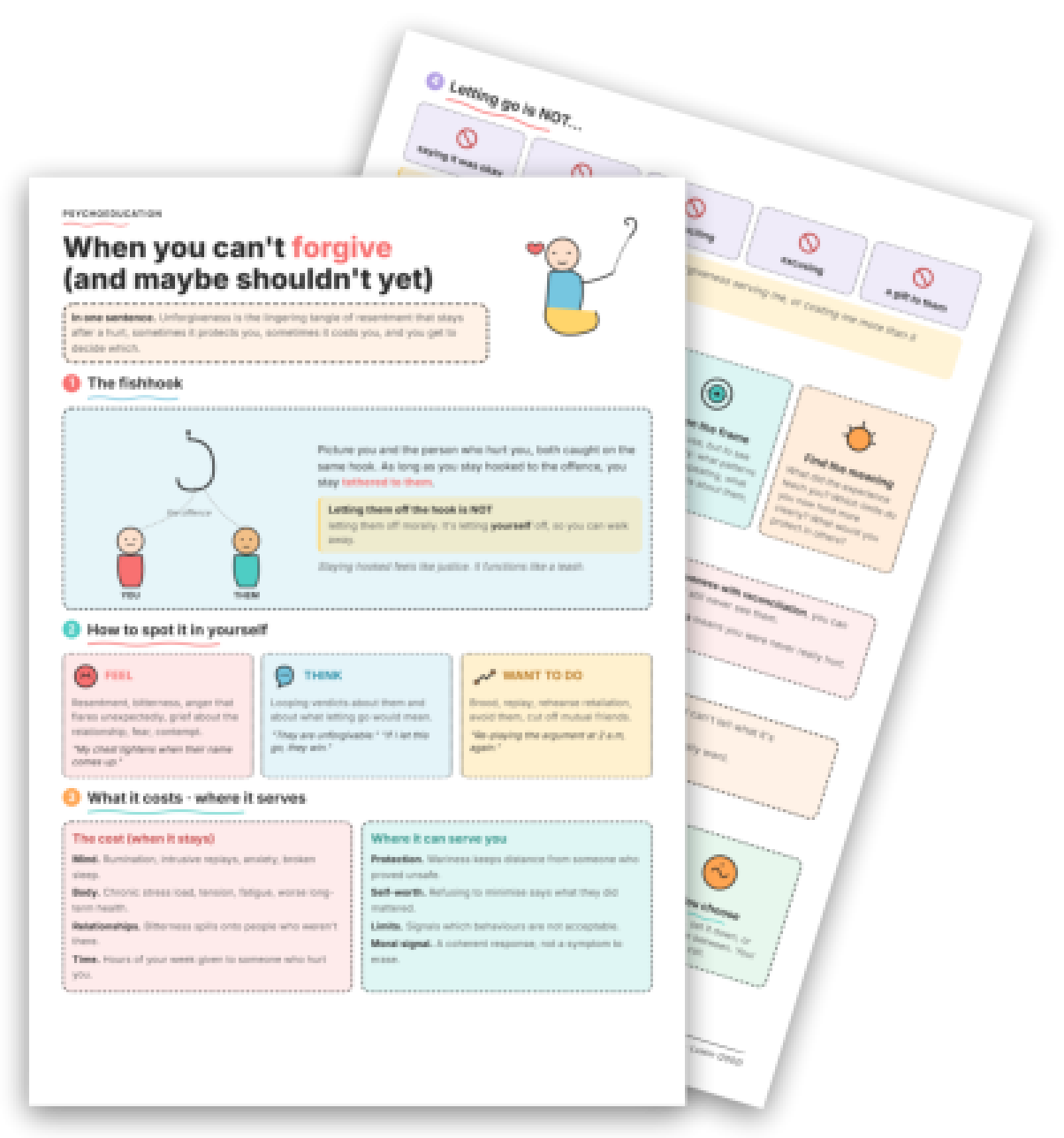
A visual psychoeducation tool helping clinicians explain the protective and costly dimensions of unforgiveness, and introduce the concept of releasing the grip without premature forgiveness.
Clinical vignettes
Unforgiveness as Protection, Revisited
Looping Verdicts in Prolonged Grief
Clinical picture. T., a man in his mid-thirties, was seen following the breakdown of a long-term relationship in which his partner had been repeatedly dishonest. He reported spending several hours each day rehearsing arguments and cataloguing his former partner's faults, and he framed this as "making sure I see it clearly." The clinician used the informational sheet to map T.'s experience across the feel, think, and want-to-do columns, which T. completed largely on his own with little prompting. He noticed that his rumination met almost every marker listed and acknowledged, with some reluctance, that the hours spent were no longer clarifying anything. A brief discussion of the "worry window" strategy gave him a concrete first step that did not require him to relinquish his sense of grievance, lowering the threshold for trying it before the next appointment.
In session, the word "forgiveness" often creates an immediate defensive reaction: the patient hears a moral demand, not a clinical concept. This PDF worksheet on unforgiveness gives you a precise visual support to reframe that reaction, distinguish protective resentment from costly rumination, and open a genuinely productive clinical conversation.
Use this resource with your patients
Handout, exercises and materials ready to use, right inside SessionFuel.
Why Unforgiveness Resists Explanation at the Oral Level
The core difficulty is that unforgiveness occupies a legitimate psychological function, and patients know it. When you try to explain this verbally, you inevitably sound like you're either validating the bitterness or nudging the patient toward a forgiveness they're not ready for. The concept collapses into ambiguity: "letting go" sounds like minimising; "holding on" sounds like pathology.
Patients who arrive with this presentation often carry an additional layer: someone (a family member, a religious community, a well-meaning friend) has already pressured them to forgive. The result is that they've collapsed forgiveness with reconciliation, and they're defending their resentment against perceived social pressure rather than examining whether it still serves them. Sorting this out verbally, without a shared visual framework, costs significant therapeutic time.
The other common obstacle is the cognitive distortion pattern embedded in unforgiveness: the verdict is global, the conclusion is permanent. The fiche gives you a tool to interrupt that loop without triggering the patient's defences.
750+ clinical tools
A library built with and for clinicians, ready to use in session and extend between appointments.
Access all the toolsWhat the Fiche Contains: A Visual Framework for a Nuanced Concept
The fiche is structured across six panels, each addressing a distinct clinical difficulty, and is designed to be read with the patient during the session, not filled in alone at home.
Panel 1 introduces the fishhook metaphor: a simple diagram showing two figures caught on the same hook, connected through the offence. The visual makes immediately legible what an oral explanation rarely lands: "Staying hooked feels like justice. It functions like a leash." Patients see, rather than hear, that their unforgiveness keeps them tethered to the person who hurt them.
Panel 2 offers a tripartite self-recognition grid organised around FEEL, THINK, and WANT TO DO, with short concrete examples ("My chest tightens when their name comes up", "Re-playing the argument at 2 a.m., again"). This normalises the presentation without pathologising it, which is precisely the psychoeducation on adaptive versus maladaptive coping your patient needs before you can go further.
Panel 3 maps the cost-benefit structure explicitly: rumination, broken sleep, chronic stress load, and bitterness spilling onto uninvolved relationships on one side; protection, self-worth, limit-signalling, and moral coherence on the other. This dual-column layout does what an oral explanation rarely achieves, it holds both truths simultaneously, and the patient can see their own position on the map.
Panel 4 lists what letting go is not (not excusing, not forgetting, not reconciling, not a gift to the offender), anchoring the pivot question the fiche proposes: "Is my unforgiveness serving me, or costing me more than it protects?"
Panel 5 presents four regulatory strategies for easing the grip without forgiving: limiting the rumination loop with a postponement technique, somatic regulation during a flare, contextual reframing (not to excuse, but to see the offender more clearly), and meaning-making from the experience. These map naturally onto the work you may already be doing with constructive versus harmful rumination or with radical acceptance.
Panel 6 covers common clinical traps, including premature social pressure to forgive, and closes with three concrete prompts for continued work in session.
> Key takeaway: the fiche is a visual support that facilitates the explanation of unforgiveness during the session; it gives the patient a concrete reference to take home, not a questionnaire to complete alone.
Use it with your patients
Share this tool in the mobile app and follow the work between sessions.
When and How to Introduce It in Practice
This fiche fits naturally after the initial anamnesis, once the relational injury has been named but before you move into restructuring work. It is particularly useful with patients carrying mistrust or interpersonal harm histories, with couples work where one partner holds a grievance that blocks trust repair, and with any patient presenting chronic anger or bitterness that has begun to leak onto relationships outside the original conflict.
You can introduce it with: "There's a distinction I'd like to show you visually, between what unforgiveness costs and where it actually protects you. It's not about whether you should forgive. It's about whether the current position is working for you."
Debrief by asking what the patient recognises in the FEEL/THINK/DO grid, which side of the cost-benefit map feels most accurate right now, and whether the fishhook image resonates. Patients who push back on the fishhook are often telling you something clinically important about their relationship to justice. That resistance is the work.
The fiche pairs well with exercises on forgiveness as a clinical process, with the perceived injustice guided exercise for patients where moral fairness is the organising schema, and with self-forgiveness tools when the person they can't forgive is themselves. It does not replace the formulation; it gives both of you a shared vocabulary before the deeper work begins.
Your session continues in your patients' pocket
Use with a patientYour resources, available everywhere
The handouts, exercises, programs and audios above: you choose which ones to make available to your patients, in the mobile app dedicated to them.
And far more than a library
The app goes well beyond resources, to support your patients every day:
Related categories
Explore other clinical resources by category.

Identity
Clinical resources for self-identity work in therapy: CBT, ACT, schema tools for clinicians addressing self-concept, core beliefs, and identity disruption.

Emotions
Clinical resources on emotion regulation: worksheets, coping tools, CBT, REBT, and ACT exercises for therapists working across diagnoses and age groups.

Relationships
Clinical worksheets and tools on relational functioning: attachment, schemas, assertiveness, and communication skills for therapists. Printable PDF resources.

Understand
Clinical hub for the therapeutic aim 'Understand': worksheets and tools to build patient insight across CBT, ACT, schema therapy and more.

Repair & soothe
Clinical resources for the repair and soothe therapeutic aim: worksheets, exercises and tools to build self-compassion, reduce shame and restore emotional safety.

ACT
Clinical hub for Acceptance and Commitment Therapy (ACT): worksheets, exercises, programs and audio resources for practitioners using the ACT model.