
Clinical picture. M., a woman in her late forties, had been seen for six sessions following the death of her husband eighteen months prior. She reported managing well until she discovered his contact still saved in her phone and found herself composing a text message to him before stopping. In session, the clinician introduced the tasks-of-mourning framework, normalizing that Task 1 can reopen long after the loss, and that this was not regression but a loop. M. identified that the reality had been intellectually accepted early on, yet had never fully registered in her body, particularly in routine moments tied to him. Over the following two sessions she was able to name this gap explicitly, which reduced her distress about what she had read as a sign she was "going backwards."
The Tasks of Mourning: PDF Worksheet, Tools and Exercises for Clinical Practice
A visual psychoeducation tool explaining Worden's four tasks of grief to use in session, establish shared clinical vocabulary, and help patients understand mourning as active, non-linear work.
Clinical vignettes
Returning to Task One After Months
Task Two Avoided Through Overwork
Clinical picture. T., a man in his early thirties, presented eight weeks after the sudden death of his father, describing himself as coping well and noting he had thrown himself into managing the estate and his mother's affairs. The clinician used the informational sheet to map which tasks were active, and T. recognized without prompting that Task 2 had been largely bypassed. He acknowledged that staying busy had kept the pain at a manageable distance but that he was sleeping poorly and drinking more on weekends. A small in-session exercise inviting him to name one feeling present in his body produced a prolonged silence followed by visible distress, confirming that the emotional processing work had not yet begun. The clinician noted the finding without pushing for more that session, and they agreed to pace Task 2 work explicitly over subsequent appointments.
When a bereaved patient comes in convinced they are grieving "wrong," the problem is rarely a lack of willingness. More often, the only framework they carry is a stage model: they expect grief to move in a straight line, they have fallen off that line, and they interpret the detour as failure. Correcting that in conversation alone is slow work. This fiche PDF gives you a visual anchor to reframe the whole picture in a few minutes of shared looking.
Use this resource with your patients
Handout, exercises and materials ready to use, right inside SessionFuel.
Why the tasks model is hard to convey without a visual support
The Kübler-Ross stage model is so culturally embedded that most patients arrive with it pre-installed. Replacing it with Worden's task-based account asks them to do two things at once: discard a familiar map and absorb a more demanding one. The cognitive load tends to produce polite nodding rather than genuine conceptual shift.
The particular sticking points are predictable. Patients grasp accept the reality and process the pain quickly, then struggle with the idea that Task 3 involves three simultaneous layers (identity, practical roles, and worldview), and that Task 4 is not about letting go but about relocation of the bond. That last distinction matters clinically: the guilt a patient feels about laughing again, or the hesitation before starting a new relationship, often maps directly onto a Task 4 blocking belief, and naming it changes the therapeutic conversation immediately. An oral explanation tends to collapse those nuances; a diagram holds them open.
There is also the loop structure. Telling someone that returning to an earlier task is normal, not regression, rarely lands in a single sentence. Seeing it drawn as a loop, with an arrow cycling back, is a different experience.
What the fiche contains: a structured visual for in-session explanation
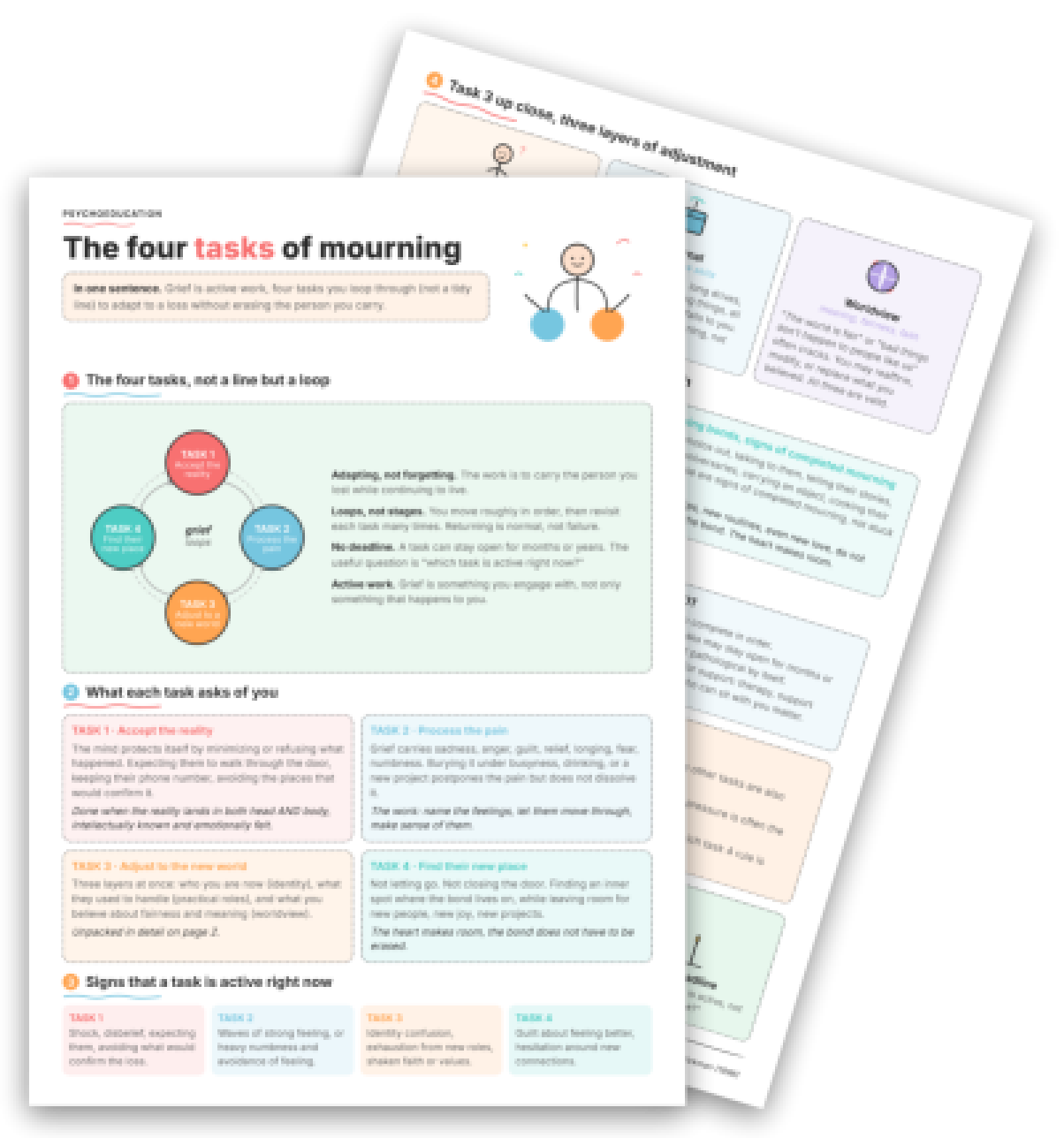
The support visuel is built across six panels, all grounded in Worden (2018) and the continuing bonds literature (Klass, Silverman & Nickman, 1996).
- Panel 1 presents the four tasks as a loop diagram, not a line. The visual immediately communicates the core reframe: "Loops, not stages. You move roughly in order, then revisit each task many times."
- Panel 2 unpacks what each task asks concretely: the cognitive-emotional gap in Task 1 ("the reality lands in both head AND body"), the avoidance patterns in Task 2, and the relocation logic in Task 4.
- Panel 3 offers a clinical sign-map, one column per task, so you and the patient can locate where energy is currently concentrated without you having to narrate it from scratch.
- Panels 4 and 5 go deeper on the two tasks patients most often misread. Task 3 is broken into its three adjustment layers (internal identity, external practical roles, worldview). Task 4 names the specific internal rules that block forward movement: "If I am happy again, I didn't love them enough." Seeing that sentence on paper often produces immediate recognition.
- Panel 6 provides ready-to-use cognitive reframes and three session prompts for moments when the patient is stuck, rating their grief against an imaginary deadline, or feeling guilt about a new connection.
> Key takeaway: this fiche is a visual support that facilitates the explanation of the tasks model in session. It is not a self-guided questionnaire. You use it to structure the psychoeducation, to point at the loop diagram when a patient says "I thought I was past this," and to leave them a concrete reference between appointments.
Pair it with a closer look at continuing bonds after loss when Task 4 is the presenting block, and with the Grief Myths worksheet when patients are carrying culturally-loaded misconceptions about timelines. If your clinical reading of prolonged grief disorder raises a concern, the task model also helps you locate where adaptive processing has stalled.
750+ clinical tools
A library built with and for clinicians, ready to use in session and extend between appointments.
Access all the toolsHow and when to introduce the fiche
Timing. The fiche fits cleanly in the first or second dedicated grief session, after the initial anamnèse. It is also useful mid-therapy when a patient says something like "I feel like I've gone backwards," as a reframe tool rather than a psychoeducation introduction.
Framing. A low-threshold introduction: "There is a model I find more useful than the stages you may have heard of. It takes about five minutes to walk through, and most people find it a relief rather than another thing to do." That framing positions the fiche as descriptive rather than prescriptive, which matters for patients who are already self-monitoring their grief.
Debrief. After going through the panels together, the most productive debrief question is the one the fiche itself names: "Which task feels most active right now?" That single question typically generates more clinically usable material than a broader open question about how the patient is coping.
Contraindication. In acute traumatic bereavement (unexpected or violent loss), wait until the patient has sufficient stabilisation before introducing a task-oriented frame. The Common Reactions to Trauma worksheet may be more appropriate as a first step. For patients where death anxiety is entangled with the grief, the fiche's worldview layer in Task 3 can open that conversation, but requires careful pacing. Pair with the Stages of Grief reference sheet if the patient specifically asks how the two models relate.
The fiche does not replace the therapeutic frame. It makes the explanation clearer, reduces the guilt load in the first few sessions, and gives the patient a map they can return to between appointments without needing you in the room to interpret it.
Use it with your patients
Share this tool in the mobile app and follow the work between sessions.
Sources
- Worden, J. W. (2018). Grief Counseling and Grief Therapy: A Handbook for the Mental Health Practitioner (5th ed.). Springer Publishing Company.
- Klass, D., Silverman, P. R., & Nickman, S. (Eds.) (1996). Continuing Bonds: New Understandings of Grief. Taylor & Francis.
Your session continues in your patients' pocket
Use with a patientYour resources, available everywhere
The handouts, exercises, programs and audios above: you choose which ones to make available to your patients, in the mobile app dedicated to them.
And far more than a library
The app goes well beyond resources, to support your patients every day:
Related categories
Explore other clinical resources by category.

Mood
Evidence-based worksheets and clinical tools for mood disorders: CBT, ACT, and positive psychology resources for psychologists and therapists.

Identity
Clinical resources for self-identity work in therapy: CBT, ACT, schema tools for clinicians addressing self-concept, core beliefs, and identity disruption.

Understand
Clinical hub for the therapeutic aim 'Understand': worksheets and tools to build patient insight across CBT, ACT, schema therapy and more.

Repair & soothe
Clinical resources for the repair and soothe therapeutic aim: worksheets, exercises and tools to build self-compassion, reduce shame and restore emotional safety.

Humanistic
Printable clinical resources for humanistic therapy: worksheets, exercises, and psychoeducation programs for practitioners using person-centered and experiential approaches.

Integrative
Integrative therapy clinical resources: worksheets, psychoeducation programs, and exercises for eclectic, multimodal practice across orientations.