
Clinical picture. M., a 34-year-old project manager, presented with persistent tension headaches and sleep-onset difficulty, reporting that she could not stop mentally rehearsing her task list at night. During session, the clinician introduced the informational sheet on time management and drew her attention specifically to the rationale for externalizing tasks: when items remain in working memory, the brain continues rehearsing them even during rest, maintaining a low-level state of vigilance. M. was skeptical but agreed to trial a paper task list for one week before the next appointment. At follow-up she noted that sleep-onset time had shortened and that she felt less compelled to review the list mentally, though she acknowledged the habit required deliberate effort to sustain.
Time Management: PDF Worksheet, Tools and Exercises for Clinical Practice
A printable PDF with seven concrete techniques, a cognitive load explainer, and a weekly rhythm structure to support time management psychoeducation in session.
Clinical vignettes
Cognitive Offloading in Generalized Anxiety
Task Breakdown for Chronic Procrastination
Clinical picture. T., a 28-year-old doctoral student, described a months-long pattern of avoidance around writing his thesis, accompanied by low mood and mounting shame. The clinician used the sheet's decomposition tip to work through one chapter live in session, translating the vague goal 'work on chapter three' into six discrete steps, each completable in under twenty minutes. T. identified 'activation cost' as the relevant concept: the global task felt paralyzing, whereas 'sketch a three-line outline' did not. He left with a written breakdown rather than a resolution to try harder, and reported completing two steps the following evening without prompting himself repeatedly.
Patients who present with chronic overwhelm rarely lack intelligence or motivation. What they lack, more often, is a framework that makes the cognitive cost of unmanaged tasks visible. Explaining time management tips verbally tends to produce polite agreement and little change. This fiche PDF provides a visual structure you can walk through together, naming mechanisms the patient is already experiencing but has not yet been able to articulate.
Use this resource with your patients
Handout, exercises and materials ready to use, right inside SessionFuel.
Why time management concepts resist verbal explanation
The central obstacle is not laziness. It is cognitive load. When tasks live only in the patient's head, working memory keeps cycling through them in the background, even during rest. This low-level rumination eats attentional resources, fuels anxiety, and undermines follow-through. Patients often arrive with a diffuse sense of being perpetually behind without understanding the mechanism maintaining it.
Oral explanations of strategies like prioritisation or task decomposition tend to sound obvious in the room and feel inapplicable the moment the patient leaves. The list of tips does not anchor anywhere. For patients presenting with burnout, ADHD traits, or perfectionism, the gap between "I know what I should do" and actual behaviour is precisely where chronic avoidance or procrastination takes hold. A visual support makes the mechanism concrete and gives the patient something to refer back to between sessions.
What the fiche contains, and why the visual layout matters
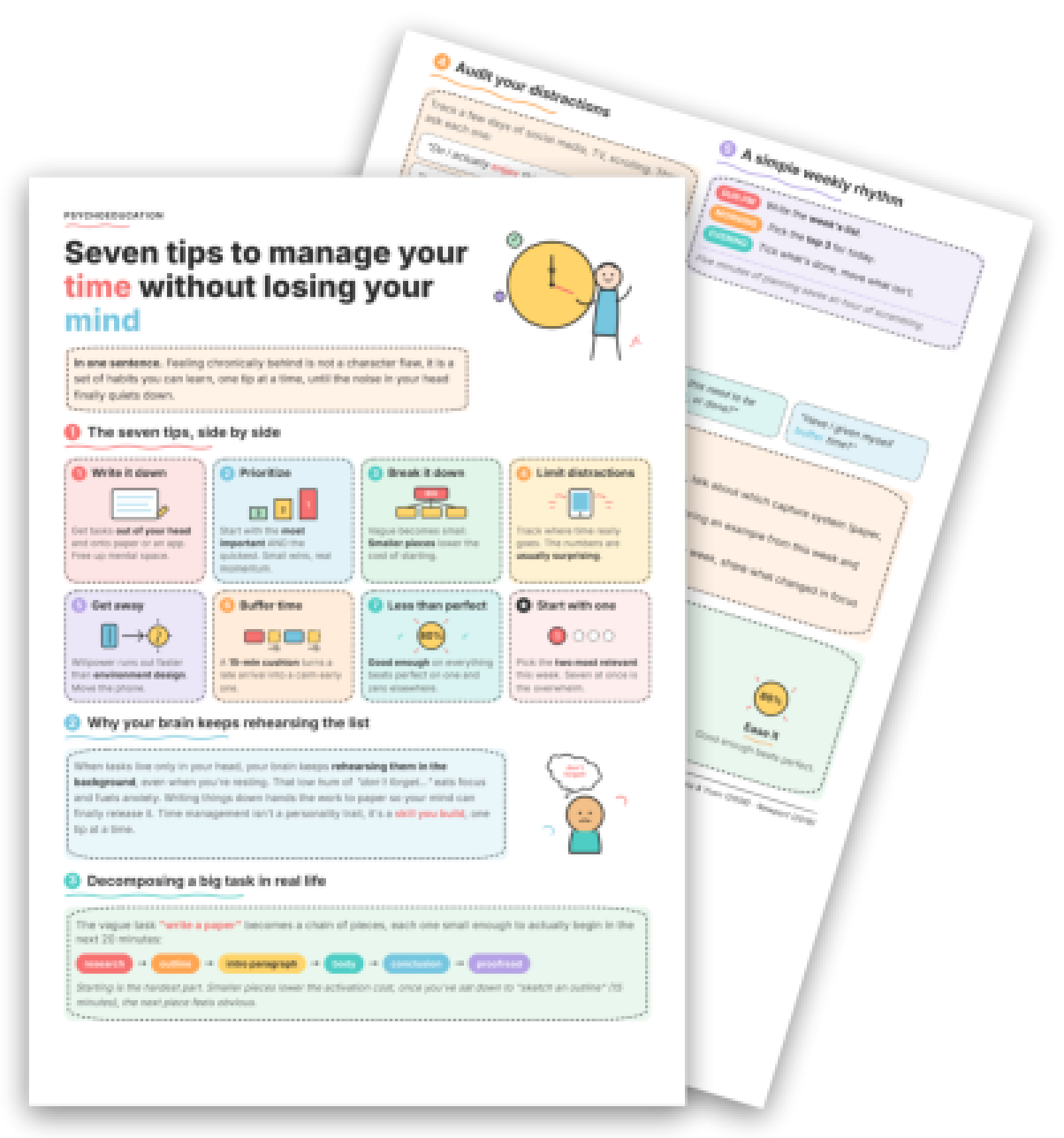
The fiche PDF presents seven tips in a side-by-side panel format: write it down, prioritise (important and quick first), break it down, limit distractions, change environment, build buffer time, and accept 80% as good enough. Each tip is rendered with a minimal icon and a brief caption, so the full set reads at a glance rather than as a wall of text. The layout itself models the principle it is teaching.
A second panel, "Why your brain keeps rehearsing the list," explains the cognitive load mechanism in plain language: tasks held only in memory force the brain to rehearse them continuously, consuming focus and generating anxiety. Reading this with the patient often produces immediate recognition. The fiche frames the solution cleanly: "Writing things down hands the work to paper so your mind can finally release it."
A third section shows task decomposition in real life, turning the vague objective "write a paper" into a visible chain (research → outline → intro paragraph → body → conclusion → proofread). Displayed as linked steps, the activation cost of beginning drops sharply. This single visual does what a spoken explanation rarely achieves. A distraction audit section adds two short prompts the patient can apply themselves: "Do I actually enjoy this one?" and "Is it giving me what I think it's giving me?" A simple weekly rhythm (Sunday evening list, morning top-three, evening review) and a set of quick self-check phrases close the fiche. Clinicians will also find a "To discuss in session" block suggesting three specific scenarios worth revisiting together.
> To note: the fiche is a visual support that facilitates explanation in session, not a self-help checklist the patient completes alone. Walk through it together, use it to name what the patient is already experiencing, and hand it over as a concrete reference they can keep.
750+ clinical tools
A library built with and for clinicians, ready to use in session and extend between appointments.
Access all the toolsWhen and how to introduce this fiche
This fiche PDF fits naturally in an early-to-mid phase of intervention, once the presenting complaint is clear and the alliance is established. It is particularly suited to patients where chronic overwhelm is a maintaining factor: burnout presentations, ADHD, depressive episodes with executive dysfunction, or anxiety patterns where task-pile-up fuels hypervigilance. It pairs well with the Eisenhower Urgency-Importance Matrix if the prioritisation component needs more structured work, and it complements Building New Habits once initial strategies are in place.
A simple introduction: "I want to show you a map of seven habits that tend to reduce that background noise you described. We'll go through them together and pick the one or two that fit your situation best right now." The fiche itself includes the instruction to start with just two tips, not all seven, which you can underline to pre-empt the all-or-nothing dynamic common in perfectionist presentations.
After the session, the fiche becomes a between-session anchor. The weekly activity scheduling exercise or the current activity inventory can extend the work further if needed. For patients who need a deeper audit of their professional situation, the work-life balance self-assessment and the procrastination exercise are natural follow-on tools.
The fiche does not replace formulation or therapeutic framing. It makes one clinically important concept clear, quickly, and leaves the patient with a reference they will actually use.
Use it with your patients
Share this tool in the mobile app and follow the work between sessions.
Sources
- Allen, D. (2015). Getting Things Done: The Art of Stress-Free Productivity. Penguin Books.
- Aeon, B., Faber, A., & Panaccio, A. (2021). Does time management work? A meta-analysis. PLoS ONE, 16(1), e0245066.
- Hafner, A., Stock, A., & Oberst, V. (2015). Decreasing students' stress through time management training: an intervention study. European Journal of Psychology of Education, 30(1), 81-94.
- MacLeod, C. M. (2020). Zeigarnik and von Restorff: The memory effects and the stories behind them. Memory & Cognition, 48(6), 1073-1088.
Your session continues in your patients' pocket
Use with a patientYour resources, available everywhere
The handouts, exercises, programs and audios above: you choose which ones to make available to your patients, in the mobile app dedicated to them.
And far more than a library
The app goes well beyond resources, to support your patients every day:
Related categories
Explore other clinical resources by category.

Emotions
Clinical resources on emotion regulation: worksheets, coping tools, CBT, REBT, and ACT exercises for therapists working across diagnoses and age groups.

Transitions
Clinical hub for life transitions: tools, worksheets and exercises to support psychosocial adjustment, role change and identity work in practice.

Regulate
Clinical resources for emotion regulation: worksheets, ACT exercises, and psychoeducation tools for affect regulation across diagnoses. For clinicians.

Build skills
Skill-building resources for clinicians: printable worksheets and exercises for coping, assertiveness, and communication skills training in therapy.

CBT
CBT worksheets, cognitive restructuring exercises & behavioral tools for clinicians. Evidence-based resources for every phase of cognitive behavioral therapy.

Anxiety
Clinical hub for anxiety disorders: CBT and ACT worksheets, psychoeducation sheets, and exercises for assessment and treatment across the anxiety spectrum.