
Clinical picture. A, a woman in her late thirties, presented with persistent fatigue, recurrent tension headaches, and growing avoidance of social contact after a demanding school year. She described her stress as a sign she was "falling apart" and had progressively cancelled plans with friends and stopped her weekly runs. The clinician introduced the informational sheet in session, focusing on the mindset-shift section; A found the reframe from threat to signal immediately credible because it matched her own observation that she only felt this way about work she cared about. Over the following two weeks she reinstated one evening walk daily and resumed one regular phone call with a colleague, reporting a modest but noticeable reduction in the sense of helplessness. The sheet's cycle diagram helped her identify that social withdrawal was her first drop-off point, which became the target for the next phase of work.
Stress Management: PDF Worksheet, Tools and Exercises for Clinicians
A printable PDF fiche, practical tools, and concrete exercises to help clinicians explain everyday stress management clearly in session.
Clinical vignettes
Reframing Arousal in a Burnt-Out Teacher
Small-Task Strategy in Chronic Overwhelm
Clinical picture. M, a man in his mid-forties managing a chronic adjustment disorder, arrived reporting that his inbox and a list of pending administrative tasks had become a persistent background stressor that disrupted sleep. He had been attempting to address the most effortful items first, consistently stalling, and then abandoning the session entirely. The clinician used the informational sheet to introduce the small-tasks principle, suggesting he identify five low-threshold items each morning before touching anything larger. M returned the following week having cleared a backlog of minor tasks and noted that the freed cognitive bandwidth made the larger items feel less fixed. He remained skeptical about the me-time block but agreed to trial a ten-minute reading period in the evening, framing it as an experiment rather than a commitment.
Patients presenting with chronic occupational stress or adjustment difficulties rarely struggle to name their stressors. What they resist is the conceptual frame clinicians need them to hold: that stress is a manageable signal, not a threat to be escaped. This stress management PDF fiche gives you a compact visual anchor to carry that argument in session, without spending twenty minutes on explanation.
Use this resource with your patients
Handout, exercises and materials ready to use, right inside SessionFuel.
Why stress management concepts resist verbal explanation
The obstacle isn't complexity. It's that patients arrive with an already-formed, deeply embodied stress-as-threat appraisal. Explaining stress regulation at the level of cognition often produces polite agreement followed by zero behavioral transfer. The patient nods, but leaves still running the same avoidance loop.
The second sticking point is the dropout paradox. When load peaks, patients systematically drop the buffers that would help: they cancel the friend, skip the meal, stop exercising, abandon the hobby. Naming this pattern verbally in session is easy; having the patient see it laid out as a cycle is different. A visual makes the irony legible.
The fiche also addresses the gap between single-strategy advice (breathe, rest) and a systems-level view of resilience. Clinicians working in TCC or ACT frameworks know that durable stress regulation requires diversifying sources of identity and reinforcement, protecting basic physiological functioning, and adjusting cognitive appraisal, all at once. Getting a patient to see these layers as a coherent whole is the psychoeducational challenge.
What the fiche contains: a visual support for explaining stress management in session
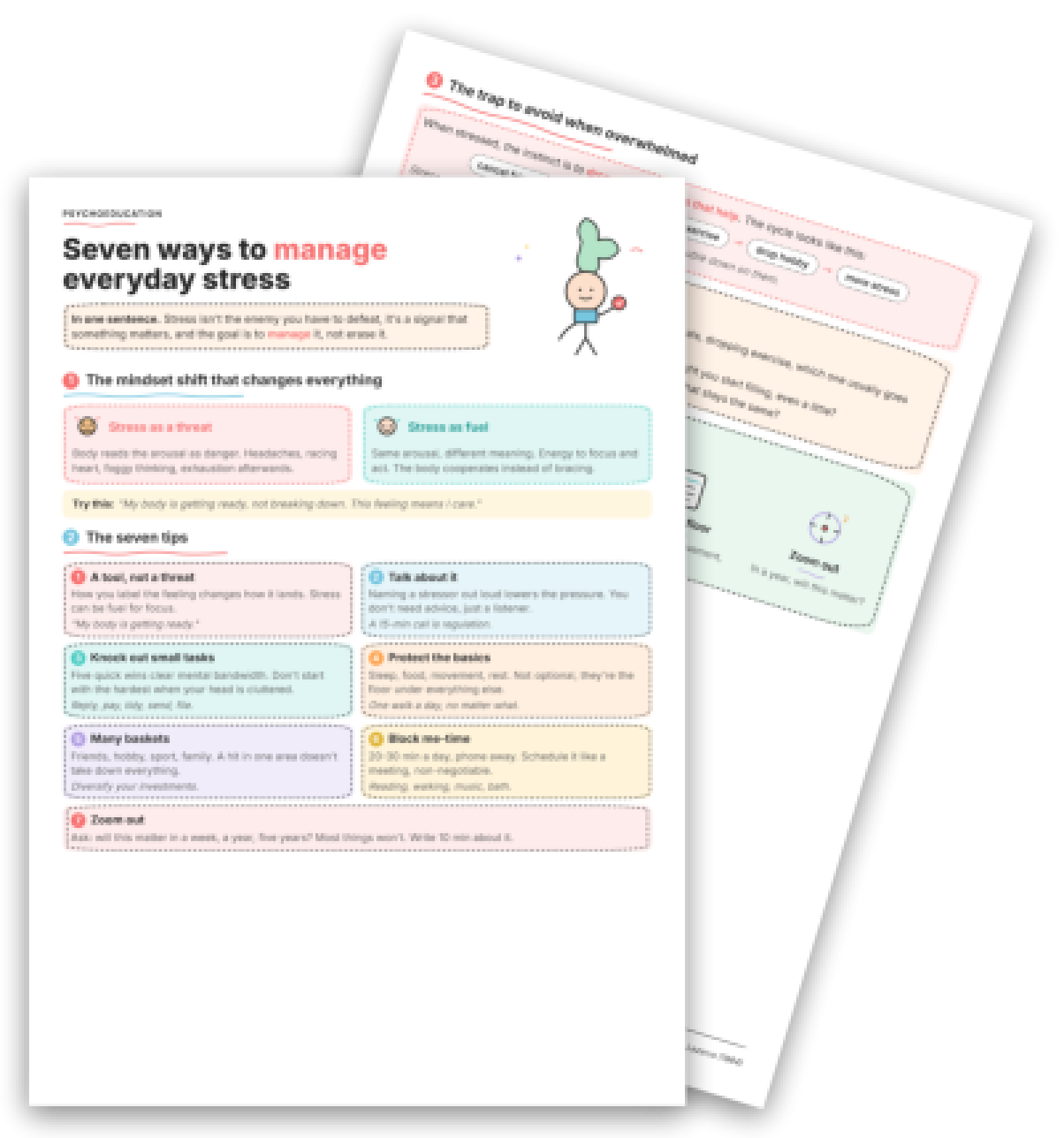
The fiche is structured around three panels you can walk through with the patient side by side.
Panel 1 presents the core appraisal shift in a two-column contrast: stress as threat versus stress as fuel. The same physiological arousal appears in both columns, with the outcome diverging depending on how it's labeled. This is the Crum (2013) stress mindset reframe, rendered visually without requiring the patient to have read anything. The cue phrase printed on the fiche, "My body is getting ready, not breaking down. This feeling means I care," gives the patient a concrete takeway they can actually use between sessions.
Panel 2 lists the seven strategies with one-line operationalizations beneath each. These cover cognitive relabeling, social disclosure, behavioral sequencing (tackling low-effort tasks first when cognitively cluttered), protecting foundational needs, diversifying sources of meaning, protecting scheduled downtime, and temporal perspective-taking (the "zoom out" exercise: "Ask: will this matter in a week, a year, five years?"). The brevity is a feature: each tip is scannable without clinical literacy.
Panel 3 maps the dropout cycle explicitly: the visual loop from cancel friends to skip meals to no exercise to drop hobby to more stress makes the paradox unmissable. Patients who have been doing this for months often recognize it immediately when they see it drawn out.
The fiche closes with three session discussion questions you can use directly for debriefing: which buffer goes first, which identity domains are currently under-diversified, and what shifts when the patient tries the "this means I care" reframe. These work naturally as a springboard toward a behavioral activation worksheet or a coping strategy effectiveness review.
> To note: this fiche is a visual support for explaining everyday stress management in session, not a self-report questionnaire to fill out alone. Its value is that it gives the clinician a shared object to point at, making abstract regulation concepts concrete and leavable as a take-home reference.
750+ clinical tools
A library built with and for clinicians, ready to use in session and extend between appointments.
Access all the toolsWhen and how to introduce the fiche
This fiche fits naturally in a second or third session, once the presenting complaint is mapped and the patient has a rough formulation of what sustains their load. It works particularly well for patients whose stress is occupational, transitional, or adjustment-related, and for those who intellectually understand the problem but remain stuck behaviorally.
Introduce it simply: "I'd like to show you something that maps what we've been discussing. Let's go through it together." Avoid framing it as homework or as a checklist to evaluate themselves against.
During debriefing, the three printed discussion questions orient you to the most clinically productive angles. A patient who always drops social connection first, for example, points toward building a more robust social support network or exploring adaptive versus maladaptive coping patterns. A patient stuck in hypervigilance about the body's stress response benefits from pairing the fiche with psychoeducation on the autonomic nervous system or the fight-flight-freeze response sheet.
For patients where burnout is in the differential, a natural next step is the burnout recognition worksheet. For those whose stress is heavily work-contextual, you might follow with the psychosocial risks at work fiche or a structured work-life balance self-assessment.
One limit worth noting: the fiche assumes a patient with reasonable mentalizing capacity and moderate load. It is not the entry point for acute crisis or severe burnout presentations, where distress tolerance tools and grounding techniques take precedence.
The fiche doesn't replace the therapeutic frame. It makes the explanation cleaner and leaves the patient with something concrete to return to when the cycle starts again.
Use it with your patients
Share this tool in the mobile app and follow the work between sessions.
Sources
- Lazarus, R. S., & Folkman, S. (1984). Stress, Appraisal, and Coping. Springer Publishing Company.
- McGonigal, K. (2015). The Upside of Stress: Why Stress Is Good for You, and How to Get Good at It. Avery / Penguin Random House.
Your session continues in your patients' pocket
Use with a patientYour resources, available everywhere
The handouts, exercises, programs and audios above: you choose which ones to make available to your patients, in the mobile app dedicated to them.
And far more than a library
The app goes well beyond resources, to support your patients every day:
Related categories
Explore other clinical resources by category.

Emotions
Clinical resources on emotion regulation: worksheets, coping tools, CBT, REBT, and ACT exercises for therapists working across diagnoses and age groups.

Understand
Clinical hub for the therapeutic aim 'Understand': worksheets and tools to build patient insight across CBT, ACT, schema therapy and more.

Regulate
Clinical resources for emotion regulation: worksheets, ACT exercises, and psychoeducation tools for affect regulation across diagnoses. For clinicians.

Build skills
Skill-building resources for clinicians: printable worksheets and exercises for coping, assertiveness, and communication skills training in therapy.

CBT
CBT worksheets, cognitive restructuring exercises & behavioral tools for clinicians. Evidence-based resources for every phase of cognitive behavioral therapy.

Positive psychology
Positive psychology clinical resources for therapists: worksheets, exercises & programs on well-being, strengths, gratitude, and resilience-based practice.