
Clinical picture. A., a woman in her early forties, presents with subsyndromal burnout following a period of sustained overwork; she reports chronic fatigue and a vague sense that her personal life has «disappeared.» The clinician introduces the work-life balance exercise as structured homework, asking her to rate her current balance on the 1-to-10 scale before the next session and to log approximate hours spent across all life domains over the preceding week. At the following appointment, A. returns with her completed grid and is visibly struck: she had allocated fewer than three hours across the entire week to activities she considers restorative, against more than sixty hours tied to professional or work-adjacent tasks. Using questions three and four, the clinician and patient together identify screen time and unpaid administrative work as candidates for reduction, and a weekly dinner with a close friend as a concrete addition. A. leaves with one modest, self-chosen adjustment rather than an overhaul, which she describes as «actually feasible.»
Work-Life Balance Assessment: A Structured Clinical Exercise
Help patients map where their time actually goes, name the imbalance, and commit to concrete weekly adjustments with this guided homework exercise.
Clinical vignettes
Mapping Time in Burnout Recovery
Recognising Imbalance in Mild Depression
Clinical picture. T., a man in his mid-thirties with a current mild depressive episode, reports spending most non-work hours either commuting or passively browsing his phone; he rates his work-life balance at 3 out of 10. The clinician presents the exercise as a way to make the imbalance concrete rather than merely felt, and T. completes the time-mapping questions between sessions. His log reveals that leisure and physical activity together account for under four hours per week, while commuting and phone use account for nearly twenty. In session, question four prompts a short discussion about a running habit he had abandoned six months earlier; he agrees to reinstate two brief weekly runs as a trial. The exercise does not resolve his depression, but it gives both clinician and patient a shared, data-grounded reference point for monitoring behavioural activation across subsequent sessions.
Why This Is Harder to Convey Than It Sounds
Almost every patient dealing with exhaustion, low motivation, or chronic stress can point to an imbalance between professional and personal life. Yet naming it verbally in session rarely produces lasting change. The difficulty is not understanding the concept: it is seeing it clearly in one's own week. Patients routinely underestimate how much time disappears into work or screens, and overestimate the room they actually give to rest, relationships, or personal projects. Words alone cannot make that gap visible. What clinicians need is a structured, concrete tool that turns a vague sense of "I have no time for myself" into quantified, patient-generated data the two of you can actually work with.
This exercise answers that need directly. It is especially relevant alongside the Burnout: PDF Worksheet, Tools and Exercises for Clinical Practice when exhaustion is already present, or next to the Psychosocial Risks at Work: PDF Worksheet, Tools and Exercises when workplace exposure is part of the clinical picture.
Use this resource with your patients
Handout, exercises and materials ready to use, right inside SessionFuel.
What the Exercise Contains
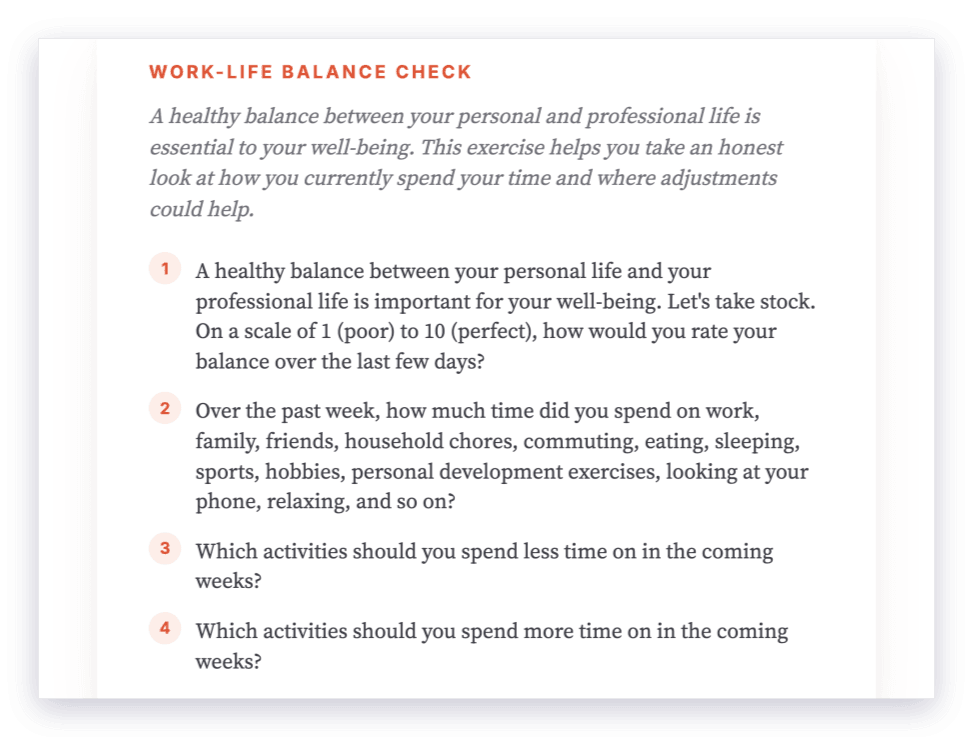
The exercise moves in four deliberate steps. First, patients rate their current balance on a 1-to-10 scale, anchoring the work in a felt, subjective appraisal before any analysis begins. That single number often surprises them and creates immediate clinical relevance.
The second question is the core of the tool: patients reconstruct how they actually distributed their time across the previous week, touching every major domain: work, family, friends, household tasks, transport, eating, sleeping, physical activity, hobbies, personal development, screen use, and deliberate rest. This time audit is what makes abstract dissatisfaction concrete and discussable. It connects naturally with the Current Activity Inventory: A Behavioral Time Audit Tool, which approaches a similar mapping from a behavioral activation angle.
Questions three and four then ask patients to identify, from that real picture, which activities deserve less time and which deserve more in the coming weeks. This forward-looking pair is what transforms observation into intention, giving the subsequent session a clear entry point for action planning.
The image above lists all four questions in order with a brief intro. Note that this image is a static preview of the question sequence only: the full guided exercise, complete with patient-facing instructions and space to write answers, is experienced by the patient directly in the app, not on this page.
This exercise is available to your patients through the patient app of SessionFuel, the mobile application reserved for the patients of clinicians who use SessionFuel: you assign the exercise directly from your account, and your patient completes it on their own phone between your appointments.
750+ clinical tools
A library built with and for clinicians, ready to use in session and extend between appointments.
Access all the toolsUse it with your patients
Share this tool in the mobile app and follow the work between sessions.
How to Assign It as Between-Session Homework
This exercise suits a wide range of profiles: patients managing burnout risk, those navigating a major life transition, people who report neglecting relationships or physical health, and anyone who expresses a diffuse sense that "something needs to change" without being able to name what. It also works well for patients already engaged in goal-directed work using tools like Setting 6 and 12 Month Goals: A Structured Clinical Exercise or Goal-Setting and Behavior Change: A Structured Clinical Exercise, where the balance audit grounds ambitious intentions in the reality of daily time.
Introduce it simply: ask the patient to take a genuine look at their week before the next session, not from memory alone but by actually accounting for time. Framing it as a factual audit rather than a self-criticism exercise reduces defensiveness. The Work-Life Boundaries: PDF Worksheet, Tools and Exercises for Clinicians can serve as a useful psychoeducation complement if boundary erosion at end-of-day is part of what the audit reveals.
When the patient returns, the richest clinical material is usually the gap between questions one and two: how the subjective rating aligns or clashes with what the time map actually shows. Questions three and four then allow you to co-construct one or two specific, feasible adjustments for the weeks ahead, which you can track in a subsequent Weekly Behavioral Review: A Self-Monitoring Exercise for Clinicians. Pair the exercise with a Healthy Habit Plan: PDF Worksheet, Tools and Exercises when the patient needs to translate "more time for rest" into a concrete daily structure.
Key insight: The clinical value of this exercise lies not in the concept of balance itself, but in the patient's own data that it generates: a personalized time map that makes the imbalance impossible to dismiss and opens space for specific, negotiated change.
For patients whose imbalance is driven partly by professional dissatisfaction, pairing this exercise with the Professional Life Assessment: A Guided Clinical Exercise or the Work Week Check-In: A Clinical Self-Assessment Exercise deepens the picture. And when screen time is visibly crowding out restorative activities in question two, the Excessive Screen Time: A Guided Self-Reflection Exercise becomes a natural follow-up assignment.
Your session continues in your patients' pocket
Use with a patientYour resources, available everywhere
The handouts, exercises, programs and audios above: you choose which ones to make available to your patients, in the mobile app dedicated to them.
And far more than a library
The app goes well beyond resources, to support your patients every day:
Related categories
Explore other clinical resources by category.

Identity
Clinical resources for self-identity work in therapy: CBT, ACT, schema tools for clinicians addressing self-concept, core beliefs, and identity disruption.

Emotions
Clinical resources on emotion regulation: worksheets, coping tools, CBT, REBT, and ACT exercises for therapists working across diagnoses and age groups.

Transitions
Clinical hub for life transitions: tools, worksheets and exercises to support psychosocial adjustment, role change and identity work in practice.

Solution-focused
Clinical hub for Solution Focused Therapy resources: worksheets, exercises and programs for goal-oriented, strengths-based practice across individual and couple work.

Anxiety
Clinical hub for anxiety disorders: CBT and ACT worksheets, psychoeducation sheets, and exercises for assessment and treatment across the anxiety spectrum.

Trauma
Clinical hub on trauma and PTSD: assessment, differential diagnosis, treatment phases, and printable resources for practitioners. 155 chars.