
Clinical picture. A, a man in his late thirties, was referred after two visits to emergency services for suspected cardiac events; both workups were negative. He described episodes of sudden racing heart and chest tightness that peaked within minutes and left him convinced he was dying. In the first session, the clinician used the five-step loop from the psychoeducation sheet to trace one recent episode with him: a mild flutter on waking (signal), the immediate thought "my heart is going wrong" (read as danger), the fear spike, the adrenaline surge that intensified every sensation, and the moment he interpreted the worsening as confirmation. Naming each step in sequence visibly reduced A's bewilderment; he said, "So the alarm is real but the fire is not." That reframe did not remove his anxiety, though it gave a shared language for the work ahead.
Panic Disorder: PDF Worksheet, Tools and Exercises for Clinicians
A visual psychoeducation PDF worksheet with tools and exercises to explain panic disorder's maintenance loop, safety behaviours, and recovery pathway in session.
Clinical vignettes
Mapping the Loop at First Session
Distinguishing Attack from Disorder
Clinical picture. M, a woman in her mid-twenties, came to consultation after a single, isolated panic attack six weeks earlier during a long flight. She had experienced no further attacks but had since declined two work trips and begun checking her pulse several times a day. The clinician introduced the informational sheet to draw the distinction between a panic attack and panic disorder, noting that isolated attacks are common and do not automatically become a disorder. The discussion highlighted that M's pattern of worry and growing avoidance was the mechanism by which an isolated event risked consolidating into something more persistent. Intervention focused on that anticipatory loop rather than on the original attack, and M agreed to monitor avoidance behaviors as a first concrete step.
Explaining panic disorder verbally is rarely enough. Patients nod along when you describe the fight-or-flight response, then leave the session still convinced their racing heart signals cardiac pathology. This panic disorder PDF worksheet gives you a structured visual support to make Clark's cognitive model concrete the moment it matters most: during psychoeducation.
Use this resource with your patients
Handout, exercises and materials ready to use, right inside SessionFuel.
Why Panic Disorder Is Hard to Explain Without a Visual Aid
The core difficulty is not conceptual complexity. Most patients with panic disorder are intelligent people whose attention is dominated by interoceptive hypervigilance. When you describe the maintenance loop verbally, they are simultaneously scanning their chest for irregularities. The explanation competes with the very process it is trying to address.
A second problem is vocabulary. "Misinterpretation of bodily sensations" is clinically precise but lands flat. Patients hear a medical-sounding phrase, not a mechanism that maps onto their lived experience of "knowing" they were about to die. And the third issue, which safety behaviours make particularly stubborn, is this: without a visible diagram of the loop, the connection between escape behaviour and belief maintenance stays abstract. Patients understand intellectually that fleeing confirmed their fear; they rarely feel it.
What the Fiche Contains: A Sequenced Visual Model
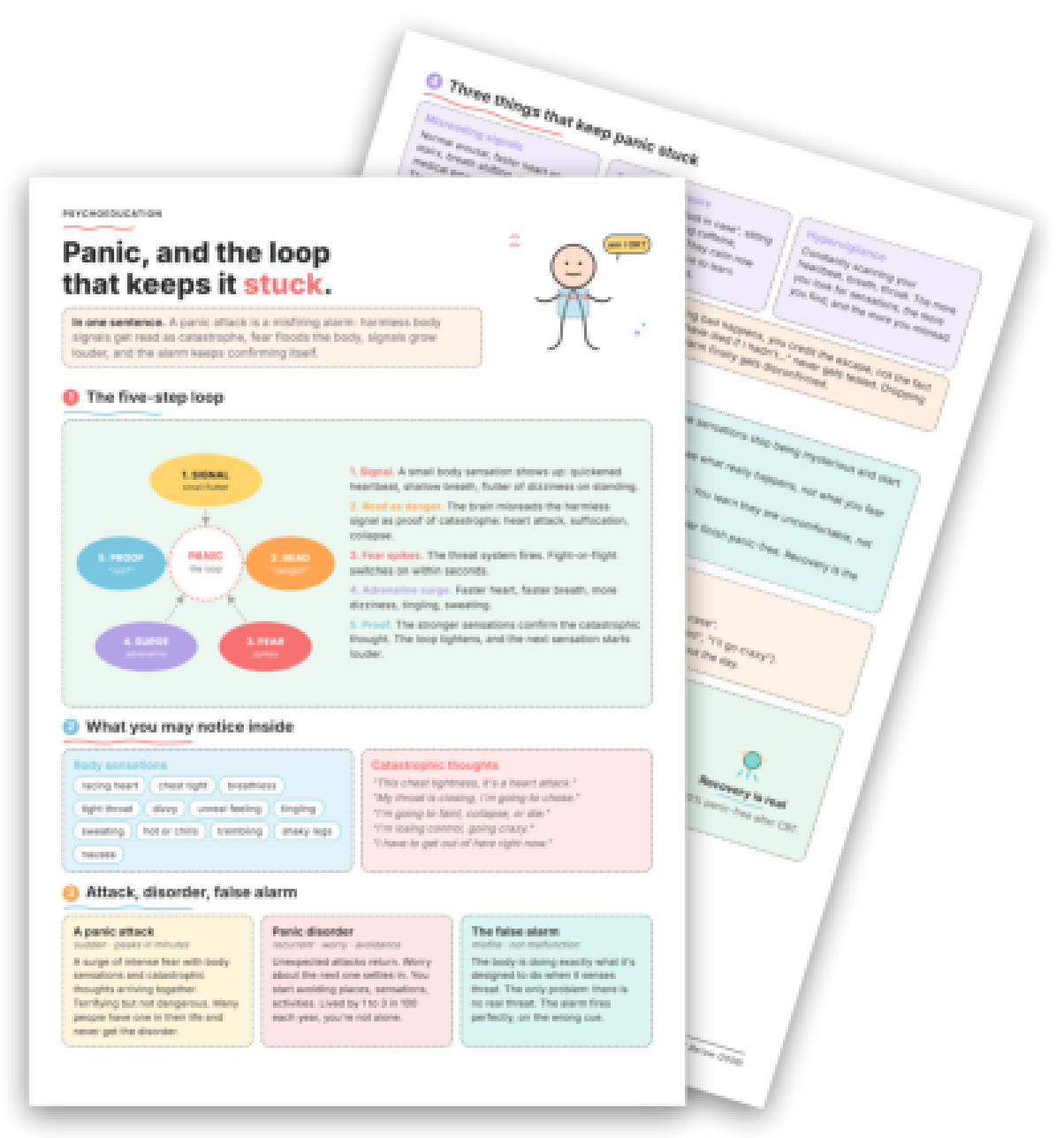
The fiche is organized into five numbered panels that you work through with the patient as a shared reading exercise, not a homework task completed alone.
Panel 1 presents the five-step loop with a clean circular diagram: Signal → Read as danger → Fear spikes → Adrenaline surge → Proof, with the label "see?" at the confirmation step. Having the loop visible on paper lets you point to where a given patient typically enters or gets most stuck, which is a more precise clinical move than any verbal description.
Panel 2 offers two parallel columns: a body sensations list (racing heart, chest tightness, derealization, tingling, shaky legs, and others) alongside five catastrophic thought examples ("This chest tightness, it's a heart attack.", "I'm going to faint, collapse, or die."). The side-by-side layout makes the sensation-interpretation link visually immediate in a way that oral explanation simply cannot replicate.
Panel 3 draws the clinically important distinction between a panic attack (sudden, peaks in minutes, not inherently disordered) and panic disorder (recurrent attacks, anticipatory worry, avoidance), with a third box for the false alarm framing. This panel tends to produce the first moment of genuine relief for many patients, the discovery that their body is functioning correctly on the wrong cue.
Panels 4 and 5 map the three maintaining factors (misreading signals, safety behaviours, hypervigilance) with an explicit explanation of the safety-behaviour trap, then pivot to what actually helps: understanding the physiology, behavioural experiments, and interoceptive exposure. The fiche closes with a "To discuss in session" checklist pointing to avoidance, recurring catastrophic thoughts, and body scanning, giving you a ready-made debrief structure. The recovery figure ("Around 80% of people who complete a full course of CBT for panic disorder finish panic-free") is stated plainly and works well as a motivational anchor early in treatment.
> Key point: this fiche is a visual support that facilitates the in-session explanation of panic disorder; the clinician works through it with the patient, not instead of that conversation, leaving a concrete reference the patient can return to between appointments.
750+ clinical tools
A library built with and for clinicians, ready to use in session and extend between appointments.
Access all the toolsWhen and How to Introduce the Fiche
The fiche fits naturally into the first or second psychoeducation session, once the diagnostic picture is clear and the therapeutic alliance is sufficiently established to name catastrophic cognitions without the patient feeling pathologised. For patients presenting with agoraphobia or significant avoidance, it pairs well with an early discussion of changing avoidance patterns and building a graded exposure hierarchy.
A low-threat way to introduce it: "I'd like to show you a diagram that maps out exactly what happens inside a panic attack, step by step. A lot of people find it helps to see it rather than just hear it described." This framing positions the fiche as a curiosity rather than a diagnosis, and avoids activating the patient's already-elevated threat system.
During the debrief, the "To discuss in session" checklist in the fiche is worth using explicitly. Ask the patient to mark which prompts apply (body scanning throughout the day, specific recurring catastrophic thoughts, situations being avoided "just in case"). Their responses sharpen the formulation and seed the rationale for interoceptive exposure work. For colleagues working with Clark's cognitive model or using the Therapy Blueprint for Panic, the fiche serves as a compact psychoeducation complement rather than a standalone intervention.
One caution: for patients with significant comorbid health anxiety, the body sensations panel in Section 2 occasionally activates rather than reassures in a first reading. With this profile, it is worth covering the CBT model of health anxiety briefly before introducing the full fiche, so the patient already has some cognitive flexibility around somatic interpretation. The fiche does not replace the formulation conversation; it makes that conversation more precise and leaves the patient something to hold onto.
Use it with your patients
Share this tool in the mobile app and follow the work between sessions.
Sources
- Salkovskis, P. M. (1991). The importance of behaviour in the maintenance of anxiety and panic: A cognitive account. Cambridge University Press.
- Barlow, D. H. (2002). Anxiety and Its Disorders: The Nature and Treatment of Anxiety and Panic (2nd ed.). Guilford Press.
- American Psychiatric Association (2013). Diagnostic and Statistical Manual of Mental Disorders (5th ed.). American Psychiatric Publishing.
- National Institute for Health and Care Excellence (NICE) (2011). Generalised anxiety disorder and panic disorder in adults: management. Clinical guideline CG113.
Your session continues in your patients' pocket
Use with a patientYour resources, available everywhere
The handouts, exercises, programs and audios above: you choose which ones to make available to your patients, in the mobile app dedicated to them.
And far more than a library
The app goes well beyond resources, to support your patients every day:
Related categories
Explore other clinical resources by category.

Anxiety
Clinical hub for anxiety disorders: CBT and ACT worksheets, psychoeducation sheets, and exercises for assessment and treatment across the anxiety spectrum.

Understand
Clinical hub for the therapeutic aim 'Understand': worksheets and tools to build patient insight across CBT, ACT, schema therapy and more.

CBT
CBT worksheets, cognitive restructuring exercises & behavioral tools for clinicians. Evidence-based resources for every phase of cognitive behavioral therapy.

Trauma
Clinical hub on trauma and PTSD: assessment, differential diagnosis, treatment phases, and printable resources for practitioners. 155 chars.

Mood
Evidence-based worksheets and clinical tools for mood disorders: CBT, ACT, and positive psychology resources for psychologists and therapists.

Identity
Clinical resources for self-identity work in therapy: CBT, ACT, schema tools for clinicians addressing self-concept, core beliefs, and identity disruption.