
Clinical picture. M., a 17-year-old referred by her school nurse, presented with a BMI of 16.8 kg/m² after losing approximately 12 kg over five months following a period of academic stress. Her parents reported she had eliminated all foods she labelled "unsafe" and exercised for 90 minutes each morning regardless of fatigue or injury. When the clinician introduced the three-pillar framework during the assessment session, M. acknowledged that her mood each day was determined almost entirely by the number she saw on the scale at 6 a.m., though she did not experience her weight as dangerous. Using the informational sheet as a shared reference, the clinician named each pillar aloud with her, which allowed M. to recognize the pattern without feeling accused; she agreed to a medical review the same week.
Recognizing Anorexia Nervosa: PDF Worksheet, Tools and Exercises
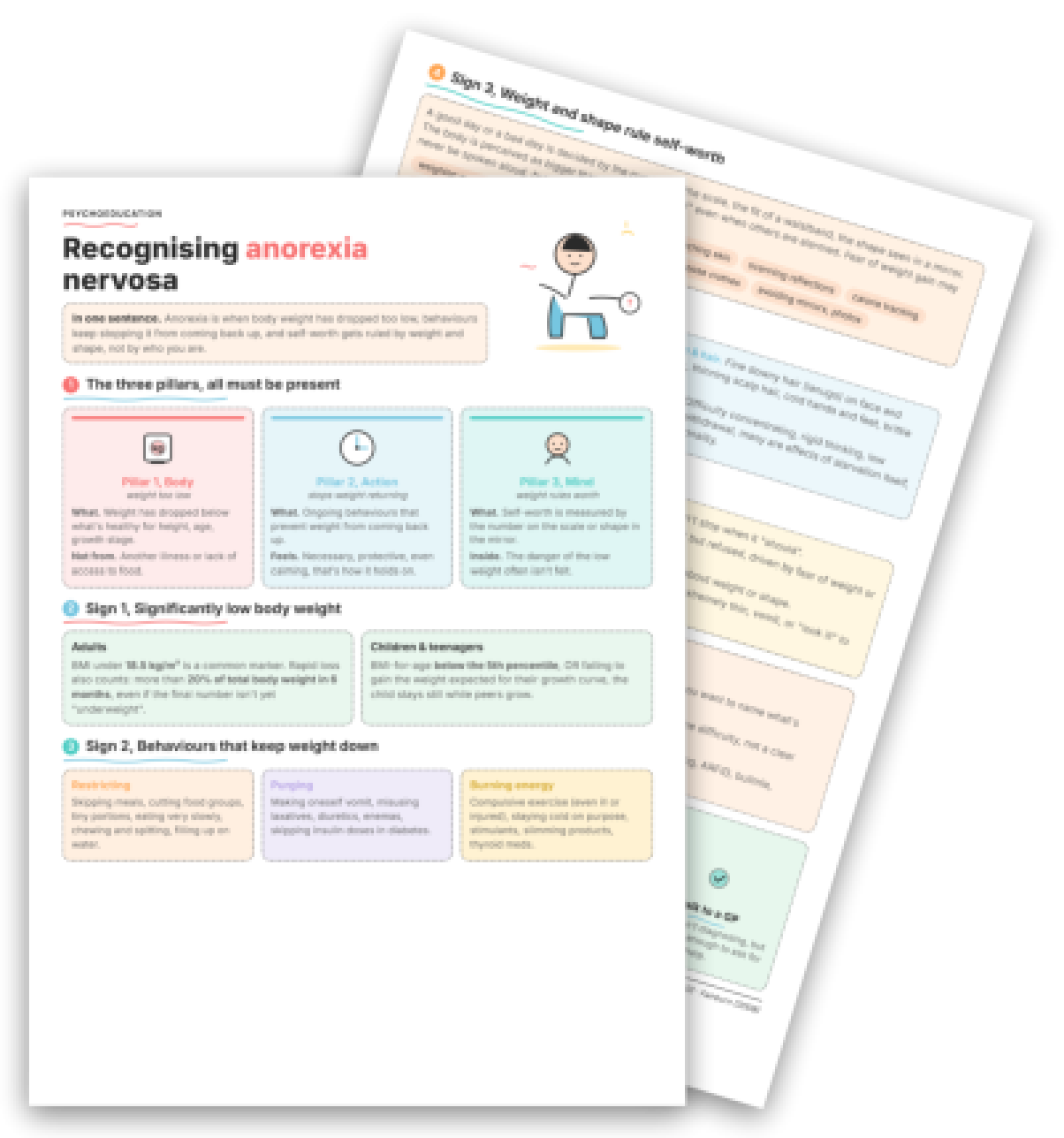
A visual psychoeducation tool to help clinicians explain the three diagnostic pillars of anorexia nervosa clearly, name differential confusions, and open the clinical conversation.
Clinical vignettes
Three Pillars Present, Diagnosis Delayed
Atypical Presentation in a Growing Adolescent
Clinical picture. T., a 14-year-old boy, was brought in by his father after the paediatrician noted that his weight had remained static for eight months while peers on his growth chart had continued to gain. His BMI fell at the 4th percentile for age, yet T. and his father both initially questioned the referral because "he doesn't look skeletal." The clinician used the informational sheet to explain that in children and adolescents, failure to follow the expected growth curve carries the same clinical weight as a low absolute BMI in adults. T. disclosed, when asked directly, that he measured his wrist each morning and felt relief when it stayed the same size, a detail that had not appeared in the referral letter. This prompted the team to move toward a full eating-disorder assessment rather than a general nutritional workup.
In consultation, explaining the diagnostic logic of anorexia nervosa verbally often lands incompletely: patients and families nod, yet the three-pillar structure that distinguishes it from other clinical pictures rarely solidifies. This fiche PDF gives you a concrete visual scaffold to make that structure explicit in session, in a format the patient can take away and return to.
Use this resource with your patients
Handout, exercises and materials ready to use, right inside SessionFuel.
Why Anorexia Nervosa Is Hard to Explain at the Verbal Level
The diagnostic challenge with anorexia nervosa is not that the criteria are unknown to clinicians; it is that patients frequently meet two of the three pillars but resist identifying the third, or present features that blur into other diagnoses. Two confusions are particularly common in practice.
First, egosyntonic cognition. The fiche names this directly: "The danger of the low weight often isn't felt." When the patient lacks distress about low weight, the conversation stalls. Pointing to a visual representation of why that absence of insight is itself part of the picture, rather than evidence that nothing is wrong, shifts the register of the explanation.
Second, differential diagnosis. Clinicians working with restrictive eating presentations routinely face the dieting/ARFID/bulimia/depressive appetite loss confusion. An oral enumeration of differences is rarely retained. A side-by-side visual panel holds the distinctions in view while you discuss them.
What the Fiche Contains: a Three-Pillar Visual Framework
The fiche PDF organises the presentation across six numbered panels, structured so that the clinician can move through them in sequence or jump to the section most relevant to a given patient.
Panel 1 presents the three pillars as a diagnostic gate: all three must be present. Pillar 1 covers body weight thresholds (BMI under 18.5 for adults; BMI-for-age below the 5th percentile, or growth stasis, for children). Pillar 2 maps the full range of weight-maintenance behaviours, from restriction and purging to compulsive exercise, stimulant use, and insulin omission in diabetes, categories that patients often compartmentalise and do not spontaneously connect. Pillar 3 names weight-based self-worth as a structural feature, not a personality trait, including the observation that "fear of weight gain may never be spoken aloud, but shows in behaviour."
Panel 4 gives a concrete behavioural checklist for Pillar 3 (weighing repeatedly, calorie tracking, hiding under loose clothes, avoiding photos), which is clinically useful when the patient denies fear explicitly but endorses the behaviours.
Panel 5 covers the medical sequelae (cardiac, hormonal, digestive, dermatological, cognitive) and frames many of them as "effects of starvation itself, not personality", a reframe that can reduce shame and improve alliance when working alongside a GP or paediatrician.
Panel 6 handles the four most common look-alikes, including the crucial note that "you don't have to be extremely thin, vomit, or 'look ill' to be experiencing anorexia." This panel directly addresses the minimisation bias that delays both self-referral and family engagement. Clinicians working with perfectionism, low self-esteem, or body image disturbance will find the differential clear enough to quote directly to families.
> Key point: the fiche is a visual support that facilitates the explanation in session; it is not a self-administered screener. Its value lies in giving both clinician and patient something to look at together, building shared vocabulary before any therapeutic model is introduced.
750+ clinical tools
A library built with and for clinicians, ready to use in session and extend between appointments.
Access all the toolsWhen and How to Introduce the Fiche in Practice
This is an early-engagement tool, most useful in the first two or three sessions, before formulation work begins. It fits naturally after the anamnèse when you need to name what you are seeing without triggering defensiveness.
A low-pressure introduction might be: "I'd like to go through a short sheet with you that describes how this condition tends to show up. Some of it will fit your experience; some may not. Tell me what you recognise." That framing positions the fiche as a shared inquiry rather than a diagnostic verdict.
For adolescent presentations, the fiche is equally readable with parents in the room; the panel on physical consequences is particularly useful for communicating urgency to families who minimise severity. For clinicians using a CBT model of anorexia or bulimia further into the treatment, the fiche serves as a psychoeducation anchor to revisit when motivational ambivalence resurges.
Use the "To discuss in session" prompts at the end as a brief debrief structure: they address the "not bad enough yet" thought explicitly, which saves time when that cognition blocks engagement. For building the motivation conversation that follows, tools grounded in discrepancy building pair naturally with what the fiche opens up. Also worth integrating: an eating and energy levels resource for patients who frame restriction in performance or fatigue terms rather than weight terms.
The fiche does not replace clinical assessment or depression screening; it creates the shared language that makes both possible.
Use it with your patients
Share this tool in the mobile app and follow the work between sessions.
Sources
- American Psychiatric Association (2022). Diagnostic and Statistical Manual of Mental Disorders, Fifth Edition, Text Revision (DSM-5-TR). American Psychiatric Association Publishing.
- National Institute for Health and Care Excellence (NICE) (2017). Eating disorders: recognition and treatment (NICE guideline NG69).
- Herpertz-Dahlmann, B., van Elburg, A., Castro-Fornieles, J., Schmidt, U. (2015). ESCAP Expert Paper: New developments in the diagnosis and treatment of adolescent anorexia nervosa - a European perspective. European Child and Adolescent Psychiatry, 24(11), 1265-1283.
Your session continues in your patients' pocket
Use with a patientYour resources, available everywhere
The handouts, exercises, programs and audios above: you choose which ones to make available to your patients, in the mobile app dedicated to them.
And far more than a library
The app goes well beyond resources, to support your patients every day:
Related categories
Explore other clinical resources by category.

Behaviours
Clinical hub for behaviors in therapy: worksheets and tools for coping, eating disorders, CBT formulation, and maladaptive behavioral patterns.

Understand
Clinical hub for the therapeutic aim 'Understand': worksheets and tools to build patient insight across CBT, ACT, schema therapy and more.

CBT
CBT worksheets, cognitive restructuring exercises & behavioral tools for clinicians. Evidence-based resources for every phase of cognitive behavioral therapy.

Anxiety
Clinical hub for anxiety disorders: CBT and ACT worksheets, psychoeducation sheets, and exercises for assessment and treatment across the anxiety spectrum.

Trauma
Clinical hub on trauma and PTSD: assessment, differential diagnosis, treatment phases, and printable resources for practitioners. 155 chars.

Mood
Evidence-based worksheets and clinical tools for mood disorders: CBT, ACT, and positive psychology resources for psychologists and therapists.