
Clinical picture. M., a woman in her mid-thirties, presented with longstanding low mood and chaotic eating. She dismissed the idea of an eating disorder because, in her words, she never ate "obscene amounts": the episodes typically involved a regular portion of pasta or a small packet of biscuits. During psychoeducation using the informational sheet, the clinician drew attention to the subjective binge concept and the central role of loss of control rather than volume. M. recognised immediately that during each episode she felt unable to stop, ate past any physical hunger, and spent the following hours in a cycle of shame and self-criticism. Reframing the episodes in terms of inner experience rather than plate size opened a first genuine discussion about the frequency and distress criterion, allowing a more accurate clinical formulation.
Binge Eating Disorder: PDF Worksheet, Tools and Exercises for Clinical Practice
A printable PDF worksheet with tools and exercises to help clinicians explain binge eating disorder, clarify the diagnostic criteria, and open the conversation in session.
Clinical vignettes
Subjective Binge Misread as Willpower Failure
BED Distinguished from Occasional Overeating
Clinical picture. T., a man in his late forties, was referred by his GP after reporting "compulsive eating" that had worsened over the previous year. He was uncertain whether his pattern qualified as a disorder, noting that everyone overeats sometimes. The clinician used the informational sheet to walk through the four pillars, focusing on the recurrent pattern across roughly three months and the marked distress criterion. T. confirmed episodes occurring two to three times weekly, consistently accompanied by eating alone in secret, a dissociative quality he called "going on autopilot", and significant shame afterwards. The distinction between a heavy celebratory meal and the pattern he described helped him accept a working diagnosis of BED and engage with the rationale for structured treatment.
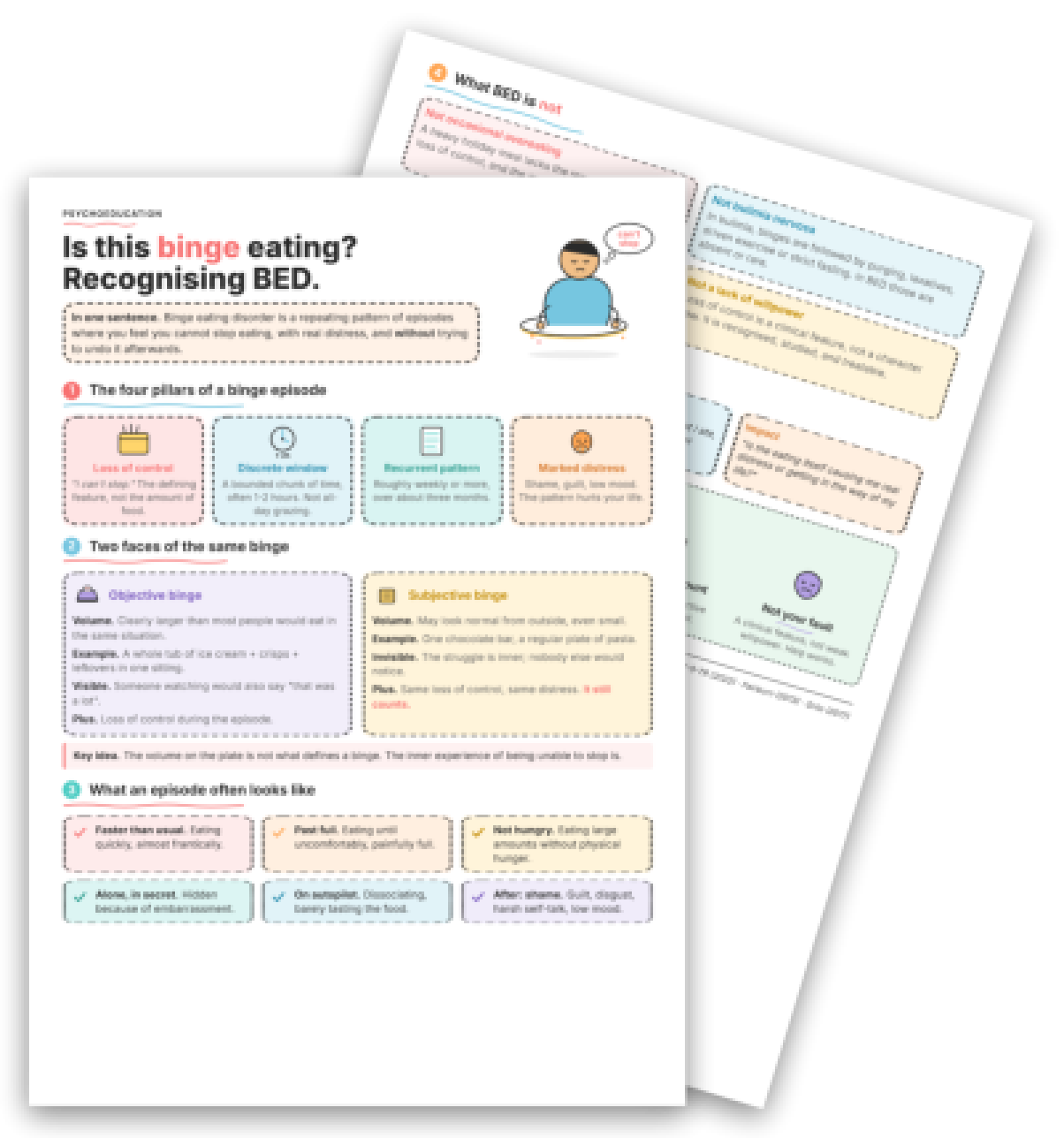
Patients presenting with binge eating disorder (BED) rarely arrive with that label. They describe shame, secrecy, and a felt inability to stop, but they often minimise the severity, dismiss the episodes as "just overeating," or confuse their experience with bulimia nervosa. This fiche PDF gives you a structured visual support to make the clinical picture explicit and shared during the consultation itself.
Use this resource with your patients
Handout, exercises and materials ready to use, right inside SessionFuel.
Why BED resists explanation in session
The core difficulty is definitional. When you tell a patient that loss of control, not food volume, is the defining feature of a binge episode, they frequently do not believe you. Culturally, "bingeing" connotes excess quantity, so patients who experience subjective binges (episodes with a normal or small amount of food, but the same felt compulsion to continue) tend to self-disqualify. They conclude that what they experience cannot be clinically significant because "I didn't eat that much."
At the same time, the shame and guilt that follow episodes make honest self-report difficult in the early alliance. Patients conflate the clinical pattern with weak willpower, a misconception that raises the cost of disclosure. Before any formulation work, you need a shared vocabulary that normalises the experience without minimising it. An oral explanation alone rarely accomplishes this: the patient listens, acquiesces, and leaves with the same private conviction that they are simply "out of control" as a character trait, not as a clinical feature of a recognised, treatable disorder.
This is also a differential issue. BED sits between symptoms consistent with bulimia nervosa (compensatory behaviours are absent or rare) and anorexia nervosa (restriction is not the primary mechanism), and the boundaries blur quickly when you rely on spoken description alone.
What the fiche contains: a visual map of the clinical picture
The fiche PDF organises five clearly delineated panels that you can walk through with your patient side by side.
Panel 1 names "the four pillars of a binge episode": loss of control, a discrete time window (often one to two hours, explicitly distinguishing episodic binges from all-day grazing), a recurrent pattern (roughly weekly over three months), and marked distress. Seeing these four criteria together on the page makes the diagnostic logic concrete rather than abstract.
Panel 2 is the most clinically useful for early disclosure work: it places "two faces of the same binge" in direct visual contrast. The objective binge (large volume, visible from outside) sits beside the subjective binge (normal or small volume, invisible to others), with the explicit statement: "The volume on the plate is not what defines a binge. The inner experience of being unable to stop is." This single image frequently releases significant shame in patients who have been silently doubting the legitimacy of their own experience.
Panel 3 lists behavioural markers of an episode (eating faster than usual, past fullness, without physical hunger, alone or in secret, on autopilot, followed by shame). These exercises in pattern recognition help patients connect their lived memory to the clinical description.
Panel 4 addresses common misattributions directly: BED is not occasional overeating, not bulimia nervosa, not defined by weight, and not a lack of willpower. Having this in print counters the internalised stigma more durably than saying it once aloud. You can also use it to navigate the differential with tools like the CBT model of bulimia nervosa or the cognitive-behavioural model of anorexia nervosa in later sessions.
Panel 5 closes with three structured questions covering frequency, compensation, and functional impact, a clean bridge toward your own clinical assessment.
> Key takeaway: the fiche is a visual support that facilitates the explanation of BED in session; it is not a self-administered questionnaire but a psychoeducation tool you use alongside the patient to build a shared clinical language before formulation begins.
750+ clinical tools
A library built with and for clinicians, ready to use in session and extend between appointments.
Access all the toolsWhen and how to introduce the fiche
The fiche is best introduced once the patient has spontaneously described at least one episode, typically in the first or second session. A low-inference frame works well: "I'd like to show you something that might help us name what you're describing, let's look at it together." This avoids the diagnostic label before the patient is ready to receive it.
It is particularly indicated with patients who minimise their symptoms, those presenting comorbid low self-esteem, or patients carrying defectiveness-shame schemas that make self-disclosure costly. You may also find it useful when adaptive versus maladaptive coping is already a thread in the case, or when a depression-linked presentation obscures the eating pattern.
After walking through the fiche, ask the patient which panel felt most accurate, and which felt unfamiliar. The gap often locates the most productive focus for the following session. The fiche does not replace the clinical formulation; it creates the conditions for it.
Use it with your patients
Share this tool in the mobile app and follow the work between sessions.
Sources
- Fairburn, C. G. (2013). Overcoming Binge Eating: The Proven Program to Learn Why You Binge and How You Can Stop (2nd ed.). The Guilford Press.
- National Institute for Health and Care Excellence (NICE) (2017). Eating disorders: recognition and treatment (NICE guideline NG69).
- American Psychiatric Association (APA) (2013). Diagnostic and Statistical Manual of Mental Disorders, Fifth Edition (DSM-5). American Psychiatric Publishing.
Your session continues in your patients' pocket
Use with a patientYour resources, available everywhere
The handouts, exercises, programs and audios above: you choose which ones to make available to your patients, in the mobile app dedicated to them.
And far more than a library
The app goes well beyond resources, to support your patients every day:
Related categories
Explore other clinical resources by category.

Behaviours
Clinical hub for behaviors in therapy: worksheets and tools for coping, eating disorders, CBT formulation, and maladaptive behavioral patterns.

Understand
Clinical hub for the therapeutic aim 'Understand': worksheets and tools to build patient insight across CBT, ACT, schema therapy and more.

CBT
CBT worksheets, cognitive restructuring exercises & behavioral tools for clinicians. Evidence-based resources for every phase of cognitive behavioral therapy.
Anxiety
Clinical hub for anxiety disorders: CBT and ACT worksheets, psychoeducation sheets, and exercises for assessment and treatment across the anxiety spectrum.

Trauma
Clinical hub on trauma and PTSD: assessment, differential diagnosis, treatment phases, and printable resources for practitioners. 155 chars.

Mood
Evidence-based worksheets and clinical tools for mood disorders: CBT, ACT, and positive psychology resources for psychologists and therapists.