
Clinical picture. A., a woman in her late thirties, was referred for persistent insomnia and irritability following a road traffic collision eight months prior. In the initial session, she described poor sleep and difficulty concentrating at work, and her GP had been treating her for an adjustment disorder. Systematic screening using the ICD-11 framework revealed that she was also experiencing intrusive sensory flashes of the impact whenever she heard a car brake sharply, had stopped driving entirely, and sat with her back to the wall in the waiting room because she felt she needed to see any threat coming. Once all three pillars were named and mapped together, the clinical picture reframed clearly as PTSD rather than a prolonged adjustment reaction, and a trauma-focused intervention was planned accordingly.
Recognizing PTSD (ICD-11): PDF Worksheet, Tools and Exercises
A structured visual PDF worksheet to explain PTSD's three pillars, differential diagnosis, and common myths, tools and exercises for clinical psychoeducation.
Clinical vignettes
Three Pillars Missed at First Presentation
Distinguishing Rumination from Re-Experiencing
Clinical picture. B., a man in his mid-fifties, presented following a life-threatening cardiac event and reported thinking about it "constantly." The referring cardiologist queried PTSD, but B. himself was uncertain whether what he experienced counted. During psychoeducation, the clinician used the re-experiencing versus ordinary remembering distinction from the informational sheet: B. described thinking back to the event with sadness and worry, body calm, language in the past tense, with no sensory intrusion or present-tense physiological activation. Avoidance was limited, and while he was vigilant about physical symptoms, his nervous system was not globally braced. The formulation indicated significant health anxiety with grief rather than PTSD, allowing treatment to be targeted appropriately without pathologising normal post-event distress.
Patients presenting with PTSD rarely arrive with the label. They come in describing fragmented sleep, a body that will not settle, and a vague sense they are "not handling it well." Getting from that presentation to a shared clinical picture, quickly and without pathologising, is exactly what this fiche PDF is designed to support.
Use this resource with your patients
Handout, exercises and materials ready to use, right inside SessionFuel.
Why PTSD Is Hard to Explain at Intake
The diagnostic criteria are deceptively clear on paper, but in session the concept fragments. Patients hear "trauma" and immediately discount their own event ("It wasn't that bad"). They confuse re-experiencing with ordinary sad memory. They read avoidance as sensible caution rather than a maintenance cycle. And the sense of current threat, expressed as hypervigilance and irritability rather than fear, almost never maps onto what they expect "PTSD" to look like.
A verbal explanation alone rarely holds. You can spend ten minutes describing the three-pillar structure, and the patient nods while privately wondering whether their own reactions qualify. The absence of a shared visual reference means each term has to be re-anchored at every subsequent session. The fiche solves this directly: it gives the patient something to look at while you speak, and something to take home as a reference point.
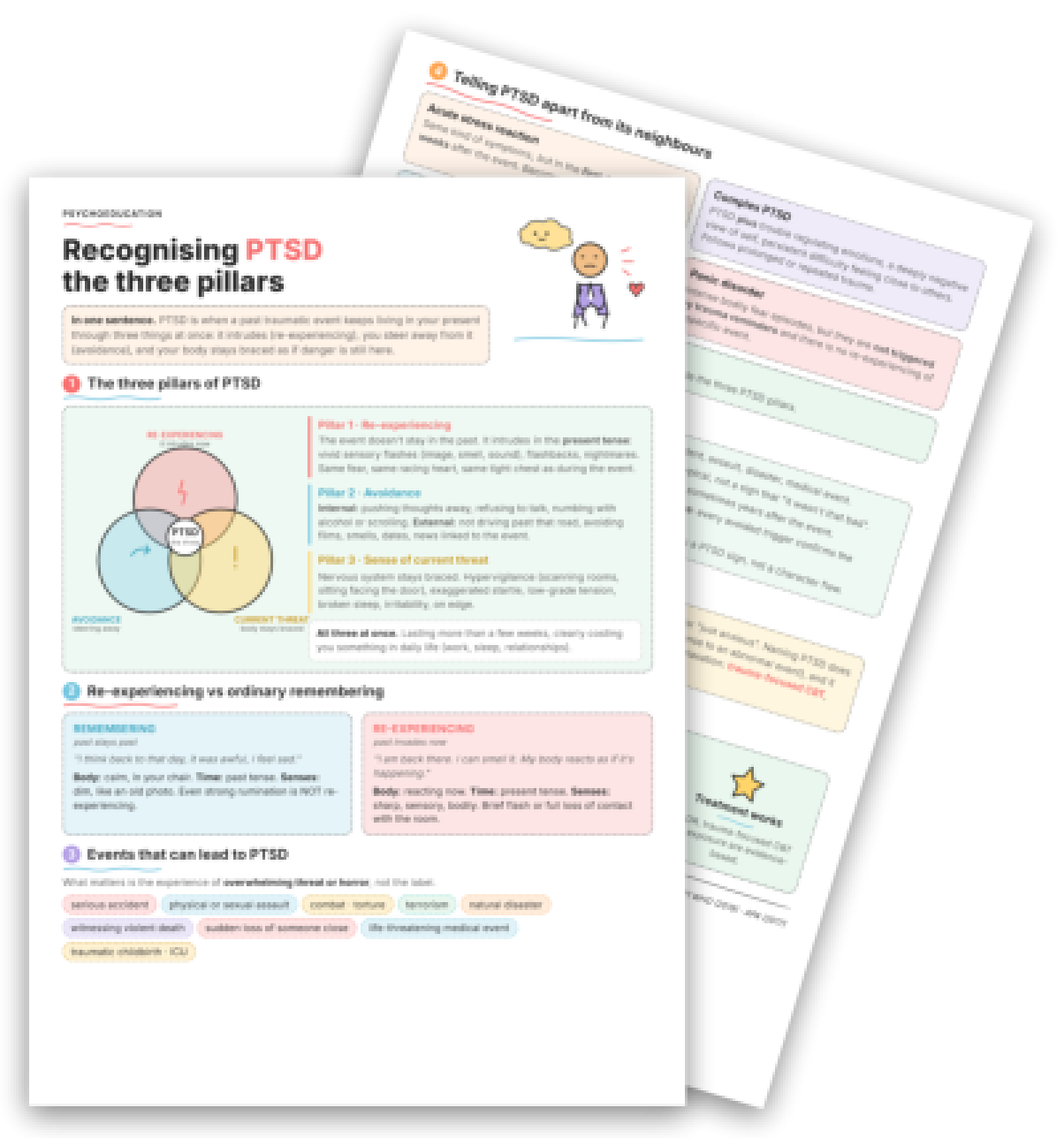
What the Fiche Contains, and Why the Visual Layout Matters
The resource is built around six panels, each addressing a distinct clinical need.
- Panel 1 presents the three-pillar diagram: Re-experiencing / Avoidance / Current threat, shown as simultaneous co-occurring dimensions, not a checklist. The visual immediately communicates that all three must be present together, which is the piece most patients miss.
- Panel 2 draws a direct, side-by-side contrast between ordinary remembering and genuine re-experiencing: "Body: calm, in your chair. Time: past tense" versus "Body: reacting now. Time: present tense." This distinction is where most psychoeducation stalls at the oral level; the parallel layout resolves the confusion in one glance.
- Panel 3 lists precipitating events broadly, anchored around the phrase "what matters is the experience of overwhelming threat or horror, not the label", directly countering the "soldiers only" myth before it surfaces.
- Panel 4 covers differential diagnosis: acute stress reaction, Complex PTSD, depression, panic disorder, and adjustment difficulties. This panel supports the early formulation conversation without requiring the clinician to narrate each distinction from scratch.
- Panel 5 addresses five named myths ("You must remember the whole event," "Avoidance is good coping"), framed as corrections the patient can re-read independently. It pairs naturally with tools for examining avoidance cycles and understanding how trauma memories form.
- Panel 6 explains why naming the diagnosis matters and names the evidence-based approaches: trauma-focused CBT, prolonged exposure, and EMDR.
> Key takeaway: This fiche is a visual support that facilitates the explanation of PTSD in session, not a self-administered questionnaire. You use it to anchor your psychoeducation, the patient leaves with a concrete reference.
750+ clinical tools
A library built with and for clinicians, ready to use in session and extend between appointments.
Access all the toolsWhen and How to Introduce It in Practice
The fiche fits naturally in a second or third session, once the anamnèse has surfaced the traumatic context and a basic alliance is established. Introducing it earlier risks feeling diagnostic before the patient is ready; waiting too long means the absence of a shared framework slows everything else.
A useful framing: "I'd like to show you something that maps what you've been describing, not to put a label on it, but so we have the same picture in mind when we talk." This positions the fiche PDF as a shared clinical vocabulary, not a verdict.
When debriefing, panel 2 (re-experiencing versus remembering) tends to produce the strongest reaction, patients frequently pause here and revise their self-assessment upward. Panel 5 is useful for patients who have spent months or years self-dismissing. For complex or prolonged trauma presentations, the fiche opens the conversation toward Complex PTSD and the additional self-organization difficulties that structure differentiates.
For patients whose trauma occurred in medical contexts, it pairs usefully with resources addressing critical illness and PTSD. Clinicians building toward an exposure-based protocol will find it a clean conceptual precursor to graded exposure hierarchy work, and understanding the fight-flight-freeze response complements panel 3's somatic content directly. Once the diagnostic picture is shared, PTSD-specific tools for memory and narrative work and the Ehlers and Clark cognitive model become the natural next steps. For clinicians using EMDR, negative and positive cognitions work follows logically once the pillar structure is understood.
The fiche does not replace clinical formulation, but it shortens the time from first disclosure to shared understanding, which is where psychoeducation earns its place in trauma work.
Use it with your patients
Share this tool in the mobile app and follow the work between sessions.
Sources
- World Health Organization (WHO) (2022). 6B40 Post traumatic stress disorder. World Health Organization.
- Brewin, C. R. (2020). Complex post-traumatic stress disorder: a new diagnosis in ICD-11. BJPsych Advances, 26(3), 145-152.
- Cloitre, M., Garvert, D. W., Brewin, C. R., Bryant, R. A., & Maercker, A. (2020). ICD-11 complex post-traumatic stress disorder: simplifying diagnosis in trauma populations. The British Journal of Psychiatry, 216(3), 129-131.
Your session continues in your patients' pocket
Use with a patientYour resources, available everywhere
The handouts, exercises, programs and audios above: you choose which ones to make available to your patients, in the mobile app dedicated to them.
And far more than a library
The app goes well beyond resources, to support your patients every day:
Related categories
Explore other clinical resources by category.

Trauma
Clinical hub on trauma and PTSD: assessment, differential diagnosis, treatment phases, and printable resources for practitioners. 155 chars.

Understand
Clinical hub for the therapeutic aim 'Understand': worksheets and tools to build patient insight across CBT, ACT, schema therapy and more.

CBT
CBT worksheets, cognitive restructuring exercises & behavioral tools for clinicians. Evidence-based resources for every phase of cognitive behavioral therapy.
Anxiety
Clinical hub for anxiety disorders: CBT and ACT worksheets, psychoeducation sheets, and exercises for assessment and treatment across the anxiety spectrum.

Mood
Evidence-based worksheets and clinical tools for mood disorders: CBT, ACT, and positive psychology resources for psychologists and therapists.

Identity
Clinical resources for self-identity work in therapy: CBT, ACT, schema tools for clinicians addressing self-concept, core beliefs, and identity disruption.