
Clinical picture. M., a 29-year-old graduate student, was referred after two years of what his GP had framed as generalized anxiety. He described feeling like a spectator of his own life, his hands looking foreign to him, and familiar lecture halls appearing flat and stage-like. Crucially, he retained full reality testing throughout, repeating unprompted that he knew none of it was real, only that it felt that way. The clinician introduced the psychoeducational sheet on depersonalization-derealization disorder in session, naming the two-component model and drawing the explicit distinction from psychosis. M. reported immediate relief at having a conceptual frame, and his engagement with subsequent functional assessment improved markedly.
Depersonalization-Derealization: PDF Worksheet, Tools and Exercises
A structured PDF worksheet, visual tools, and clinical exercises to explain DPDR in session, map the differential, and support targeted psychoeducation.
Clinical vignettes
Persistent Unreality Mistaken for Anxiety
Derealization Onset After Cannabis Use
Clinical picture. T., a 22-year-old woman, presented six months after a single high-dose cannabis episode that had triggered acute derealization. The symptoms had never fully resolved: she described her surroundings as washed-out and dreamlike, and she was spending considerable effort at work maintaining the appearance of normal functioning. She had avoided seeking help, fearing a diagnosis of psychosis. The clinician used the informational sheet to clarify the intact reality-testing criterion and to distinguish DPDR from both psychosis and a straightforward substance reaction, helping T. understand why her symptoms had persisted beyond the acute episode. She agreed to a structured symptom diary as a first step toward mapping triggers and severity.
Patients presenting with depersonalization-derealization disorder often arrive with a paradox already articulated: they describe their experience precisely ("I'm watching my life instead of living it") and yet remain convinced they are losing their mind. This fiche PDF gives you a structured visual support to use in session the moment that phenomenology surfaces, so you can name the condition, map the differential, and establish a shared clinical vocabulary before the fear loop consolidates further.
Use this resource with your patients
Handout, exercises and materials ready to use, right inside SessionFuel.
Why DPDR Resists Oral Explanation
The core difficulty is structural. Reality testing stays intact in DPDR, which means the patient already "knows" the world is real, and that knowledge offers zero relief. Every verbal reassurance you offer triggers an immediate self-checking loop: the patient tests for the feeling, fails to find it, and amplifies the hypervigilance that maintains the symptom. That loop is one reason DPDR is chronically under-identified: the patient appears insight-intact, so clinicians sometimes move past the phenomenology before fully naming it.
The differential is equally hard to convey in words alone. Patients routinely fear they are entering psychosis, experiencing panic disorder, or reliving a traumatic intrusion. Untangling those distinctions verbally eats session time and often leaves the patient with a partial, distorted map of their own condition. A visual support settles the question more cleanly, in less time.
Safety behaviours compound maintenance further: mirror avoidance, repeated reassurance-seeking, reality-testing dozens of times a day. These map directly onto the CBT maintaining processes model, and avoidance reduction is an explicit target, but a patient who has never heard the term "safety behaviour" needs to see the loop before they can engage with disrupting it.
Clinical library
750+ clinical tools
A library built with and for clinicians, ready to use in session and extend between appointments.
Access all the toolsSeveral resource types
Psychoeducation handouts
Understand at a glance
Interactive exercises
To do and fill in
Interactive programs
A structured path
Audios
Meditation and relaxation
Psychometric tests
Automatic scoring
What the Fiche Contains: A Visual Support for In-Session Explanation
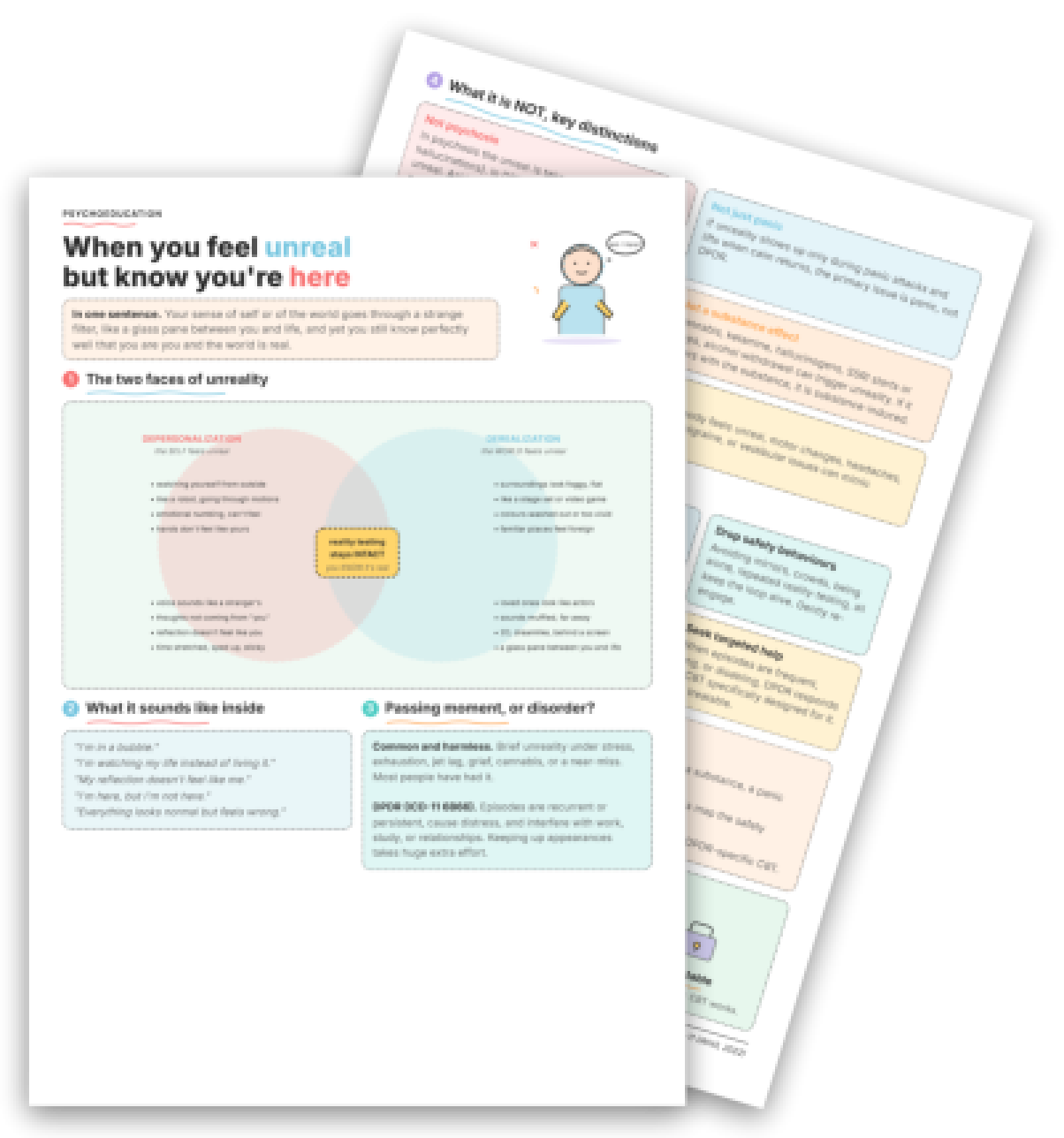
The fiche is built around five content panels plus a dedicated clinical debrief section. Panel 1, "The two faces of unreality," arranges depersonalization and derealization in a parallel side-by-side layout, with specific phenomenological descriptors under each column ("hands don't feel like yours," "surroundings look foggy, flat," "loved ones look like actors"). The visual separation does something oral explanation cannot: it shows the patient exactly where their experience sits within a named taxonomy, anchored to ICD-11 code 6B66, without pathologising the encounter.
Panel 3 draws the clinically decisive line between a transient episode and a diagnosable disorder, grounding the distinction in functional impairment rather than symptom count. Panel 4, "What it is NOT," covers four differential exclusions in parallel blocks: not psychosis, not primary panic, not a PTSD flashback, not substance-induced unreality. Patients can return to this panel between sessions, which reduces the demand for repeated reassurance in subsequent appointments.
Panel 5 introduces six self-management directions: naming the symptom to break the fear loop, redirecting attention outward rather than inward, dropping safety behaviours, sensory grounding, addressing upstream load (sleep disruption, cannabis, chronic anxiety), and seeking DPDR-specific CBT through the dedicated CBT resource on depersonalization. Each direction is stated in a single line, which suits patients whose attentional resources are already taxed by the disorder.
The closing "To discuss in session" block offers three structured prompts: trigger mapping, safety behaviour inventory, and criteria for CBT referral. This section is yours to use as a clinical scaffold, not a patient homework assignment.
> To remember: this fiche is a visual support that facilitates in-session explanation, not a self-report questionnaire. Its value lies in what it lets you show while you speak; the patient leaves with a concrete reference map, not a task to complete alone.
Use it with your patients
Share this tool in the mobile app and follow the work between sessions.
When and How to Introduce the Fiche
The fiche fits naturally in the first or second session once the phenomenology has emerged, before the differential is fully closed. It works particularly well with patients who present with marked health anxiety (see the Health Anxiety resource) or a history of unusual perceptual experiences that have never been properly labelled.
A low-stigma introduction works best: "I'd like to show you a map of what you've been describing, so we have a common language for it." Walk through Panel 4 together before handing the fiche over; patients who read the psychosis distinction without contextual framing can misread it in both directions.
For debrief, ask which descriptors in Panel 1 fit their experience most precisely and which do not. That small calibration task serves diagnostic refinement and the therapeutic alliance simultaneously. If safety behaviours surface during Panel 4, the fiche pairs naturally with grounding technique resources and a deeper look at psychological safety crutches in subsequent sessions.
One clear limit: when active substance use is the primary driver of unreality, the fiche itself states that pathway requires separate management. Address the substance before building the DPDR psychoeducation arc.
The fiche does not replace formulation. It makes the explanation sharper and leaves the patient with a reference they can reach for when the filter descends again between appointments.
Patient mobile app
Your session continues in your patients' pocket
Use with a patientYour resources, available everywhere
The handouts, exercises, programs and audios above: you choose which ones to make available to your patients, in the mobile app dedicated to them.
Psychoeducation handoutsInteractive exercisesInteractive programsAudiosPsychometric tests
And far more than a library
The app goes well beyond resources, to support your patients every day:
Standardized tests
Therapy journal
Gamification
Wellbeing challenges
Introspection prompts
Therapist homework
Related categories
Explore other clinical resources by category.

Trauma
Clinical hub on trauma and PTSD: assessment, differential diagnosis, treatment phases, and printable resources for practitioners. 155 chars.

Understand
Clinical hub for the therapeutic aim 'Understand': worksheets and tools to build patient insight across CBT, ACT, schema therapy and more.

CBT
CBT worksheets, cognitive restructuring exercises & behavioral tools for clinicians. Evidence-based resources for every phase of cognitive behavioral therapy.

Anxiety
Clinical hub for anxiety disorders: CBT and ACT worksheets, psychoeducation sheets, and exercises for assessment and treatment across the anxiety spectrum.

Mood
Evidence-based worksheets and clinical tools for mood disorders: CBT, ACT, and positive psychology resources for psychologists and therapists.

Identity
Clinical resources for self-identity work in therapy: CBT, ACT, schema tools for clinicians addressing self-concept, core beliefs, and identity disruption.