
Clinical picture. M., a woman in her mid-thirties, presented with chronic low-grade exhaustion and recurrent conflicts with her partner that she described as "explosions over nothing." She had no prior schema therapy exposure and struggled to connect her habitual compliance at work and at home to the anger that surfaced afterward. The clinician introduced the Subjugation Schema Handout midway through the fourth session, walking through the compliance loop diagram together and asking M. to map a recent episode onto each step. She immediately recognized the body sensations listed, jaw tightening and breath held, noting she had experienced exactly that sequence the previous weekend before agreeing to a social engagement she had not wanted to attend. By the close of the session, M. was able to name the loop as a pattern rather than a character flaw, which reduced her self-critical framing enough to allow more curious exploration in subsequent sessions.
Subjugation Schema: PDF Worksheet, Tools and Exercises for Clinical Practice
A printable handout to explain the subjugation schema in session, map the compliance loop, and guide assertiveness work within a schema therapy framework.
Clinical vignettes
Naming the Loop Before the Session Ends
Childhood Origins, Present Compliance
Clinical picture. T., a man in his late forties, sought therapy following a work-related burnout after two decades in a demanding management role. He reported that he had always found it "easier to adapt" than to voice disagreement, and he attributed this to being "low maintenance." The clinician used the handout's section on childhood learning signals as a shared reading exercise, asking T. to note which phrases resonated with his family of origin. He paused at "disagreement equals disrespect" and disclosed that open contradiction of his father had routinely resulted in prolonged silence and withdrawal of approval. Connecting this early learning to his present-day automatic agreement with senior colleagues gave T. a functional explanation for the pattern rather than a moral one, and he began monitoring his compliance responses between sessions using a brief log tied to the body signals listed in the handout.
The subjugation schema is one of the hardest to name in session because patients don't experience it as a schema. They experience it as being reasonable, flexible, low-maintenance. This fiche PDF gives you a visual anchor to shift that framing, from "I'm just easygoing" to a genuine examination of an automatic compliance loop that costs the patient far more than they recognise.
Use this resource with your patients
Handout, exercises and materials ready to use, right inside SessionFuel.
Why the Subjugation Schema Resists Explanation in Session
Patients with marked subjugation, as defined in schema therapy (Young, Klosko & Weishaar, 2003), rarely present with the chief complaint of "I can't say no." They come in with low self-esteem signs, unexplained bursts of anger, somatic exhaustion after social contact, or persistent relationship dissatisfaction. The schema itself is ego-syntonic: compliance was protective once, and the relief it still provides is genuine, if brief.
Explaining this orally tends to hit a wall. The patient acknowledges the pattern intellectually but cannot track where the automatic yes begins, because it begins in the body, before deliberate thought. Without a visual support, the chain from request to guilt-driven compliance remains abstract. The resentment that accumulates between sessions stays disconnected from the schema, and psychoeducation does not land.
A second obstacle: naming subjugation can feel like a criticism of the patient's identity. The fiche sidesteps that by locating the origin clearly in early learning, not in character.
What the Handout Contains: A Visual Support for Session Explanation
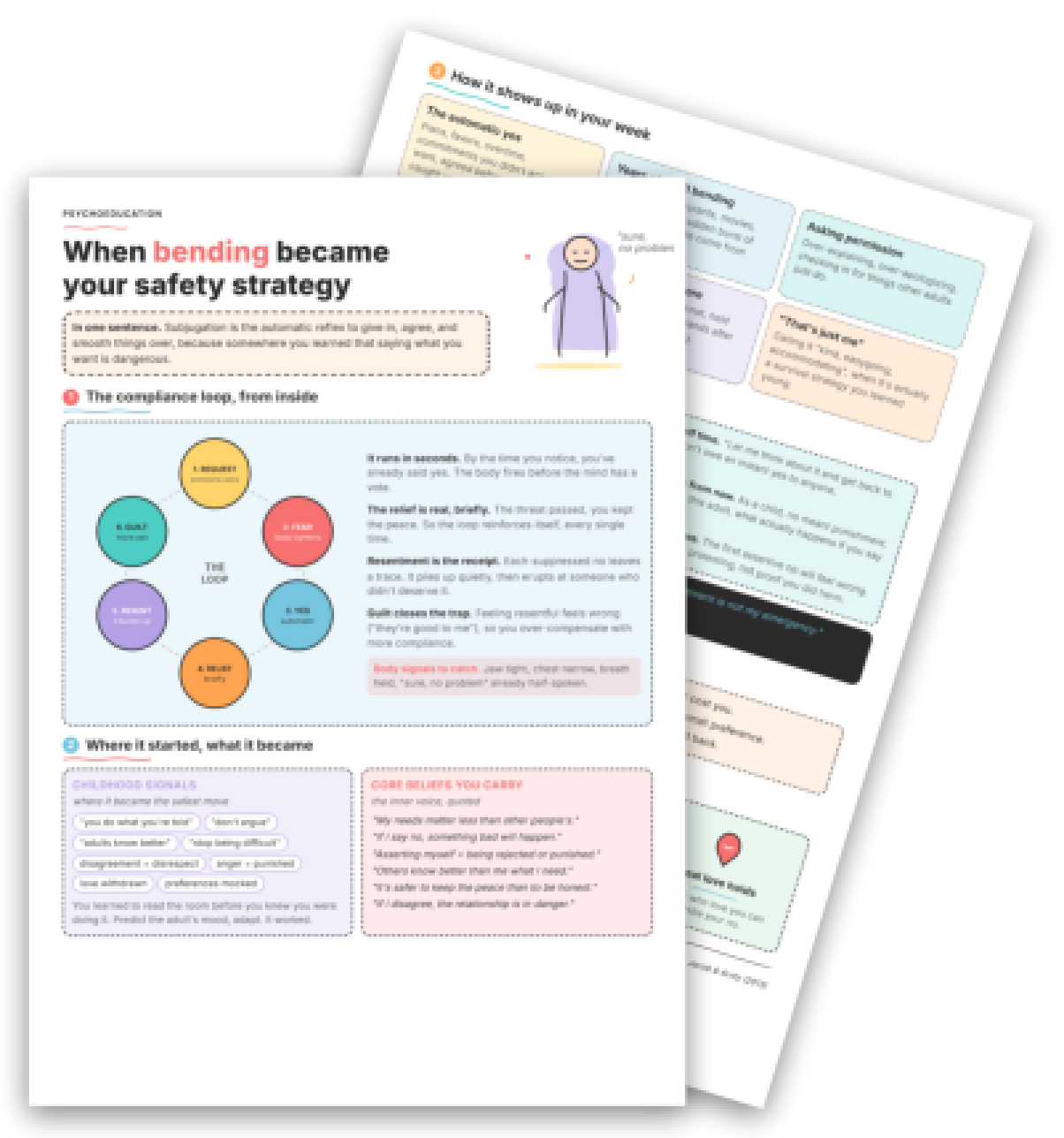
The fiche PDF is structured in six panels, each serving a distinct clinical function.
The centrepiece is "The Compliance Loop, from Inside", a circular diagram with six labelled nodes: Request → Fear → Yes → Relief → Resent → Guilt, looping back. Seeing the cycle as a closed loop, rather than hearing it described, makes the self-reinforcing logic immediately apparent. Patients often recognise the sequence in the first thirty seconds of looking at it. The caption "It runs in seconds. By the time you notice, you've already said yes" names the automaticity without blame.
The second panel maps childhood signals ("don't argue", "stop being difficult", love withdrawn after disagreement) alongside the core beliefs that crystallised from them: "My needs matter less than other people's" and "Asserting myself = being rejected or punished." This two-column layout makes the developmental logic visible in a way that a verbal formulation alone rarely achieves. You can use it to ground a longitudinal case formulation or to enrich a schema maintenance discussion.
The third panel catalogues behavioural signatures across the week: automatic yeses, permission-seeking, hidden opinions, post-contact exhaustion. This is clinically useful because patients often discount isolated incidents; seeing them listed together shifts the attribution.
The fourth panel offers concrete behavioural exercises: buying time before answering, practising low-stakes refusals, tracking the cost of suppressed nos. These map directly onto a graded assertiveness approach and pair well with setting personal boundaries work. The fifth panel provides three session-discussion prompts the patient can use between appointments. The sixth is a brief four-point reminder card.
> To keep in mind: this fiche is a visual support that facilitates the explanation of the subjugation schema during the session itself. It is not a questionnaire the patient fills in alone; it is a psychoeducation tool you work through together, leaving the patient with a concrete reference to take home.
750+ clinical tools
A library built with and for clinicians, ready to use in session and extend between appointments.
Access all the toolsWhen and How to Introduce It in Session
The handout fits naturally from session two or three onward, once the initial anamnesis has surfaced compliance-related patterns. It is particularly indicated when the patient presents with self-sacrifice schema features, approval-seeking behaviour, or emotional inhibition alongside subjugation, schemas that frequently co-occur.
A low-threshold introduction: "I'd like to show you something that might map onto what you've been describing, a loop that a lot of people recognise." Framing the loop as something to recognise, not diagnose, preserves the alliance.
During the debrief, pay particular attention to which node the patient stalls on. Some locate themselves clearly in the guilt stage; others dispute the resentment node, which often indicates secondary shame about anger. The "Then vs. Now" differentiation in panel four ("As a child, no meant punishment. Right now, with this adult, what actually happens if you say no?") maps directly onto stimulus discrimination work and opens the door to assertiveness exercises at a pace the patient chooses.
One clinical limit to note: with patients whose abandonment schema is primary, the "Real love holds" reframe in the summary panel may activate threat before the therapeutic alliance is solid enough to contain it. Introduce the fiche, and save that panel for a later session.
The handout does not replace the schema conceptualisation; it makes the first explanation stickier, gives the patient a vocabulary to bring back into session, and shortens the distance between insight and behavioural experiment.
Use it with your patients
Share this tool in the mobile app and follow the work between sessions.
Sources
- Young, J. E., Klosko, J. S., Weishaar, M. E. (2003). Schema Therapy: A Practitioner's Guide. Guilford Press.
- Young, J. E., Klosko, J. S. (1993). Reinventing Your Life: The Breakthrough Program to End Negative Behavior and Feel Great Again. Plume / Penguin.
Your session continues in your patients' pocket
Use with a patientYour resources, available everywhere
The handouts, exercises, programs and audios above: you choose which ones to make available to your patients, in the mobile app dedicated to them.
And far more than a library
The app goes well beyond resources, to support your patients every day:
Related categories
Explore other clinical resources by category.

Identity
Clinical resources for self-identity work in therapy: CBT, ACT, schema tools for clinicians addressing self-concept, core beliefs, and identity disruption.

Relationships
Clinical worksheets and tools on relational functioning: attachment, schemas, assertiveness, and communication skills for therapists. Printable PDF resources.

Cognition
Printable cognitive therapy worksheets and clinical tools for therapists: CBT, ACT, schema work, defusion, distortions, and belief restructuring.

Understand
Clinical hub for the therapeutic aim 'Understand': worksheets and tools to build patient insight across CBT, ACT, schema therapy and more.

Build awareness
Clinical worksheets and tools to build awareness in therapy: cognitive distortions, schemas, emotions, ACT and CBT resources for practitioners.

Integrative
Integrative therapy clinical resources: worksheets, psychoeducation programs, and exercises for eclectic, multimodal practice across orientations.