
Clinical picture. M., a 34-year-old graphic designer, presented with chronic self-doubt and a pattern of consulting multiple colleagues and family members before acting on any professional decision. Her therapist introduced the five-question exercise after she spent two sessions describing an unresolved choice about accepting a freelance contract. Completing the questions at home, M. identified that she was not seeking information but rather reassurance that she would not be blamed if things went wrong. She returned the following week having signed the contract, noting that writing out question five made her realise the other person's opinion had not changed the quality of her reasoning. Progress remained cautious, though she reported a modest reduction in the urge to seek a final endorsement before acting.
Approval-Seeking in Therapy: A Clinical Reflection Tool
A structured five-question homework exercise helping patients examine approval-seeking patterns and rebuild autonomous decision-making.
Clinical vignettes
Approval-Seeking Before a Career Change
Distinguishing Advice from Validation
Clinical picture. P., a 47-year-old teacher, described a longstanding habit of asking his partner to confirm decisions he had already made, then feeling destabilised when she expressed any reservation. The therapist offered the exercise as structured reflection between sessions, framing it as an opportunity to examine one specific recent episode rather than the pattern in general. Question four proved particularly useful: P. wrote at length about the difference between gathering a second perspective and needing external permission, a distinction he said he had never articulated before. In the next session he acknowledged that his partner's reservations were often useful, yet his reaction to them had more to do with a fragile sense of self-trust than with the content of her feedback. The exercise did not resolve the pattern, but it opened a more precise line of inquiry for subsequent work.
Why Approval-Seeking Resists Verbal Explanation Alone
Approval-seeking sits at the crossroads of self-worth, relational dependence, and autonomous agency. Patients rarely frame it as a problem. They describe it as "just wanting a second opinion" or "making sure before I commit." The discomfort only surfaces when the approval is withheld, and the collapse that follows, the sudden loss of conviction, the need to start over, is what brings the pattern into clinical view.
What makes this pattern so hard to work with verbally is that patients often cannot reliably distinguish seeking an opinion from outsourcing their own judgment. The functional difference is real, but without a concrete prompt to examine a specific recent instance, the insight tends to stay abstract. That is where a structured between-session exercise changes the dynamic. Tools such as the Approval & Admiration Seeking Schema worksheet and the Approval-Seeking Schema fiche offer strong psychoeducation anchors; this exercise deepens the work by turning the patient's own recent experience into the clinical material.
Use this resource with your patients
Handout, exercises and materials ready to use, right inside SessionFuel.
What the Exercise Contains
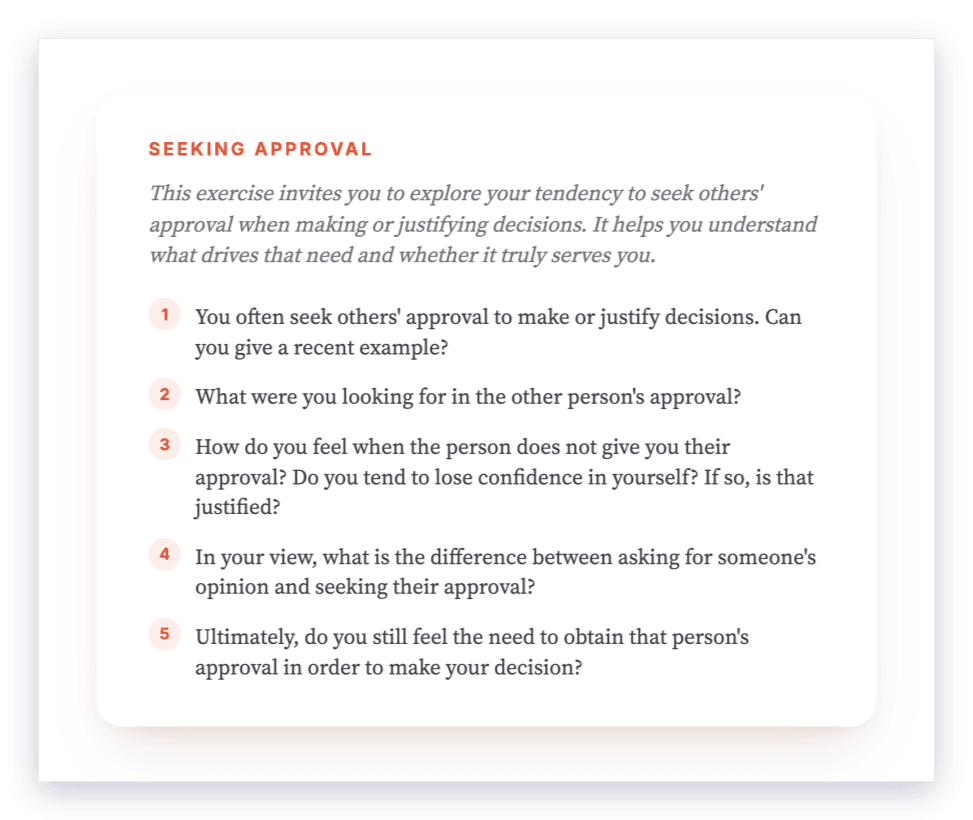
The exercise is built around five sequenced questions. Above is a static preview of those questions as they appear in the tool. Note that this image shows the question list only: the full guided experience, complete with patient-facing instructions and space to write, unfolds on the patient's own device through the SessionFuel patient app, not in this image.
The sequence is deliberate. The first two questions anchor the patient in a concrete recent event and surface the underlying need driving the behavior, whether that is reassurance, validation, or relief from doubt. Question three targets the emotional consequence of disapproval and invites the patient to evaluate whether the confidence loss was actually warranted. This is a critical moment: many patients discover, in writing, that their self-doubt was disproportionate to any real information received. Question four builds conceptual distinction between healthy input-seeking and dependency, a nuance that often requires this kind of private, unhurried reflection to crystallise. Question five closes the loop by inviting the patient to re-examine their decision with fresh eyes.
This exercise is available to patients through the mobile application that is the dedicated patient-side interface of SessionFuel: the clinician assigns it as homework from their SessionFuel account, and the patient completes it directly on their phone, on their own, between sessions.
Key clinical takeaway: The exercise's real leverage is in questions three and four taken together. When a patient writes that their confidence collapsed after disapproval and then articulates, in their own words, that they were not actually looking for information, the behavioral pattern and the schema behind it become undeniable.
750+ clinical tools
A library built with and for clinicians, ready to use in session and extend between appointments.
Access all the toolsUse it with your patients
Share this tool in the mobile app and follow the work between sessions.
How to Assign and Use It in Your Practice
This exercise suits a wide range of presentations. It is particularly well matched to patients working on the emotional dependency pattern, those with low self-esteem maintained by external validation, and those presenting with self-deprecating patterns in social contexts. It also integrates naturally alongside assertiveness work, particularly when a patient knows the theory but remains relationally blocked by the need for others' confirmation before acting.
To introduce it, you do not need to name approval-seeking explicitly. A simple framing works well: "Before our next meeting, I would like you to take some time with a few questions about a recent situation where you checked in with someone before making a decision." That low-key framing reduces defensiveness and invites honest self-observation.
When the patient returns, the richest material usually comes from questions three and five side by side. If the patient still feels they need the approval after completing question five, that information is clinically significant and opens a direct line toward core belief work with tools such as Scaling Beliefs About Yourself or the Downward Arrow Technique. If confidence has shifted, even slightly, that movement is worth naming explicitly as evidence that their own judgment is more reliable than the pattern suggests.
For patients where the approval-seeking is relationally embedded, pairing this exercise with the Ego and Pride relational reflection exercise or the Building Secure Attachment worksheet can extend the work across multiple sessions without losing continuity.
Your session continues in your patients' pocket
Use with a patientYour resources, available everywhere
The handouts, exercises, programs and audios above: you choose which ones to make available to your patients, in the mobile app dedicated to them.
And far more than a library
The app goes well beyond resources, to support your patients every day:
Related categories
Explore other clinical resources by category.

Identity
Clinical resources for self-identity work in therapy: CBT, ACT, schema tools for clinicians addressing self-concept, core beliefs, and identity disruption.

Emotions
Clinical resources on emotion regulation: worksheets, coping tools, CBT, REBT, and ACT exercises for therapists working across diagnoses and age groups.

Behaviours
Clinical hub for behaviors in therapy: worksheets and tools for coping, eating disorders, CBT formulation, and maladaptive behavioral patterns.

Relationships
Clinical worksheets and tools on relational functioning: attachment, schemas, assertiveness, and communication skills for therapists. Printable PDF resources.

Cognition
Printable cognitive therapy worksheets and clinical tools for therapists: CBT, ACT, schema work, defusion, distortions, and belief restructuring.

Build awareness
Clinical worksheets and tools to build awareness in therapy: cognitive distortions, schemas, emotions, ACT and CBT resources for practitioners.