
Clinical picture. A, a woman in her mid-thirties presenting with generalised anxiety and a long pattern of passive communication, described chronic resentment toward her partner after consistently suppressing her own needs at home. The therapist introduced the LACE framework using the worksheet, walking through each step with a recent situation in which A had silently gone along with plans she found overwhelming. A practised aloud, replacing her habitual apologetic preamble with a calm acknowledgement of her partner's wish followed by a plain first-person statement of her own need; she noted that dropping the word "but" felt unfamiliar but less combative. By the next session she reported having used the sequence once at home; the conversation had been brief and unresolved, yet she had not ruminated about it for days afterward.
LACE Empathic Assertion: PDF Worksheet, Tools and Exercises
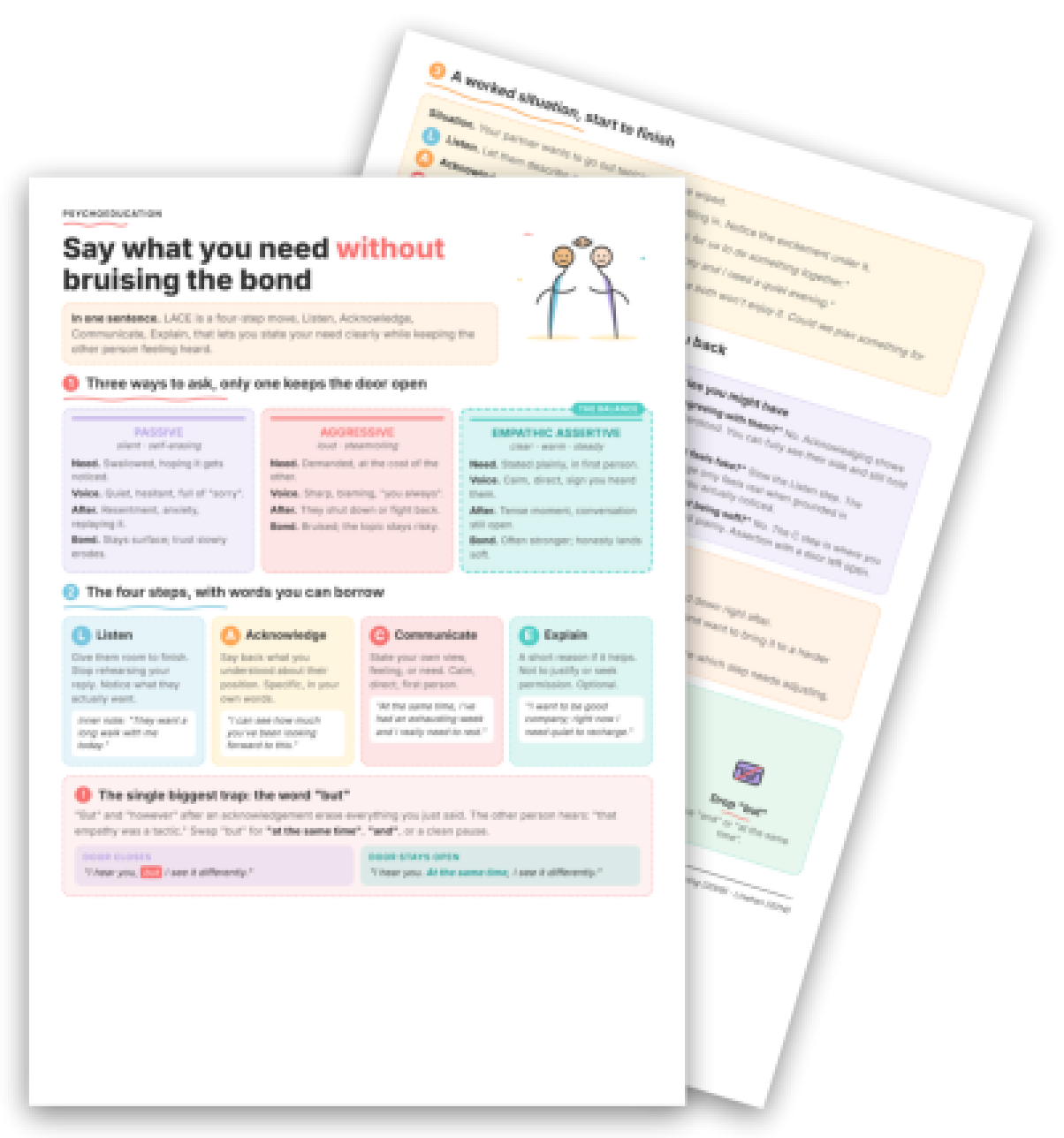
A printable visual support clinicians can use in session to teach patients the four-step LACE method for stating needs clearly while preserving the relational bond.
Clinical vignettes
LACE With a Conflict-Avoidant Patient
Addressing Aggression Patterns in a Couples Context
Clinical picture. During an individual session, M, a man in his late forties referred following escalating arguments with his adult son, acknowledged that his communication style had been sharp and blaming, shutting down dialogue rather than opening it. The clinician used the LACE sheet to contrast the aggressive and empathic-assertive columns, and M identified several of his typical phrases in the "loud, steamrolling" description without prompting. He rehearsed the Acknowledge step specifically, producing a specific, non-ironic reflection of his son's position before moving to the Communicate step. Progress was modest: M found the Explain step felt like "seeking permission," which became a productive focus for the following session.
Patients often leave a session on assertiveness knowing, in theory, that they should speak up. They still won't. The gap between conceptual agreement and behavior change is where most assertiveness work stalls, and it usually comes down to one thing: patients can't picture what the alternative actually sounds like in the moment. This LACE PDF worksheet gives you a concrete visual scaffold to bridge that gap during the consultation itself.
Use this resource with your patients
Handout, exercises and materials ready to use, right inside SessionFuel.
Why Empathic Assertion Is Hard to Convey Without a Visual Support
Empathic assertion sits in genuinely uncomfortable territory for most patients. Pure assertiveness training, as clinicians who work with the DBT DEAR MAN skill or assertive rights frameworks know, risks being heard as a license to prioritize the self at the other's expense. Patients with relational anxiety, abandonment schemas, or a high need for approval frequently reject assertiveness training for exactly this reason: they perceive it as a threat to the bond.
At the same time, pure validation without self-expression leads to the cycle of passive accumulation and eventual blow-up that many chronically conflict-avoidant patients describe. Explaining this verbally generates insight; it rarely generates skill. What patients miss is the feel of a response that holds both poles simultaneously: warmth toward the other and clarity about the self.
That simultaneous holding is almost impossible to convey in a spoken explanation. It takes a side-by-side comparison.
What the Fiche Contains: A Visual Tool Built Around Contrast and Sequence
The fiche PDF structures the concept across four panels, each doing specific clinical work.
The first panel places three communication styles in direct visual contrast: Passive, Aggressive, and Empathic Assertive. Rather than definitions, it maps each style across four dimensions: what happens to the need, the vocal quality, what the speaker feels afterward, and what happens to the relational bond. The contrast is stark and immediate. The Passive column reads "swallowed, hoping it gets noticed" and "resentment, anxiety, replaying it"; the Assertive column reads "often stronger; honesty lands soft". Patients locate themselves in this grid faster than they do in any verbal description, which opens up communication styles work without triggering defensiveness.
The second panel breaks down the four LACE steps with scripted phrases patients can borrow directly: "I can see how much you've been looking forward to this" for the Acknowledge step; "At the same time, I've had an exhausting week and I really need to rest" for the Communicate step. Giving patients borrowed language is a well-supported technique in assertive communication training, and seeing it laid out sequentially removes the cognitive load of having to invent phrasing under relational pressure.
The third panel isolates the "but" trap, the single most common mechanism that collapses a well-constructed acknowledgment. The fiche shows, in parallel columns, that "I hear you, but I see it differently" closes the door, while "I hear you. At the same time, I see it differently" keeps it open. This is the kind of micro-level linguistic distinction that active listening skills resources rarely make explicit, and seeing the two versions side by side is far more compelling than hearing it explained.
A fourth panel works through a complete scenario from Listen to Explain, and a final section addresses common patient worries (fake empathy, perceived softness, confusion with agreement) alongside discussion prompts for the next session.
> To retain: the LACE fiche is a visual support that facilitates the explanation of empathic assertion in session; it gives patients a reference they can take home, not a worksheet they fill out alone.
750+ clinical tools
A library built with and for clinicians, ready to use in session and extend between appointments.
Access all the toolsWhen and How to Introduce It in Session
The fiche fits naturally from the second or third session onward, once you have a clear picture of the patient's relational functioning and some interpersonal conflict or avoidance pattern has been identified. It is particularly well-indicated for patients presenting with approval-seeking schemas, those working through assertiveness behavioral experiments, or anyone who intellectually endorses assertiveness but consistently defaults to passivity or periodic aggression.
You can introduce it simply: "I want to show you a model that might give us a shared language for what we've been describing." Placing the fiche between you rather than handing it across the desk signals that you are working through it together.
During debriefing, the "To discuss in session" prompts on the fiche do useful clinical work: they ask whether the patient noticed a "but" slip out, whether they tried LACE in a low-stakes moment, and whether acknowledging felt fake or self-betraying. Each prompt points toward the specific mechanism that blocked the skill, rather than requiring the patient to generate their own analysis.
For patients already using assertiveness training scenarios or building an assertiveness ladder, LACE provides the moment-to-moment verbal architecture that sequenced exposure work alone does not supply. For adolescents, consider pairing it with assertiveness for teens. The fiche does not replace the therapeutic relationship; it makes the skill visible enough to practice.
Use it with your patients
Share this tool in the mobile app and follow the work between sessions.
Sources
- Jakubowski, P., & Lange, A. J. (1978). The Assertive Option: Your Rights and Responsibilities. Research Press.
- Alberti, R. E., & Emmons, M. L. (2017). Your Perfect Right: Assertiveness and Equality in Your Life and Relationships (10th ed.). Impact Publishers.
- Rakos, R. F. (1991). Assertive Behavior: Theory, Research, and Training. Routledge.
Your session continues in your patients' pocket
Use with a patientYour resources, available everywhere
The handouts, exercises, programs and audios above: you choose which ones to make available to your patients, in the mobile app dedicated to them.
And far more than a library
The app goes well beyond resources, to support your patients every day:
Related categories
Explore other clinical resources by category.

Anxiety
Clinical hub for anxiety disorders: CBT and ACT worksheets, psychoeducation sheets, and exercises for assessment and treatment across the anxiety spectrum.

Mood
Evidence-based worksheets and clinical tools for mood disorders: CBT, ACT, and positive psychology resources for psychologists and therapists.

Identity
Clinical resources for self-identity work in therapy: CBT, ACT, schema tools for clinicians addressing self-concept, core beliefs, and identity disruption.
Relationships
Clinical worksheets and tools on relational functioning: attachment, schemas, assertiveness, and communication skills for therapists. Printable PDF resources.

Build awareness
Clinical worksheets and tools to build awareness in therapy: cognitive distortions, schemas, emotions, ACT and CBT resources for practitioners.

Build skills
Skill-building resources for clinicians: printable worksheets and exercises for coping, assertiveness, and communication skills training in therapy.