
Clinical picture. M., a woman in her late thirties presenting with chronic stress and a pattern of over-commitment at work, described reflexively agreeing to extra tasks before she had assessed her actual capacity. During a session focused on assertiveness, the clinician introduced the TACT framework and walked through each step using a recent scenario in which a manager had asked her to cover a colleague's presentation at short notice. M. practised saying aloud, "Let me think about that," and then silently ran through the Check-in questions: what she was feeling, what she actually wanted, and what a yes would cost her that week. By the following session she reported having used the pause twice, and on one occasion had returned to her manager the next day with a conditional acceptance rather than an immediate full yes.
TACT: Using Pauses Assertively, PDF Worksheet, Tools and Exercises
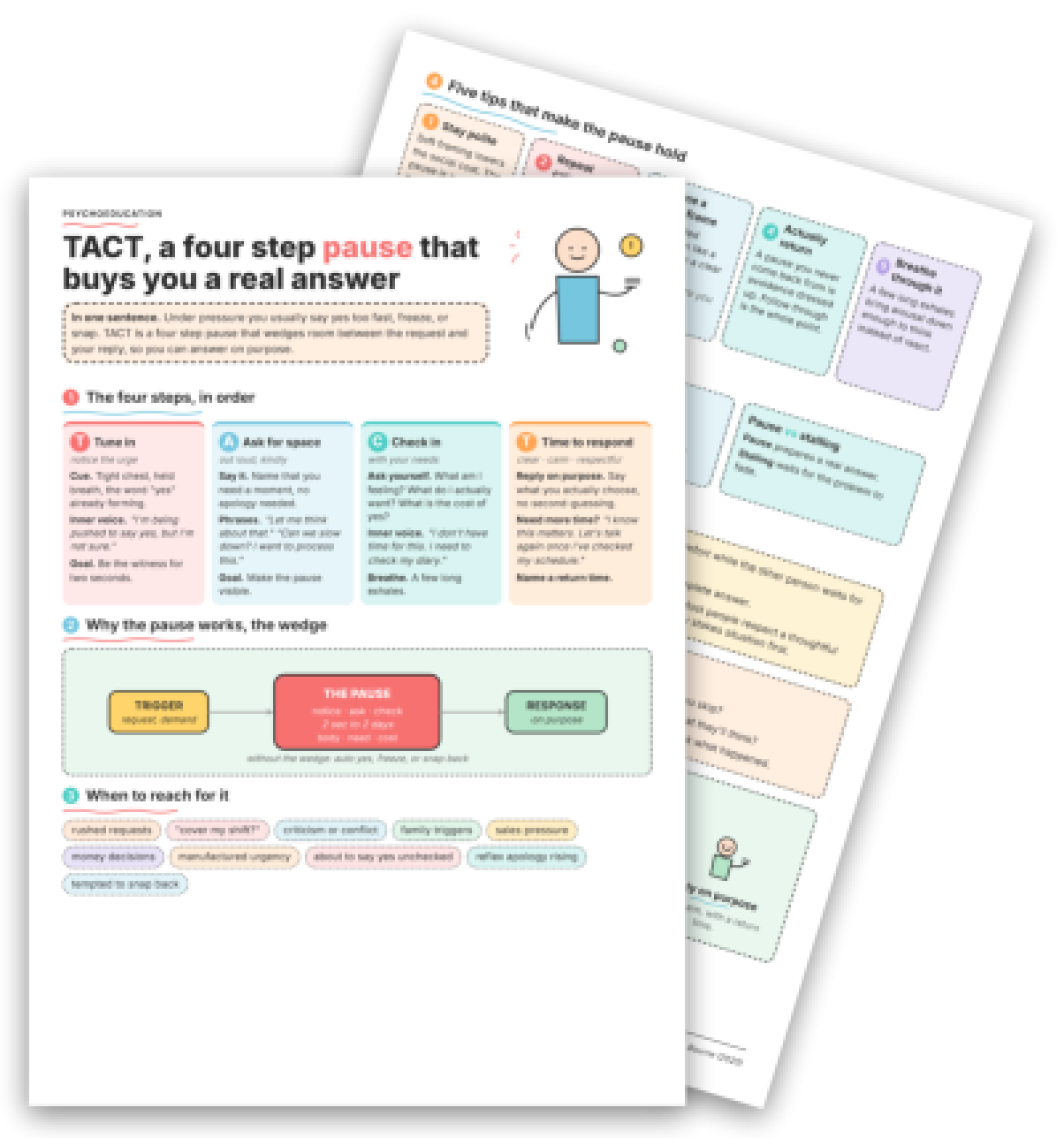
A visual PDF worksheet clinicians can use in session to turn the abstract idea of 'pausing before you respond' into a concrete, four-step procedure patients can actually follow under pressure.
Clinical vignettes
TACT Introduced for Workplace Compliance
Pause Use During Family Conflict
Clinical picture. P., a man in his mid-forties with a history of irritability and strained family relationships, consistently described snapping at his adult sibling during visits whenever money was raised. The clinician used the TACT informational sheet to map where the automatic response was firing, specifically at the Tune-in stage, since P. noticed no body signal before he reacted. Work in session focused on naming the physical cue (jaw tension, shallow breath) and rehearsing the Ask-for-space phrase "Can we slow down?" for use in real interactions. At a follow-up appointment P. reported one instance where he had used the phrase, paused, and then offered a short factual reply rather than a counter-attack; he described the outcome as "flat, but not a fight," which he considered a workable improvement.
Most patients who arrive for assertiveness work already know, intellectually, that they should slow down before responding under pressure. The knowing rarely becomes doing. This PDF worksheet gives the concept traction by making it sequential, embodied, and immediately usable, a visual support you can walk through together in session rather than a technique the patient tries to reconstruct from memory on a Tuesday afternoon when their manager is standing in the doorway.
Use this resource with your patients
Handout, exercises and materials ready to use, right inside SessionFuel.
Why "just pause" doesn't hold under pressure
The standard assertiveness consultation runs into a specific impasse: the patient understands the principle of pausing, but cannot operationalize it the moment activation kicks in. Under physiological arousal, tight chest, held breath, the automatic "yes" already forming, abstract advice dissolves. The majority of patients default to one of three patterns: automatic compliance, freeze, or reactive pushback. None of these is deliberate, and all three are downstream of the same problem: no wedge between the incoming request and the outgoing reply.
Oral psychoeducation alone rarely closes that gap. You can name the mechanism, and the patient will nod. What the nervous system needs in the moment of a rushed request, criticism, or manufactured urgency is a sequential, embodied procedure, not a principle. Patients following work in assertive communication or DEAR MAN in DBT often stall at exactly this point: they know what the end response should look like, but they have no structured on-ramp to get there calmly.
What the TACT fiche contains, and what the visual layout shows
The fiche organizes the skill into six numbered panels, which is where the visual support does its clinical work. Panel 1 walks through the four TACT steps in sequence: Tune in (notice the urge, cue: tight chest or breath held), Ask for space (say it aloud, with suggested phrases), Check in (ask yourself what you feel, what you want, what the cost of yes is), and Time to respond (reply on purpose, or name a return time). Each step carries a bodily cue, an inner voice prompt, and a concrete goal, the kind of granularity that an oral explanation glosses over.
Panel 2 gives the mechanism in a single diagram: TRIGGER → THE PAUSE → RESPONSE, with the phrase "without the wedge: auto yes, freeze, or snap back." Showing this graphic to a patient who has been stuck in automatic compliance tends to produce recognition faster than any explanation of expérientiel avoidance would. Panel 3 lists situations where the pause applies: rushed requests, sales pressure, family triggers, reflex apologies rising, concrete enough to be immediately recognizable.
Panel 4 addresses the five tips that make the pause hold (staying polite, repeating calmly, naming a timeframe, actually following through, breathing through discomfort), and Panel 5 dismantles three common confusions: pause versus avoidance, pause versus silence, and pause versus stalling. The distinction "Pause has a return time and a follow through / Avoidance hopes the issue disappears on its own" is the kind of precision that patients often need to see in writing before it sticks. Panel 6 flags the counter-intuitive aspects, notably, that tolerating the few seconds of discomfort while the other person waits is harder than finding the words.
The fiche closes with three session discussion prompts ("When you notice yourself saying yes too fast this week, which step of TACT did you skip?") that feed directly into debrief at the next appointment.
> Key takeaway: the fiche is a visual support that facilitates the in-session explanation of assertive pausing; it gives the patient a concrete reference to take away, not a questionnaire to complete alone.
750+ clinical tools
A library built with and for clinicians, ready to use in session and extend between appointments.
Access all the toolsWhen and how to propose it in session
This fiche fits naturally once the patient has named a pattern of automatic compliance, freeze, or snapping back, typically after a first assertiveness mapping, or alongside resources like assertive rights, communication styles, or how to assert yourself with an aggressive person. It is equally relevant for patients doing work on setting personal boundaries who need a concrete procedure rather than another cognitive rationale.
You can introduce it simply: "I'd like to show you a four-step model that creates the space between a request and your reply, let's go through it together." Working through the wedge diagram in Panel 2 first tends to anchor the clinical rationale before you detail the steps. For patients with marked physiological reactivity, pairing it with the fight-flight-freeze response gives the arousal side of the model a name. For those struggling with repetition when their pause is ignored, the companion resource CALM Assertive Repetition extends the skill set logically.
One limit to flag: patients with strong punitiveness schema activation may experience the return-time commitment in Panel 4 as another demand on themselves to perform perfectly. A brief normalization of "good enough" responses, "I need more time" is itself a complete answer, is worth making explicit before the patient takes the fiche home.
The fiche does not replace the therapeutic frame; it makes the explanation cleaner, saves session time, and leaves the patient with a step-by-step reference they can actually reach for when the moment arrives.
Use it with your patients
Share this tool in the mobile app and follow the work between sessions.
Sources
- Alberti, R. E., Emmons, M. L. (2017). Your Perfect Right: Assertiveness and Equality in Your Life and Relationships (10th ed.). New Harbinger Publications.
- Paterson, R. J. (2022). The Assertiveness Workbook: How to Express Your Ideas and Stand Up for Yourself at Work and in Relationships (2nd ed.). New Harbinger Publications.
- Linehan, M. M. (2015). DBT Skills Training Manual (2nd ed.). Guilford Press.
- University at Buffalo School of Social Work. Assertiveness, Non-Assertiveness, and Assertive Techniques.
Your session continues in your patients' pocket
Use with a patientYour resources, available everywhere
The handouts, exercises, programs and audios above: you choose which ones to make available to your patients, in the mobile app dedicated to them.
And far more than a library
The app goes well beyond resources, to support your patients every day:
Related categories
Explore other clinical resources by category.

Anxiety
Clinical hub for anxiety disorders: CBT and ACT worksheets, psychoeducation sheets, and exercises for assessment and treatment across the anxiety spectrum.

Identity
Clinical resources for self-identity work in therapy: CBT, ACT, schema tools for clinicians addressing self-concept, core beliefs, and identity disruption.

Relationships
Clinical worksheets and tools on relational functioning: attachment, schemas, assertiveness, and communication skills for therapists. Printable PDF resources.

Build awareness
Clinical worksheets and tools to build awareness in therapy: cognitive distortions, schemas, emotions, ACT and CBT resources for practitioners.

Build skills
Skill-building resources for clinicians: printable worksheets and exercises for coping, assertiveness, and communication skills training in therapy.
CBT
CBT worksheets, cognitive restructuring exercises & behavioral tools for clinicians. Evidence-based resources for every phase of cognitive behavioral therapy.